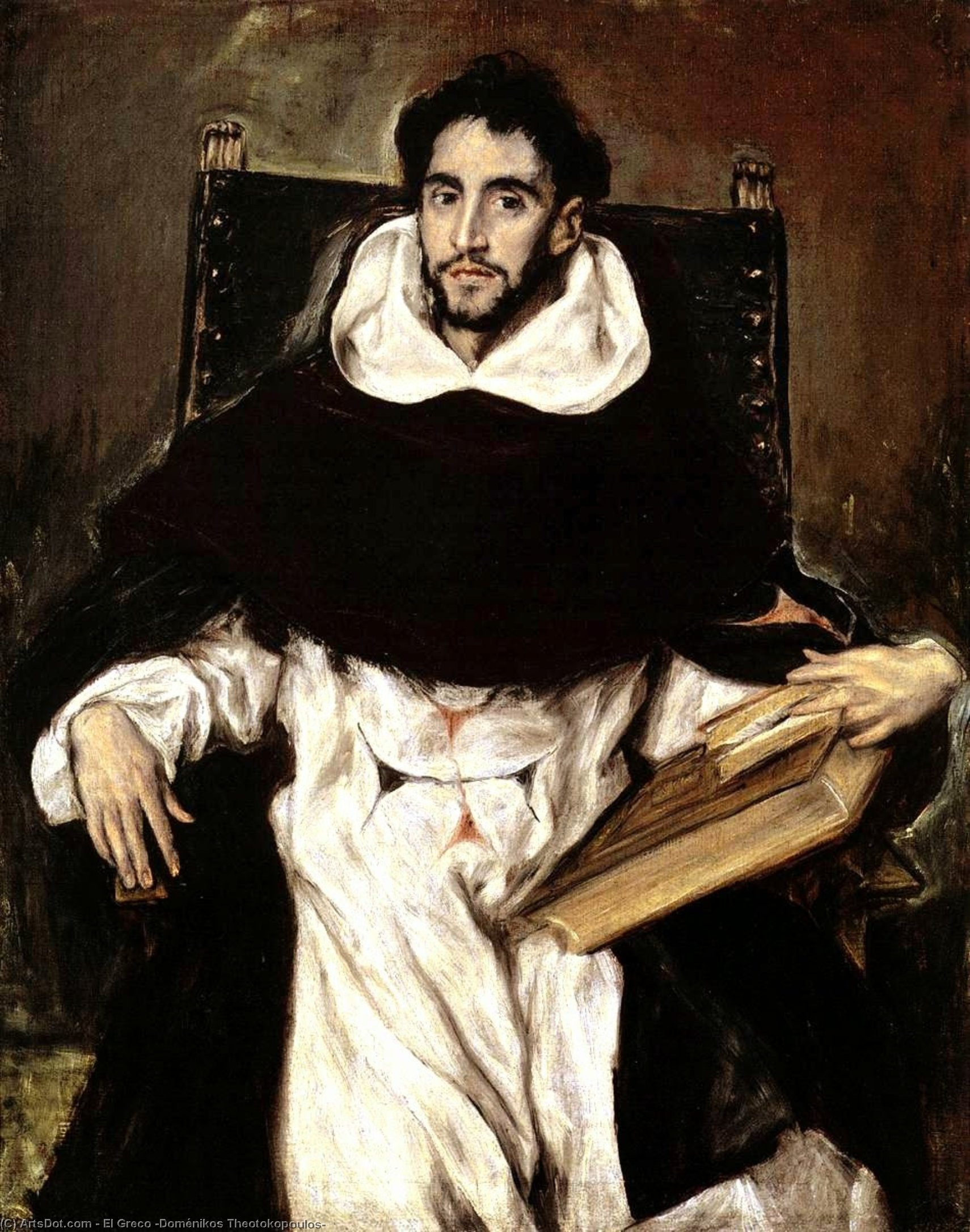
A Portrait of Faith and Intellect: El Greco’s Fray Hortensio Félix Paravicino
Doménikos Theotokópoulos, universally known as El Greco, possessed an extraordinary ability to imbue his canvases with a potent blend of spirituality, drama, and deeply personal emotion. His 1609 painting, “Fray Hortensio Félix Paravicino,” stands as a testament to this singular talent, offering a captivating glimpse into the life of a Trinitarian friar and a significant Spanish poet. More than simply a likeness, it’s a carefully constructed meditation on faith, intellect, and the quiet dignity of contemplation – a work that continues to resonate with viewers centuries later.
The painting depicts Fray Hortensio seated in a simple yet commanding chair, deeply engrossed in a book. The composition is remarkably restrained, focusing entirely on the subject’s face and upper body. This deliberate simplicity draws attention to his intense gaze, a mixture of solemnity and profound concentration. El Greco masterfully employs a muted palette – predominantly browns, ochres, and subtle blues – creating an atmosphere of contemplative seriousness. The brushstrokes are visible, contributing to a sense of immediacy and texture that invites the viewer into the scene.
The Subject: A Man Defined by Learning and Devotion
Fray Hortensio Félix Paravicino was not merely a religious figure; he was a respected intellectual and poet within the Spanish court. His attire, while indicative of his friar status – the Trinitarian habit is clearly visible – also suggests an appreciation for learning and refinement. The details of his clothing, particularly the quality of the fabric, hint at a certain social standing. The book itself, open before him, represents not just knowledge but also a commitment to spiritual growth and understanding. It’s a visual shorthand for the friar's dedication to both earthly pursuits and divine contemplation.
El Greco’s choice of subject is significant. He frequently depicted religious figures in ways that transcended mere representation, imbuing them with psychological depth and emotional complexity. Fray Hortensio isn’t presented as a saintly figure radiating unattainable perfection; instead, he appears as a man wrestling with his faith, grappling with ideas, and seeking solace within the pages of his book. This humanization of religious subjects was a hallmark of El Greco's style.
Composition and Symbolism: A Language of Quiet Intensity
The placement of Fray Hortensio within the frame is deliberate. He’s positioned slightly off-center, lending a sense of dynamism to the composition. The chair, angled towards the left side of the canvas, directs the viewer's eye toward him and reinforces his central role in the scene. The book occupies a substantial portion of the lower half of the image, symbolizing not just literacy but also the pursuit of wisdom and spiritual enlightenment. It’s a powerful visual metaphor for the friar’s intellectual journey.
Beyond these immediate elements, the painting is rich with symbolic potential. The stern expression on Fray Hortensio's face suggests a man deeply committed to his studies and his faith. The lighting, carefully controlled by El Greco, casts dramatic shadows that heighten the sense of introspection and mystery. It’s a subtle yet effective technique that contributes significantly to the painting’s overall impact.
El Greco’s Artistic Style: A Bridge Between Byzantium and Spain
El Greco's distinctive style was a product of his unique artistic heritage. Trained in Crete within the Byzantine tradition, he inherited a meticulous attention to detail and a profound understanding of religious iconography. However, he never remained confined by these influences. He embraced the dramatic flair of Italian Mannerism and infused it with his own intensely personal vision. His elongated figures, vibrant colors, and emotionally charged compositions foreshadowed the Expressionist movement centuries later.
“Fray Hortensio Félix Paravicino” exemplifies this synthesis of traditions. The painting’s emotional intensity, its dramatic lighting, and its carefully constructed composition are all hallmarks of El Greco's distinctive style. It represents a pivotal moment in his artistic development – a transition from the more rigidly formal works of his early career to the emotionally charged, psychologically complex paintings that would define his legacy.
A Legacy of Inspiration: Reproductions and Enduring Beauty
Today, “Fray Hortensio Félix Paravicino” resides in the Museum of Fine Arts in Boston, a testament to its enduring artistic merit. ArtsDot offers meticulously crafted oil painting reproductions that faithfully capture the essence of El Greco’s masterpiece. These reproductions are created by skilled artisans who employ traditional techniques and materials, ensuring that the colors, textures, and overall atmosphere of the original painting are preserved with remarkable accuracy.
Whether you're an art collector, a design enthusiast, or simply someone seeking to bring a touch of timeless beauty into your home, ArtsDot’s reproduction of “Fray Hortensio Félix Paravicino” is a captivating choice. It’s more than just a print; it’s a window into the soul of one of history's most enigmatic and influential artists.
Experience the beauty of art with ArtsDot’s handmade oil painting reproductions.