Explore El Greco's dramatic art! Discover Mannerist masterpieces, religious scenes & elongated figures. A pioneer of Expressionism & Cubism – view his iconic paintings!
Mary Magdalen in Penitence: A Vision of Sorrow and Spiritual Reflection
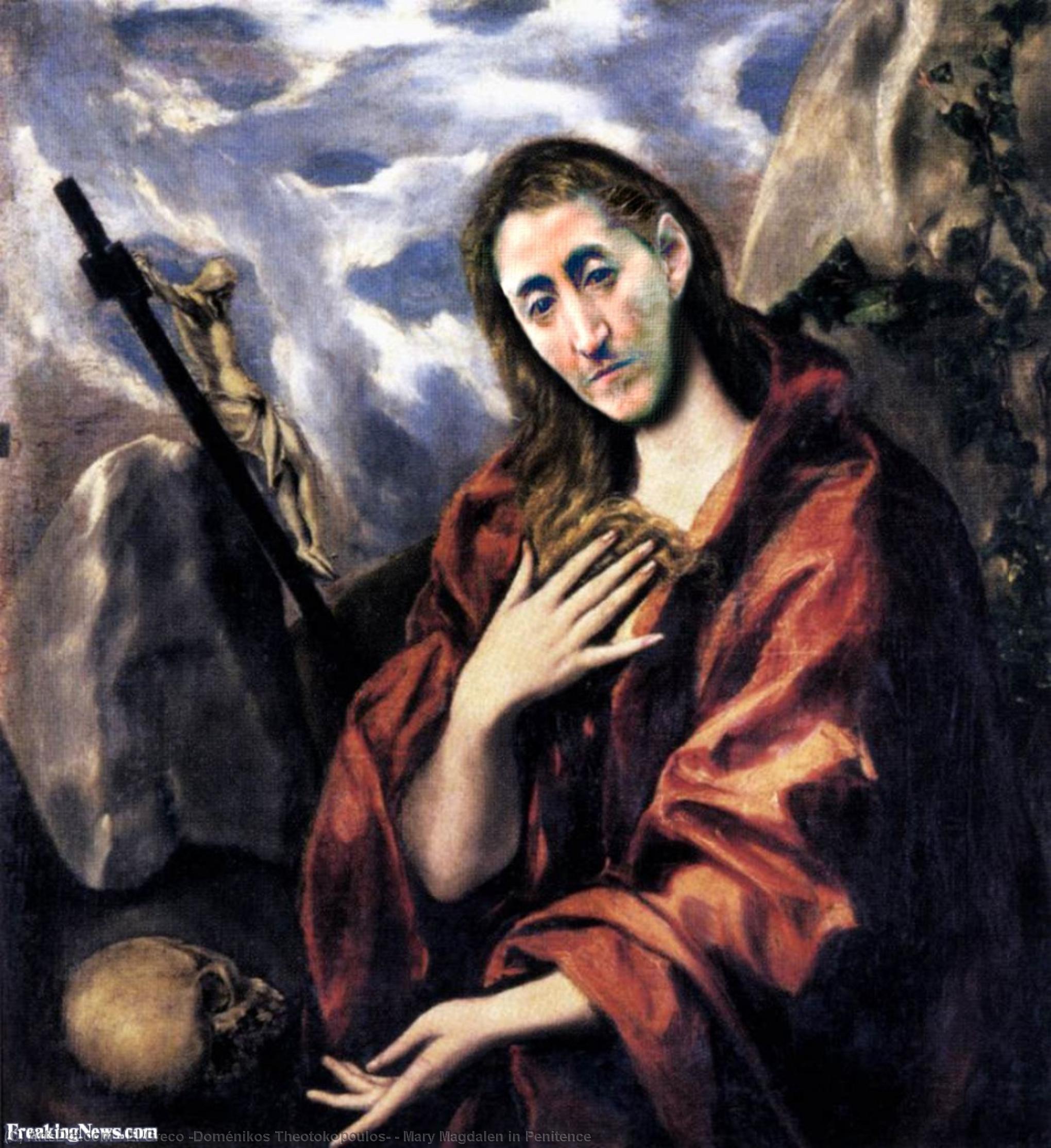
El Greco’s “Mary Magdalen in Penitence” stands as a testament to the artist's unparalleled ability to fuse Byzantine solemnity with Renaissance humanist ideals. Painted around 1585, this monumental oil on canvas transcends mere representation; it embodies a profound meditation on faith, mortality, and divine grace—a characteristic hallmark of El Greco’s oeuvre and a cornerstone of Spanish Mannerism.
Composition and Visual Narrative
The painting immediately captivates the viewer with its dramatic arrangement. Mary Magdalene is positioned centrally, seated in repose yet radiating palpable sorrow. Her scarlet robe serves as a striking visual anchor against the rugged landscape backdrop—a rocky expanse punctuated by a solitary sword—underscoring her isolation from worldly comforts and devotion to inner contemplation. Two angelic figures hover above her head and to her right, offering solace and symbolizing divine protection; their luminous presence contrasts sharply with the muted tones of the earthly realm. A shadowy figure stands discreetly in the upper left corner, adding depth and complexity to the scene’s spatial dynamics. This careful orchestration contributes to a narrative that speaks volumes about repentance and spiritual yearning.
Symbolism: Skull, Landscape, and Divine Guidance
The central motif—the skull—is laden with symbolic significance. It serves as a poignant reminder of human mortality and underscores Mary Magdalene's acceptance of her fate. The desolate landscape mirrors her inner turmoil, representing the arduous path toward spiritual purification. Beyond these immediate visual cues, the sword symbolizes Saint Longinus’ lance thrust into Christ’s side during the Crucifixion—a potent emblem of suffering endured for redemption. These elements converge to create a multilayered tapestry of meaning that elevates “Mary Magdalen in Penitence” beyond a simple portrait; it becomes an allegory of spiritual transformation.
El Greco's Distinctive Style: Mannerist Innovation
El Greco’s artistic style is instantly recognizable—characterized by elongated figures, vibrant hues achieved through glazing techniques, and a pervasive sense of mysticism. Unlike the idealized forms favored by Renaissance artists, El Greco deliberately distorted proportions to convey emotional intensity and spiritual ecstasy. The artist skillfully employs chiaroscuro – dramatic contrasts between light and dark – to sculpt Mary Magdalene’s form and imbue the landscape with atmospheric depth. This masterful manipulation of technique underscores his commitment to expressing inner experience rather than merely documenting external reality—a defining feature of Mannerism, which anticipated the expressive fervor of later artistic movements.
Historical Context and Artistic Legacy
“Mary Magdalen in Penitence” emerged during a period of fervent religious devotion in Spain following the Reformation. El Greco’s work reflects the anxieties and aspirations of his time, grappling with questions of faith and suffering amidst societal upheaval. However, its influence extends far beyond its immediate historical context. The painting's emotive power and stylistic innovation profoundly impacted subsequent generations of artists—inspiring painters like Rembrandt and Caravaggio to explore similar expressive strategies. Today, reproductions of “Mary Magdalen in Penitence” continue to captivate audiences worldwide, serving as a reminder of El Greco’s enduring artistic vision and his mastery of conveying profound spiritual truths.