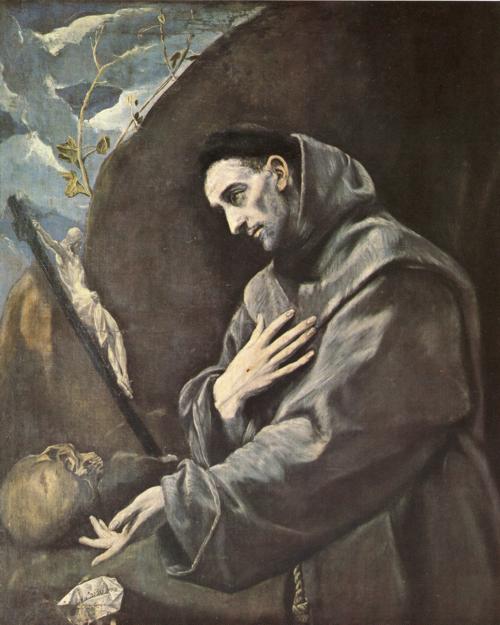
St. Francis in Meditation: A Journey into Spirituality
El Greco (Doménikos Theotokopoulos), a Greek artist who flourished during the Spanish Renaissance, stands as a unique figure in Western art history. His painting "St. Francis in Meditation" (1580s) exemplifies his distinctive style—a compelling blend of post-Byzantine artistry with Mannerist and Renaissance influences. This work is not merely a depiction; it's an exploration of profound spirituality conveyed through masterful use of oil on canvas.
Dimensions, Technique, and Materials
The original painting measures 116 x 102 cm, a size that allows for intricate detail while maintaining a powerful emotional presence. El Greco’s choice of oil paint on canvas was crucial to achieving the rich colors, textures, and dramatic lighting characteristic of his work. The layering technique allowed him to build depth and create a palpable sense of volume within the scene. The materials used were primarily high-quality oil paints applied to a carefully prepared canvas.
Style and Influences: Mannerism and Beyond
"St. Francis in Meditation" firmly belongs to the Mannerist movement, recognizable by its elongated figures, dynamic compositions, and striking use of light and shadow. While influenced by Venetian masters like Tintoretto and Titian—renowned for their vibrant color palettes and skillful manipulation of light—El Greco forged his own path. He prioritized conveying spiritual intensity and emotional depth over strict naturalism, a hallmark of his unique artistic vision. His style moved beyond the Renaissance ideals of balance and harmony, embracing a more expressive and subjective approach.
A Moment of Profound Contemplation
The painting depicts St. Francis of Assisi immersed in deep contemplation. With eyes closed and hands folded in prayer, he embodies a state of profound spiritual connection. The saint’s simple robe contrasts with the elaborate background—a landscape punctuated by an architectural element—creating visual interest and emphasizing his humility. Dramatic lighting focuses on St. Francis' face and hands, drawing the viewer's eye to these points of intense emotion. A skull at his feet serves as a potent symbol of mortality, while a small crystal suggests divine grace or redemption, adding layers of symbolic meaning to the scene.
Historical Context and Legacy
Created in the 1580s, "St. Francis in Meditation" reflects the religious fervor of the Counter-Reformation era. El Greco’s work often explored themes of faith, mysticism, and divine encounter. The painting now resides within the Museo de El Greco in Toledo, Spain—a treasure trove showcasing over 6,000 works spanning various periods and styles, with a particular focus on El Greco's oeuvre. The museum provides valuable context for understanding El Greco’s artistic development and his place within Spanish cultural history.
Bringing El Greco Home: Hand-Made Reproductions
ArtsDot.com offers meticulously crafted, hand-made oil painting reproductions of "St. Francis in Meditation." Our skilled artists employ traditional techniques and premium materials to faithfully recreate the beauty and emotional depth of El Greco's original masterpiece. These reproductions are not merely copies; they are works of art in their own right, offering a tangible connection to one of history’s most compelling artistic voices.
El Greco: A Life in Art
- Born in 1541 on the island of Crete, then under Venetian rule.
- Initially trained as an icon painter within the Byzantine tradition – a rigorous discipline emphasizing religious imagery and precise technique.
- His early work demonstrates a mastery of Byzantine conventions, including detailed ornamentation and symbolic color palettes.
- He signed his works in Greek, often adding “Krḗs” (Cretan) to denote his origin.
Journey to Italy
- Around 1567, El Greco moved to Venice, immersing himself.