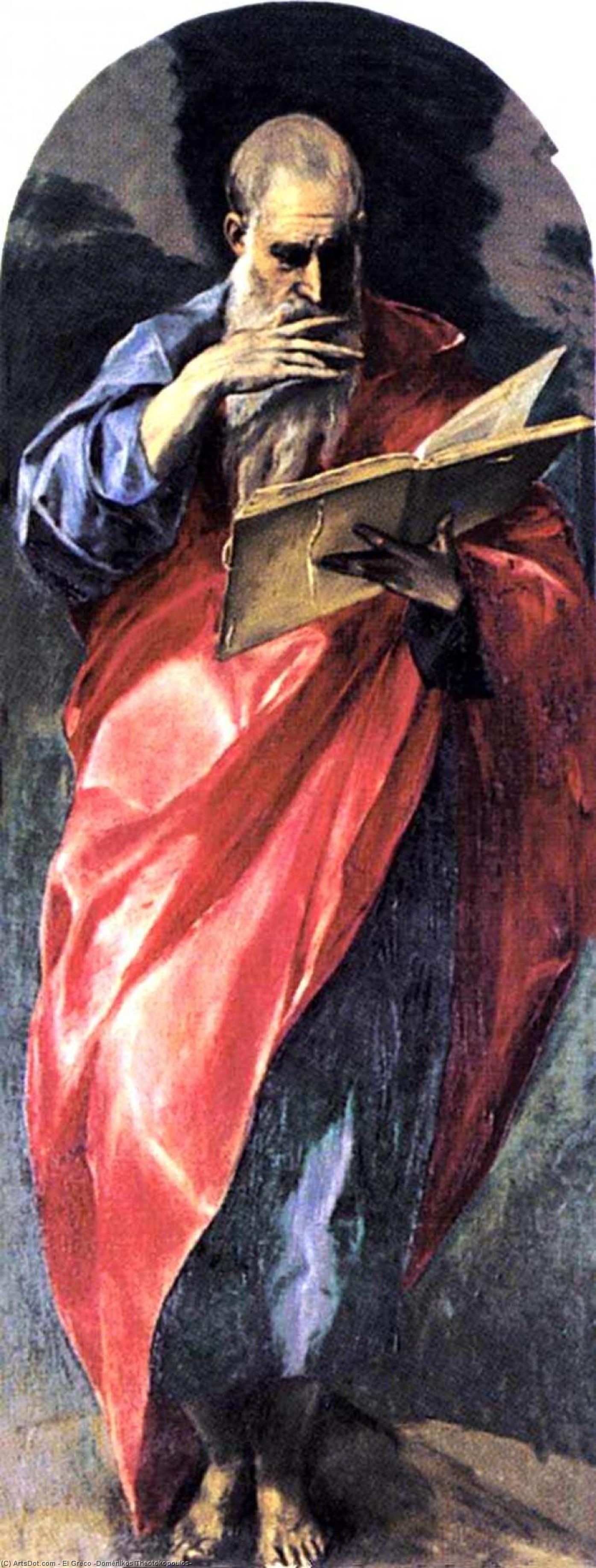
A Vision of Contemplation: Exploring El Greco’s *St John the Evangelist*
This captivating painting by Doménikos Theotokópoulos, known as El Greco, presents a powerful image of Saint John the Evangelist immersed in thought and spiritual reflection. A masterwork of the late Renaissance/early Baroque period, this piece exemplifies El Greco’s unique style – a synthesis of Byzantine tradition, Venetian colorism, and Mannerist exaggeration.
Subject & Symbolism
The painting depicts Saint John, traditionally believed to be the author of the Gospel of John, the three Johannine epistles, and the Book of Revelation. He is portrayed not as a martyred figure, but as an *intellectual* – deeply engaged with scripture, holding an open book in his hand. This emphasizes John’s role as a theologian and visionary. The swirling, dark sky behind him isn't merely atmospheric; it suggests a realm beyond the earthly, hinting at divine inspiration and the mysteries of faith.
The very act of reading becomes symbolic, representing wisdom, introspection, and the pursuit of spiritual understanding.
Style & Technique: A Mannerist Master
El Greco’s style is instantly recognizable. He departs from strict realism, favoring elongated figures, dramatic lighting, and vibrant, often unnaturalistic colors. This painting showcases his masterful use of
chiaroscuro – the stark contrast between light and dark – which sculpts the figure, drawing our eye to Saint John’s face and hands, and heightening the emotional intensity. The flowing red robe provides a striking visual counterpoint to the cooler blues beneath, further emphasizing the dynamism of the composition.
His brushwork is visible, creating a textured surface that adds depth and energy to the scene. While rooted in Renaissance techniques like layering paint for form and glazing for luminosity, El Greco pushes these boundaries, anticipating the emotional intensity of the Baroque era.
Historical Context & Artistic Influences
Born in Crete, El Greco’s artistic journey took him through Venice and Rome before he settled in Toledo, Spain. In Italy, he absorbed influences from masters like Titian and Tintoretto – evident in his use of color and dramatic composition. However,
he ultimately forged a style entirely his own. His work was initially met with mixed reactions; his unconventional approach didn’t always align with the tastes of his contemporaries. Yet, by the 20th century, El Greco's unique vision gained widespread recognition, influencing movements like Expressionism and Cubism.
Emotional Impact & Interior Design
*St John the Evangelist* is more than just a religious painting; it’s an exploration of the human condition – our capacity for thought, faith, and spiritual longing. The intensity of Saint John's gaze invites contemplation, creating a powerful connection with the viewer.
The painting’s dramatic composition and rich color palette make it a striking focal point for any interior. It would be particularly well-suited to libraries, studies, or contemplative spaces, adding a touch of historical gravitas and spiritual depth. A high-quality reproduction captures the essence of El Greco's vision, bringing this masterpiece into your home or office.
Key Characteristics
- Artist: El Greco (Doménikos Theotokópoulos)
- Style: Mannerism / Early Baroque
- Medium: Oil on Canvas
- Dominant Colors: Red, Blue, Dark Tones
- Key Features: Chiaroscuro, Elongated Figures, Dramatic Composition