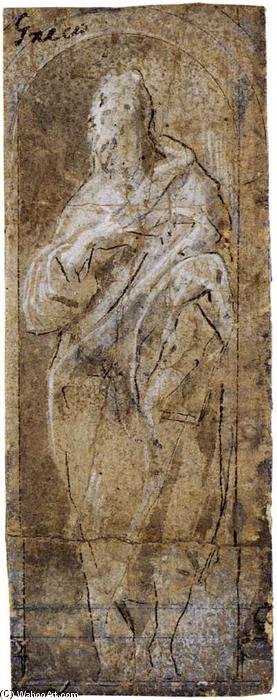
A Vision of Faith Illuminated: Exploring El Greco’s St John the Evangelist
Doménikos Theotokópoulos, universally known as El Greco – “the Greek” – stands apart in the annals of European art history. Born in Crete around 1541, his artistic journey traversed Venice and Rome before anchoring him firmly in Toledo, Spain, where he spent the latter half of his life creating masterpieces that continue to resonate with audiences today. More than simply a painter; El Greco was an innovator who synthesized influences from Byzantium and Mannerism into a singular aesthetic—a style anticipating the expressive fervor of Expressionism and the fractured perspectives of Cubism centuries ahead of their time. His formative years in Crete instilled within him a meticulous attention to detail and a deep understanding of Byzantine iconography, yet he refused to be confined by tradition, boldly forging his own path toward artistic experimentation. He proudly inscribed his works in Greek, appending “Krḗs” – Cretan – as a testament to his origins, demonstrating an unwavering connection to his heritage while simultaneously embracing new artistic horizons. The genesis of El Greco’s distinctive style lies in the interplay between these contrasting influences—a fusion that resulted in images imbued with palpable spiritual intensity.
- Subject Matter: The painting portrays St John the Evangelist, a central figure in Christian theology and revered for his role as disciple and witness to Jesus Christ's crucifixion.
- Style: El Greco’s oeuvre is firmly rooted in Mannerism—a stylistic movement that rejected the idealized forms of High Renaissance art in favor of elongated figures, dramatic poses, and unsettling perspectives. This deliberate distortion served not merely as aesthetic choice but as a vehicle for conveying profound emotional states.
Technique: Pen and Ink on Paper – A Masterful Exercise in Detail
El Greco’s St John the Evangelist exemplifies his unparalleled mastery of pen and ink drawing technique. He employed this medium with extraordinary precision, meticulously rendering every contour and nuance of St John's drapery and facial features. The resulting image possesses a remarkable luminosity achieved through subtle shading—a technique that anticipates the chiaroscuro principles championed by Caravaggio and Michelangelo Buonarroti. Careful observation reveals an astonishing level of detail: the folds of St John’s robe are rendered with painstaking accuracy, capturing the texture and movement of fabric; his gaze is focused intently on the book in his hand, conveying a sense of solemn contemplation. The artist's dedication to achieving realism within this stylized framework underscores the profound conviction underpinning his artistic endeavors.
- Medium: Pen and Ink
- Surface: Paper
- Notable Features: Exceptional shading technique; meticulous rendering of drapery folds; expressive gaze conveying spiritual contemplation
Historical Context: Toledo – A Crucible of Faith and Artistic Innovation
Created around 1577, St John the Evangelist emerged during a period marked by significant religious upheaval in Spain—the Counter-Reformation. The Catholic Church actively sought to reaffirm its authority following the Protestant Reformation, fostering an environment conducive to artistic patronage aimed at bolstering piety and disseminating Christian ideals. El Greco’s Toledo workshop benefited greatly from this support, allowing him to produce ambitious artworks that reflected the spiritual fervor of the era. Furthermore, the painting aligns with broader trends in Mannerist art—a reaction against the harmonious balance of Renaissance aesthetics—characterized by psychological depth and emotional turbulence. It stands as a testament to El Greco's ability to capture the complexities of human experience within a framework of religious symbolism.
Symbolism: The Book – A Testament to Knowledge and Divine Revelation
The book held firmly in St John’s hand is not merely an incidental element of the composition; it functions as a potent symbol representing knowledge, scripture, and divine revelation—central themes within Christian theology. Its placement directs the viewer's gaze upward, emphasizing St John’s spiritual contemplation and highlighting the importance of faith in accessing God’s wisdom. The book symbolizes the Gospels, which recount Jesus Christ’s life, teachings, and crucifixion—the cornerstone of Christian belief. Through this carefully chosen visual motif, El Greco elevates the painting beyond mere representation, transforming it into a profound meditation on theological concepts.
St John the Evangelist remains an enduring masterpiece—a testament to El Greco's artistic genius and his unwavering devotion to conveying spiritual truths through masterful technique and evocative imagery.