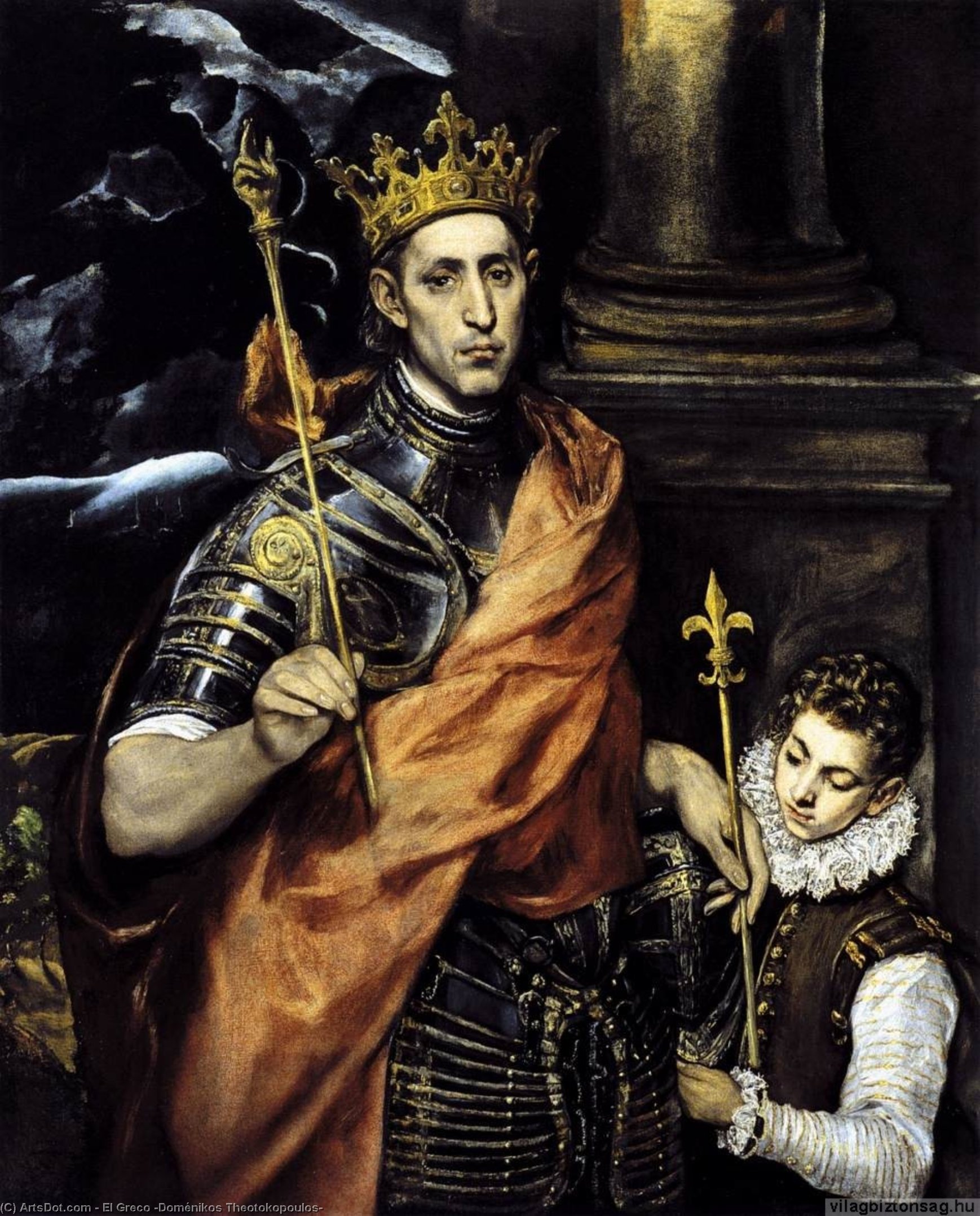
A Regal Vision: El Greco’s St Louis, King of France, with a Page
This captivating painting by Doménikos Theotokópoulos, known as El Greco, offers a compelling glimpse into the world of 16th-century royalty and spirituality. Created in 1592, *St Louis, King of France, with a Page* is more than just a portrait; it’s a masterful blend of artistic innovation, religious devotion, and psychological insight, currently residing within the esteemed collection of the Musée du Louvre in Paris.
Subject & Narrative
The artwork depicts Saint Louis IX, King of France – revered for his piety and justice – alongside a young attendant or page. The king is presented in regal attire, complete with crown and scepter, symbols unequivocally denoting his power and authority. However, El Greco doesn’t simply present a static image of royalty. There's an introspective quality to the King’s gaze, hinting at the burdens and responsibilities inherent in leadership and faith. The page stands attentively beside him, dressed in armor suggesting nascent knighthood, perhaps representing loyalty, service, or the continuation of noble lineage. Two further figures are subtly included in the background, adding depth and a sense of courtly life without distracting from the central focus.
Artistic Style & Technique
El Greco’s distinctive style is immediately recognizable here. He was a pivotal figure transitioning between the
Mannerist and
Baroque periods, and this painting beautifully exemplifies that synthesis. The elongated figures, characteristic of his work, contribute to an ethereal quality, moving away from strict realism towards emotional expression. His technique is marked by loose brushwork and a dramatic use of color. Notice the visible brushstrokes – a hallmark of El Greco’s approach – which create texture and movement within the composition. He masterfully employs
chiaroscuro, the interplay of light and shadow, to sculpt the forms and draw the viewer's eye to key elements like the King’s face and hands.
Symbolism & Iconography
The painting is rich in symbolic meaning. The column visible in the background isn’t merely an architectural element; it evokes strength, stability, and perhaps alludes to classical ideals of leadership. The night landscape, bathed in moonlight, adds a layer of mystery and spiritual significance – darkness often representing contemplation or divine presence. The King's armor, while modern for its time, is partially open at the forearms, potentially symbolizing his willingness to be vulnerable and accessible despite his royal status. Saint Louis was known for his humility and dedication to justice, qualities subtly conveyed through these visual cues.
Historical Context & El Greco’s Journey
Born in Crete, El Greco (1541-1614) absorbed influences from both Byzantine and Venetian art before ultimately settling in Toledo, Spain. This painting was created during his mature period in Spain, where he developed a unique artistic voice that initially met with mixed reception but has since become profoundly influential. His work foreshadowed later movements like
Expressionism and
Cubism, demonstrating his forward-thinking approach to form and emotion. The painting reflects the religious fervor of Counter-Reformation Spain, where depictions of saints were often commissioned to inspire devotion.
Emotional Impact & Interior Design Considerations
*St Louis, King of France, with a Page* evokes a sense of solemnity, dignity, and spiritual contemplation. The dramatic lighting and elongated figures create an atmosphere of otherworldly grace. For interior design, this artwork would serve as a striking focal point in a library, study, or formal living room. Its rich color palette – deep blues, reds, and golds – complements traditional décor while adding a touch of artistic sophistication to more contemporary spaces. The painting’s scale (120 x 96 cm) makes it substantial enough to command attention without overwhelming the room. A high-quality reproduction would bring this masterpiece's emotional depth and visual power into any home or office.
Key Features at a Glance
- Artist: El Greco (Doménikos Theotokópoulos)
- Year: 1592
- Medium: Oil on Canvas
- Dimensions: 120 x 96 cm
- Location: Musée du Louvre, Paris, France
- Style: Mannerism & Baroque