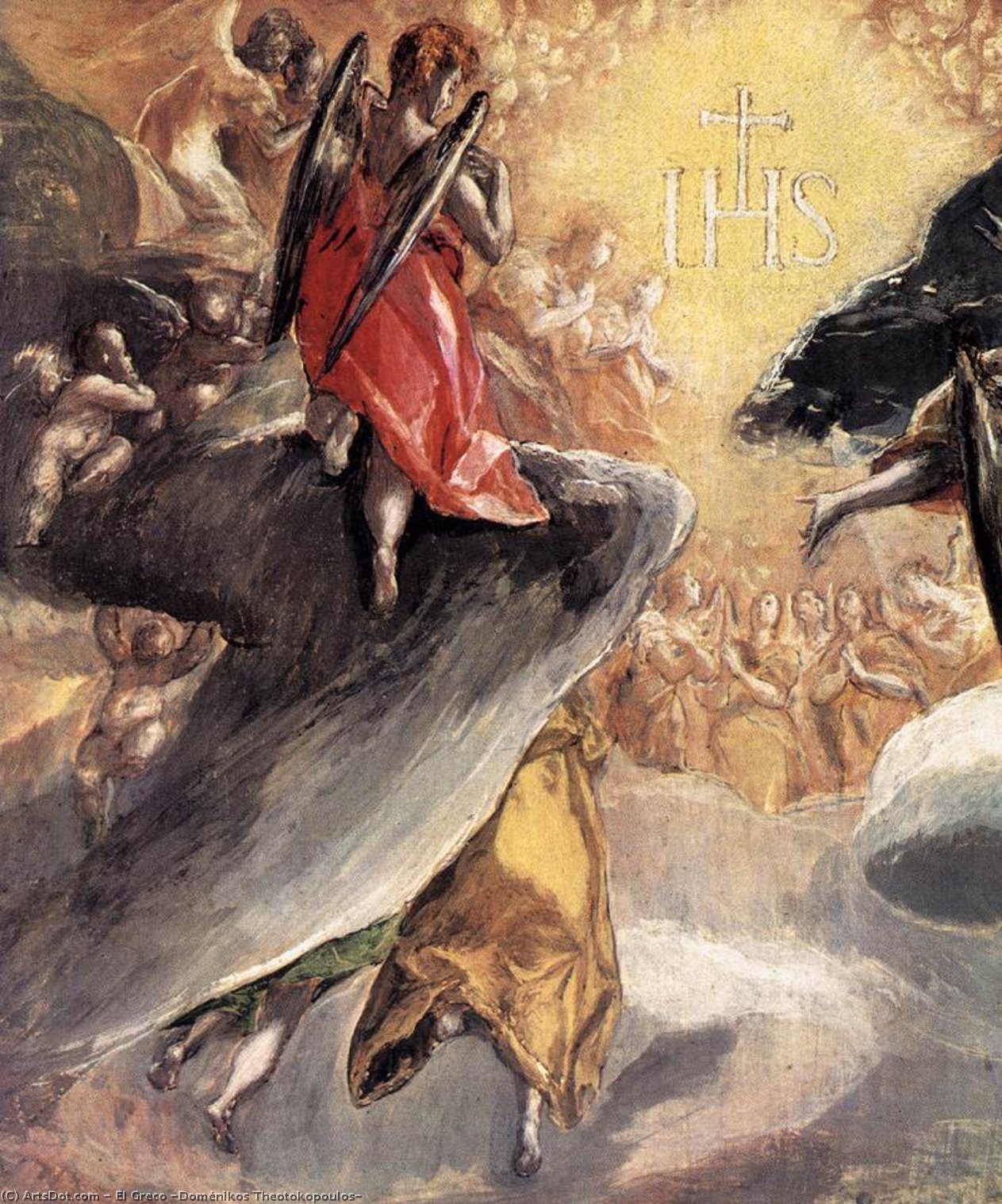
A Divine Vision: Exploring El Greco’s “The Adoration of the Name of Jesus” (detail)
This captivating detail from *The Adoration of the Name of Jesus* offers a glimpse into the spiritual intensity and innovative style of
El Greco (Doménikos Theotokopoulos), one of the most singular figures in art history. Originally commissioned for the high altar of the Colegio de Doña Maria in Madrid, this fragment reveals El Greco’s masterful ability to convey religious fervor through dynamic composition and expressive figuration.
Historical Context & Artistic Journey
Born in Crete in 1541, El Greco's artistic path was remarkably diverse. He began his training within the Byzantine tradition before absorbing influences from Venice and Rome – notably the works of Titian and Tintoretto. In 1577, he settled in Toledo, Spain, where he developed a uniquely personal style that defied easy categorization. His work emerged during the Counter-Reformation, a period of intense religious zeal, which profoundly shaped his subject matter and artistic expression.
Composition & Symbolism Unveiled
The detail showcases a swirling vortex of angelic figures adoring Jesus Christ, whose outstretched arms embody both welcome and divine authority. At least thirteen angels are visible, their forms rendered with elongated grace and dynamic movement. The composition is deliberately dramatic, eschewing classical balance for an emotionally charged effect. The pose of Christ echoes that of Saint Sebastian, a subtle connection highlighting themes of sacrifice and devotion. This bipartite structure recalls *The Burial of the Count of Orgaz*, demonstrating El Greco’s recurring compositional strategies. A particularly striking angel between the Baptist and Christ embodies the ecstatic spiritualism increasingly present in his work – a symbol of divine intervention and grace. The prominent display of the ‘IHS’ (a monogram for Jesus) further emphasizes the painting's central theme: adoration of the Holy Name.
A Revolutionary Artistic Style
El Greco’s style was initially met with mixed reactions, considered unconventional by many contemporaries. However, his dramatic use of color, elongated forms, and emotional intensity foreshadowed key movements of the 20th century – Expressionism and Cubism. He broke from Renaissance conventions, prioritizing spiritual expression over strict realism. His work has inspired generations of artists, writers (like Rainer Maria Rilke and Nikos Kazantzakis), and thinkers who recognized his profound originality.
Technical Brilliance & Emotional Resonance
Painted in oil on panel (29 x 24 cm), the detail reveals El Greco’s masterful brushwork. Visible strokes create a sense of movement, depth, and luminosity. The dramatic chiaroscuro – the strong contrast between light and dark – heightens the emotional impact, drawing the viewer into the scene's spiritual realm. The flattened perspective contributes to the painting’s otherworldly quality, prioritizing feeling over precise spatial representation.
Legacy & Collecting Information
Today, *The Adoration of the Name of Jesus* resides in the
National Gallery (London, United Kingdom), a testament to its enduring artistic and historical significance. For those captivated by El Greco’s vision, high-quality handmade oil painting reproductions are available, offering an opportunity to bring this masterpiece into your home or collection.
- Artist: El Greco (Doménikos Theotokopoulos)
- Painting Title: The Adoration of the Name of Jesus
- Museum: National Gallery (London, United Kingdom)
- Medium: Oil on Panel
- Size: 29 x 24 cm
Discover more about El Greco and his extraordinary life at
[Wikipedia: El Greco](https://en.wikipedia.org/wiki/El_Greco).