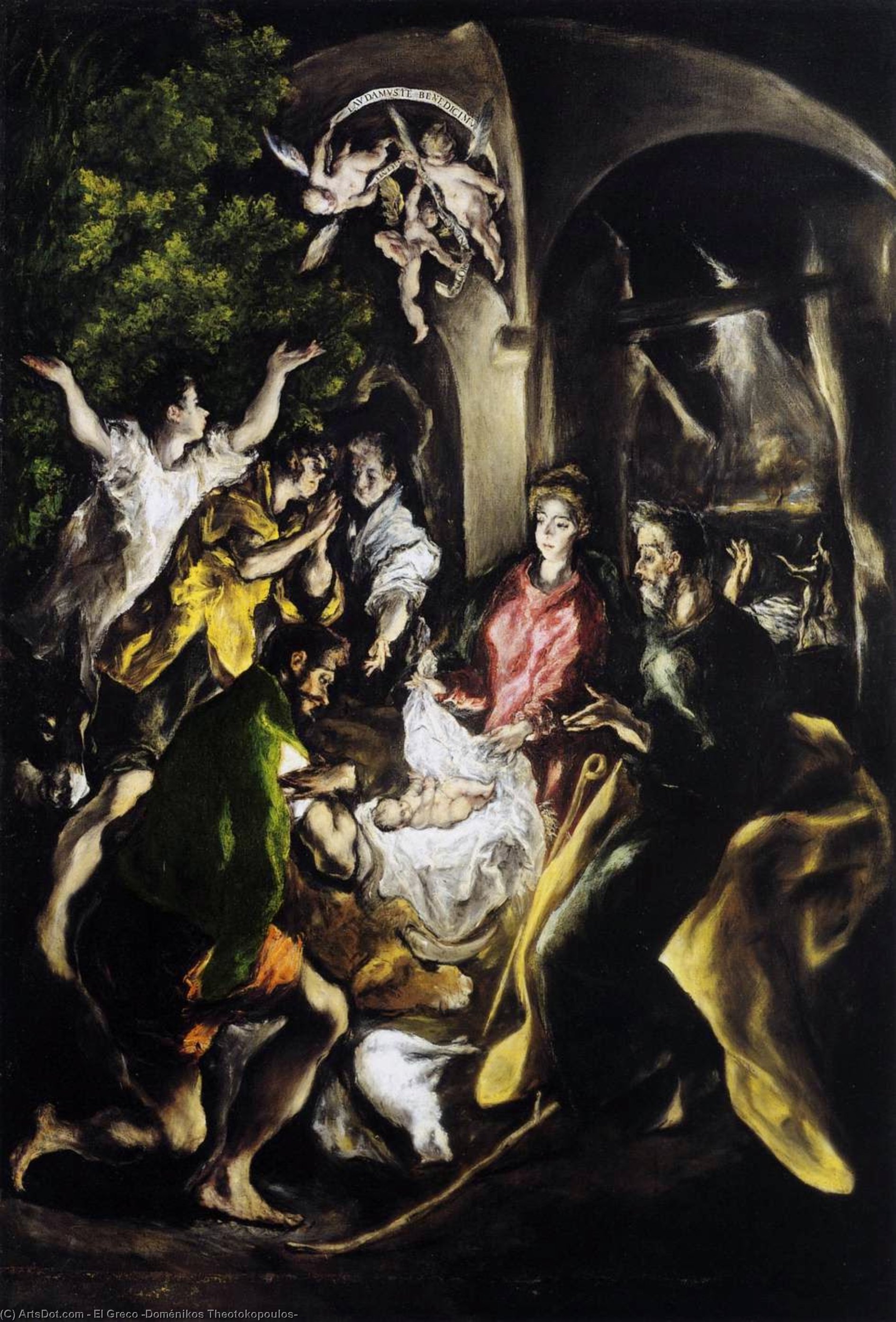
The Adoration of the Shepherds: A Visionary Synthesis
Doménikos Theotokópoulos, universally known as El Greco—“the Greek”—stands apart in the annals of art history not merely as a painter but as a prophet of emotion and form. Born in Crete in 1541, under Venetian rule, his artistic journey traversed Venice and Rome before anchoring itself in the spiritual heartland of Spain: Toledo. He wasn’t simply absorbing influences; he transformed them into something utterly singular—a style that foreshadowed the expressive fervor of Expressionism and the fragmented aesthetic of Cubism centuries later.
El Greco's formative years within Byzantine tradition instilled a meticulous attention to detail and an unparalleled understanding of religious iconography. Yet, this foundational grounding wouldn’t confine him. He boldly signed his canvases in Greek—often appending “Krḗs”—Crete—as a proud declaration of his origins, even as he ventured into uncharted artistic territories. The seeds of his distinctive style were sown during his formative years in Crete where he was exposed to the traditions of Byzantine art.
His embrace of Mannerism and Venetian Renaissance aesthetics – witnessed during his time in Venice – profoundly shaped his oeuvre. Artists like Tintoretto and Titian served as pivotal mentors, imparting techniques that would become hallmarks of El Greco’s distinctive visual language. This fusion resulted in a style characterized by elongated figures—a deliberate departure from classical proportions—and vibrant pigmentation—often bordering on hallucinatory—creating an atmosphere charged with dramatic intensity.
Composition and Technique
“The Adoration of the Shepherds,” completed around 1570-1576, exemplifies El Greco’s masterful command of technique. Painted on canvas measuring 144 x 101 cm, it showcases a pyramidal composition—a compositional device favored by Mannerist painters—that directs the viewer's gaze towards the central figure: Jesus Christ cradled in the manger.
El Greco’s use of chiaroscuro—the dramatic interplay between light and shadow—is particularly noteworthy. He employs intense contrasts to sculpt the figures, emphasizing their musculature and conveying a palpable sense of spiritual fervor. The artist meticulously layered thin glazes of pigment upon each other, achieving remarkable luminosity and depth – a technique honed during his Venetian apprenticeship.
Symbolism and Spiritual Depth
Beyond its formal brilliance, “The Adoration of the Shepherds” resonates with profound symbolic meaning. The shepherds—representing humility and piety—bow before Jesus, symbolizing humanity’s yearning for divine grace. The presence of a lamb—a traditional emblem of innocence and sacrifice—underscores the sacred narrative.
El Greco's stylistic choices – elongated figures, vibrant colors, and dramatic lighting – deliberately disrupt conventional artistic conventions. This deliberate distortion serves not merely as aesthetic embellishment but as a conduit for conveying emotional intensity—a characteristic that aligns El Greco with the burgeoning Expressionist movement of the early 20th century.
Legacy and Relevance Today
Despite initial skepticism during his lifetime, El Greco’s work gained posthumous acclaim, securing its place among the most influential artists of the Baroque era. He is regarded as a precursor to Expressionism and Cubism, inspiring poets and writers such as Rainer Maria Rilke and Nikos Kazantzakis.
“The Adoration of the Shepherds” continues to captivate audiences today—a testament to El Greco’s visionary artistic vision. Its enduring appeal lies in its ability to evoke a powerful emotional response—a reflection of the artist's profound engagement with religious themes and his pioneering exploration of expressive form.