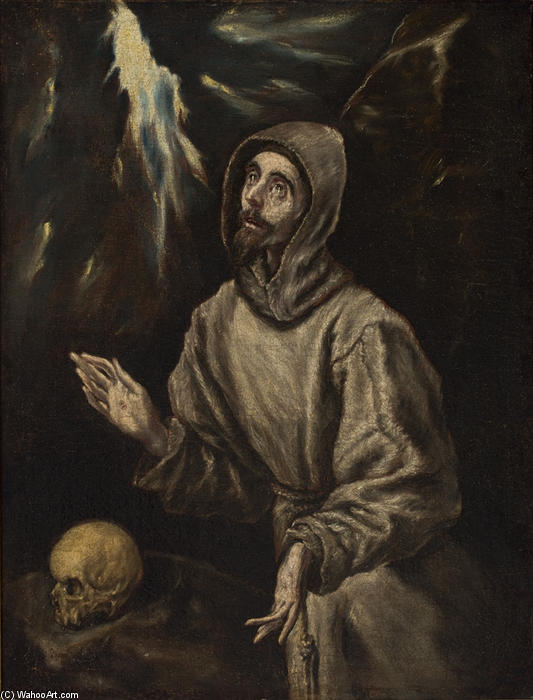
The Ecstasy of St. Francis of Assisi: A Baroque Revelation
Doménikos Theotokópoulos, universally known as El Greco – “the Greek” – stands apart from his contemporaries not merely as a painter but as an artist who fundamentally reshaped the visual language of his era. Born in Crete in 1541, amidst the waning influence of Byzantium and burgeoning Venetian patronage, El Greco embarked on a prolific artistic journey that traversed Venice and Rome before establishing himself definitively in Toledo, Spain – a city steeped in religious fervor and artistic tradition. His output defies easy categorization; he synthesized disparate influences into a singular style that anticipates the expressive power of Expressionism and the fragmented aesthetic of Cubism centuries ahead of their time. This wasn’t simply about adopting new trends; it was about distilling them into something profoundly personal, an idiom born from deep conviction and intellectual curiosity.
- Subject Matter: The painting depicts St. Francis of Assisi in a moment of transcendent ecstasy, captured with unparalleled sensitivity. He is portrayed kneeling before a skull – a poignant reminder of mortality – while extending his hands upwards towards the heavens, bathed in an ethereal glow.
- Style: El Greco’s distinctive Mannerist style is characterized by elongated figures, stylized drapery, and vibrant hues that prioritize emotional impact over naturalistic representation. This stylistic choice deliberately departs from Renaissance ideals of proportion and harmony, favoring instead a dramatic tension that conveys spiritual fervor.
Technique & Composition: Baroque Drama Embodied
Executed in oil on canvas, “The Ecstasy” exemplifies El Greco’s masterful command of chiaroscuro – the interplay of light and shadow – creating an atmosphere of palpable drama. The artist meticulously renders textures with painstaking detail, capturing the folds of St. Francis' robe and the rugged contours of the mountainous landscape with remarkable precision. However, these technical achievements serve a higher purpose: to heighten the emotional intensity of the scene and draw the viewer’s gaze directly to the central figure. The pyramidal composition reinforces this focus, guiding the eye upwards towards St. Francis’ outstretched hands and symbolizing his ascent toward divine grace.
Symbolism & Spiritual Significance
Beyond its aesthetic brilliance, “The Ecstasy” is laden with symbolic meaning. The skull represents the inevitability of death and serves as a catalyst for contemplation on the spiritual realm. Simultaneously, the bird hovering above St. Francis embodies freedom and divine providence – suggesting that even in facing mortality, faith offers solace and transcendence. The luminous background—a stylized depiction of Mount Carmel—further underscores the painting’s religious core, referencing Saint Francis' pilgrimage to Mount Carmel as a pivotal moment in his spiritual life.
Historical Context & Legacy
Created around 1600, “The Ecstasy” resides within The Museum Galleria Estense in Modena, Italy—a testament to El Greco’s enduring influence on European art history. Its placement alongside other masterpieces from the Mannerist period underscores its significance as a cornerstone of Baroque artistic expression. Works by El Greco such as Poet Ercilla y Zuniga and St Martin and the Beggar demonstrate his versatility and ability to convey profound emotion through religious iconography. “The Ecstasy” continues to inspire artists and collectors alike, representing not merely a depiction of Saint Francis’ spiritual experience but also an embodiment of the Baroque ideal: a quest for sublime beauty and emotional catharsis—a timeless masterpiece accessible through high-quality reproductions offered by ArtsDot.com.