Explore El Greco's dramatic art! Discover Mannerist masterpieces, religious scenes & elongated figures. A pioneer of Expressionism & Cubism – view his iconic paintings!
Discover Hospital Tavera in Toledo, Spain – a Renaissance gem! Explore El Greco & Titian masterpieces at the Museo Fundación Lerma, plus historic archives & stunning architecture.
A Vision of Faith Illuminated: El Greco’s Holy Family
Doménikos Theotokópoulos, universally known as El Greco – “the Greek” – stands apart from his contemporaries not merely as a painter but as an artist who wrestled with the very essence of spirituality and translated it onto canvas. Born in Crete in 1541, during Venetian rule, his artistic journey took him through Venice and Rome before establishing himself definitively in Toledo, Spain—a city steeped in religious fervor and profoundly influential on his oeuvre. El Greco’s genius wasn't simply absorbing stylistic trends; he actively reshaped them, anticipating the expressive power of Expressionism and the fractured perspectives of Cubism centuries ahead of their time. His formative years spent studying Byzantine iconography instilled within him a meticulous attention to detail and an unwavering grasp of religious symbolism—a foundation that would propel him beyond convention. He famously signed his works in Greek, appending “Krḗs” – Cretan – as a defiant assertion of his heritage, demonstrating a commitment to artistic authenticity amidst evolving artistic landscapes. The genesis of El Greco’s distinctive style lies in this paradoxical blend of tradition and innovation.
The Painting's Narrative & Composition
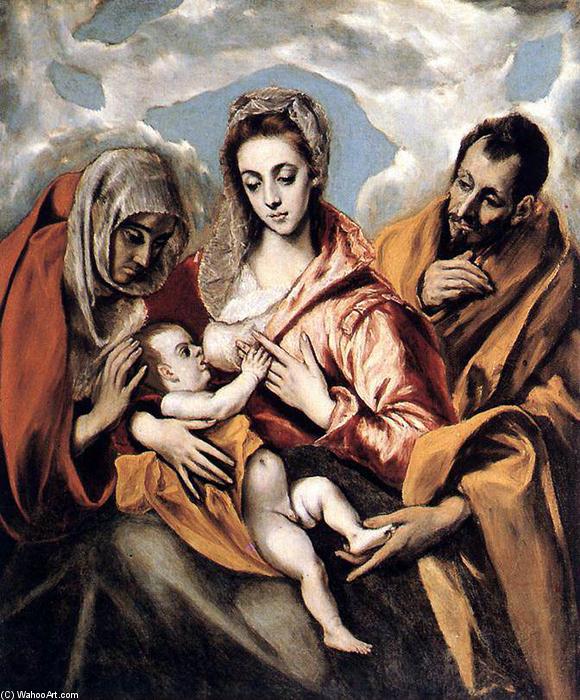
“The Holy Family,” painted circa 1595, depicts Mary, Joseph, and the infant Jesus within a dimly lit interior space—a deliberate choice that underscores the painting’s overarching theme: divine contemplation. Unlike many depictions of the Holy Family prevalent during the Baroque period, El Greco eschewed realism in favor of conveying profound emotional resonance. The figures are elongated, almost ethereal, embodying an idealized form that transcends earthly limitations. Their poses are subtly asymmetrical, creating a dynamic tension that draws the viewer’s eye upwards towards a luminous halo—a visual metaphor for God's grace and omnipresence. The background is sparsely populated with indistinct architectural elements, serving to heighten the focus on the central family group and emphasizing their spiritual significance.
Stylistic Innovation & Technique
El Greco’s technique distinguishes him from his peers. He employed a glazing method—applying thin layers of translucent paint over opaque underlayers—resulting in an unparalleled luminosity and depth of color. This masterful manipulation of light creates an atmosphere of otherworldly serenity, mirroring the spiritual yearning expressed by the figures. The artist's brushstrokes are loose and expressive, conveying movement and emotion rather than precise anatomical representation. He utilized a palette dominated by muted reds, yellows, and blues—colors traditionally associated with piety and divine majesty—further enhancing the painting’s solemn mood.
Symbolism & Spiritual Depth
Beyond its formal qualities, “The Holy Family” is laden with symbolic meaning. The halo surrounding Jesus symbolizes his divinity and foreshadows his ascension into heaven. Mary's gaze upward signifies her unwavering faith and devotion—she embodies the contemplative spirit of Christian piety. Joseph’s posture conveys steadfastness and protection, representing God’s providence safeguarding His holy family. Even the muted colors contribute to the painting’s symbolic resonance, reflecting the subdued beauty of divine grace.
Emotional Impact & Legacy
“The Holy Family” transcends mere visual representation; it communicates a powerful emotional experience—a palpable sense of peace and reverence. It invites viewers to contemplate the mysteries of faith and redemption, prompting introspection and fostering an appreciation for spiritual contemplation. El Greco’s masterpiece continues to inspire artists and collectors alike, cementing his place as one of the most influential figures in European art history. Its enduring beauty lies not only in its technical brilliance but also in its profound ability to capture the essence of Christian devotion—a testament to El Greco's visionary artistry.