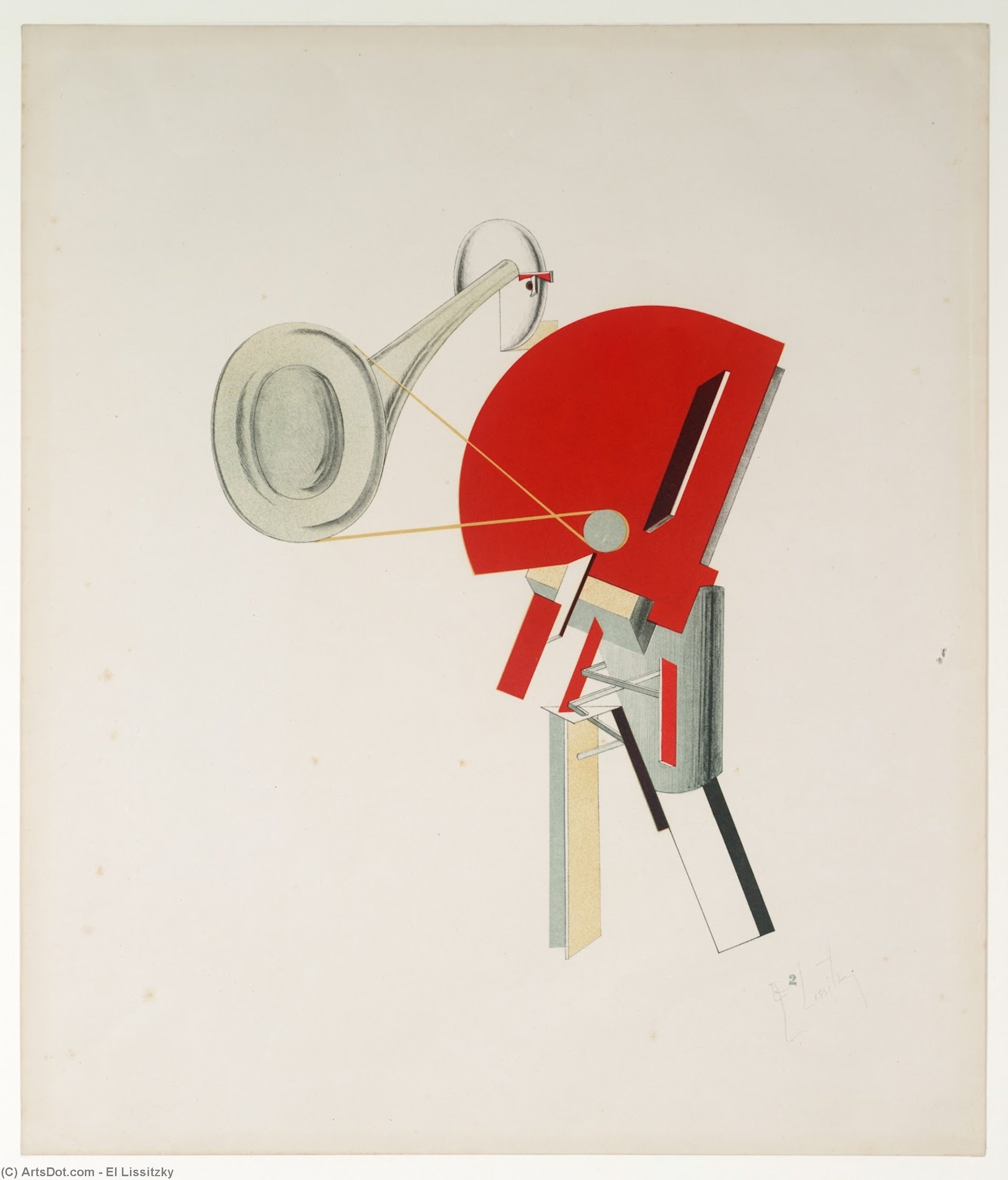
Announcer by El Lissitzky: A Geometric Echo of Revolution
El Lissitzky’s “Announcer,” painted in 1923, is more than just a depiction of an object; it's a crystallized embodiment of the artistic fervor gripping Russia during the early years of Soviet rule. This striking piece—a vibrant red and white geometric form punctuated by a central circle—immediately draws the eye into its meticulously crafted composition.
- Subject Matter: The artwork presents a stylized horn, seemingly constructed from two interlocking segments. Its simplicity belies a profound conceptual underpinning rooted in Lissitzky’s exploration of visual communication and his unwavering belief in the transformative potential of abstraction.
- Style & Technique: Lissitzky championed Suprematism—a radical movement prioritizing pure geometric forms devoid of representational imagery—and “Announcer” exemplifies this aesthetic perfectly. Employing bold, contrasting colors against a stark white background, Lissitzky achieved an arresting visual impact through precise lines and planar surfaces. The technique is characterized by meticulous execution, reflecting the artist’s commitment to rational precision.
- Historical Context: Created during the height of the Bolshevik Revolution, “Announcer” speaks directly to the ideological currents shaping Soviet art and design. Lissitzky's work aligns with Constructivism—another influential movement advocating for art as a tool for social reform—emphasizing functionality and geometric abstraction as instruments for constructing a new visual language.
Geometric Abstraction: Lissitzky’s Suprematist Vision
Lissitzky's embrace of Suprematism wasn’t merely stylistic preference; it was a philosophical stance. Influenced by Kazimir Malevich—his mentor and fellow pioneer—he sought to liberate art from the constraints of illusionism, arguing that true expression resided in pure geometric forms like squares, circles, and rectangles. This approach mirrored broader intellectual debates concerning the role of art in shaping consciousness and promoting social progress.
- Malevich’s Influence: Malevich's iconic “Black Square,” completed in 1915, served as a catalyst for Lissitzky’s artistic explorations. Both artists rejected traditional representational conventions, prioritizing the fundamental elements of visual perception to convey emotional and intellectual ideas.
Symbolism Beyond Form: Communicating Revolution
While seemingly devoid of recognizable imagery, “Announcer” carries significant symbolic weight. The horn itself can be interpreted as representing sound—specifically broadcasting—a crucial element in disseminating revolutionary propaganda. Simultaneously, the central circle embodies unity and wholeness, symbolizing the aspiration for a harmonious society underpinned by rational thought and geometric order.
- Typography & Design: Lissitzky’s mastery extended beyond painting; he was also a prolific designer, applying Suprematist principles to typography and exhibition displays. His designs aimed to communicate complex ideas concisely and powerfully—a hallmark of Constructivist aesthetics.
Emotional Resonance: A Quiet Assertion of Ideals
"Announcer" possesses an understated elegance that belies its profound ideological significance. Lissitzky’s deliberate simplification of form invites contemplation, prompting viewers to consider the underlying principles of geometric abstraction and its capacity to convey enduring values—such as clarity, precision, and unwavering conviction in the pursuit of social transformation. It remains a testament to Lissitzky's artistic vision and his contribution to the history of modern art.