A Portrait of Resilience: Exploring El Lissitzky’s ‘Book Cover for Ingle-Tsingl-Khvat’
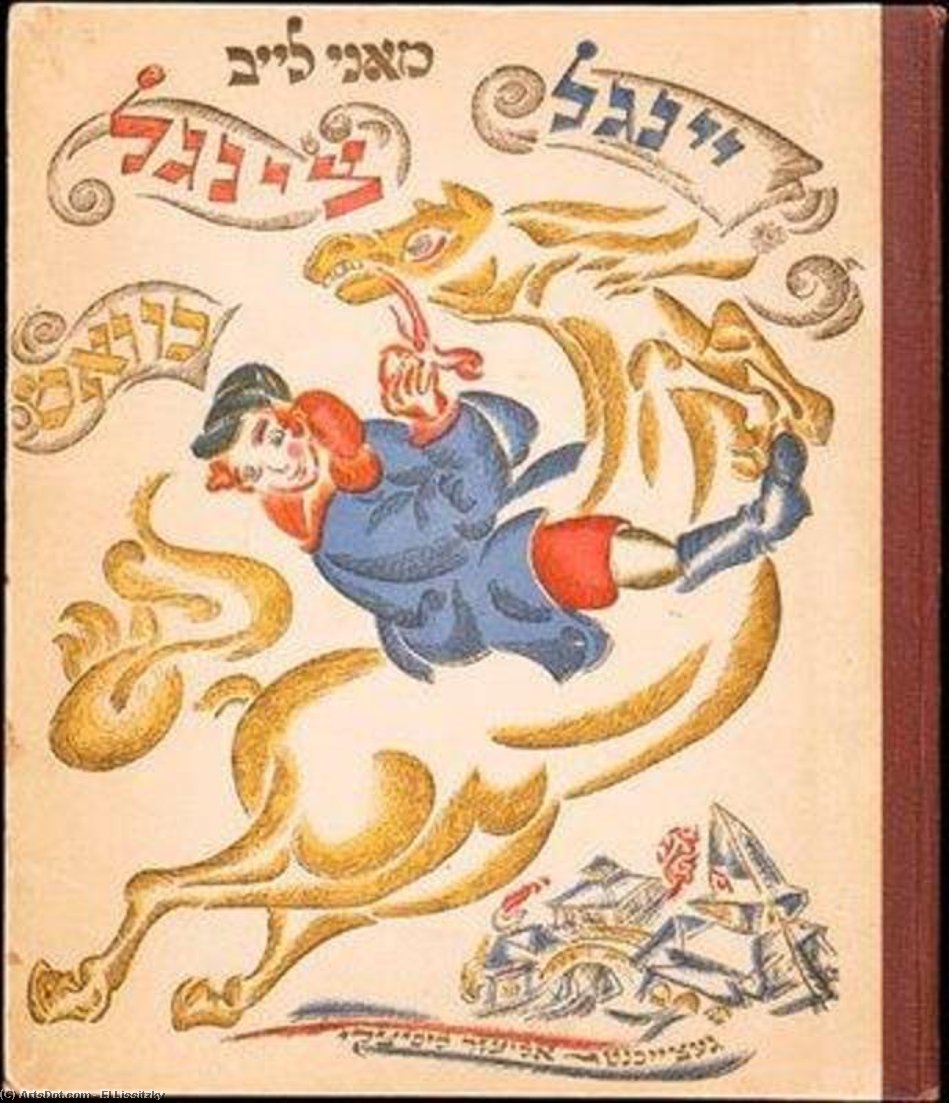
El Lissitzky's 'Book Cover for Ingle-Tsingl-Khvat,' created in 1918, transcends mere illustration; it embodies a potent distillation of revolutionary idealism and Jewish cultural heritage. This striking image captures a solitary rider atop a horse—a figure rendered with meticulous geometric abstraction—against a backdrop punctuated by birds, a clock, and a book, elements laden with symbolic significance that speak to the anxieties and aspirations of its time. The painting’s enduring appeal lies not only in its visual dynamism but also in its ability to convey a complex narrative about identity and perseverance amidst societal upheaval.
- Subject Matter & Composition: Lissitzky's depiction centers around a single male figure positioned prominently on horseback, symbolizing strength and movement—themes central to the Russian Revolution. The horse’s placement on the left establishes a visual hierarchy, directing the viewer’s gaze towards the rider’s unwavering posture.
- Style & Technique: Lissitzky's signature style is characterized by Constructivism, an artistic movement that championed geometric abstraction as a tool for conveying social and political ideas. The artist employs precise lines and planes to construct the horse and rider, eschewing traditional representational techniques in favor of simplified forms that prioritize clarity and impact.
Historical Context: The Dawn of Revolution & Jewish Diaspora Concerns
The painting’s genesis coincides with the tumultuous period following Russia's Bolshevik takeover in 1917. Lissitzky, deeply invested in Zionist ideals—a movement advocating for the establishment of a Jewish homeland—was acutely aware of the challenges faced by his fellow Jews navigating the complexities of Soviet society. The inclusion of birds – often interpreted as symbols of freedom and aspiration – reflects this broader preoccupation with diaspora concerns and the yearning for liberation from oppression. Simultaneously, the clock represents time passing relentlessly onward, mirroring the urgency felt by revolutionaries striving to reshape the world.
- Symbolism: Beyond its immediate visual elements, ‘Book Cover’ operates on multiple symbolic levels. The horse embodies resilience and determination, qualities crucial for overcoming obstacles. The birds signify hope and spiritual renewal, mirroring the Zionist dream of rebuilding Jewish life in Palestine.
- Color Palette & Texture: Lissitzky utilizes a restrained color palette—primarily blues and whites—creating an atmosphere of calm contemplation despite the underlying tension of the historical context. The texture is deliberately smooth and flat, furthering the Constructivist aesthetic’s emphasis on clarity and geometric precision.
Emotional Impact & Artistic Legacy
‘Book Cover for Ingle-Tsingl-Khvat’ resonates powerfully with viewers today due to its ability to evoke feelings of quiet contemplation alongside a palpable sense of determination. Lissitzky's masterful manipulation of form and symbolism transcends the specifics of his time, offering an enduring meditation on themes of identity, resistance, and the pursuit of utopian ideals. It stands as a testament to Constructivism’s ambition to transform art into a vehicle for social change—a legacy that continues to inspire artists and designers seeking innovative ways to communicate complex ideas through visual language. Its reproduction allows collectors and interior decorators alike to appreciate Lissitzky's groundbreaking contribution to modern art.