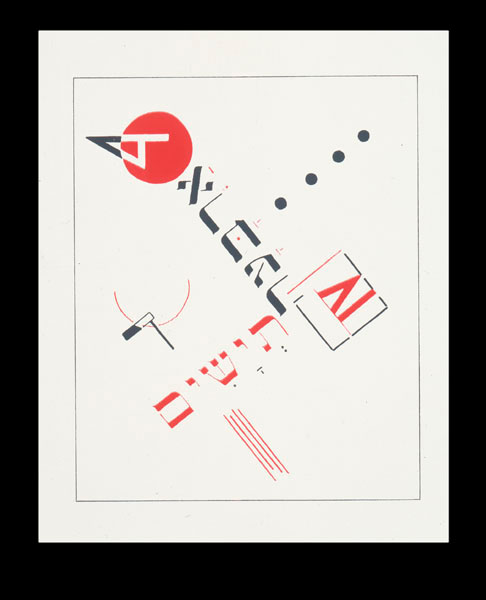
The Genesis of Constructivism: A Bold Statement in Color and Form
El Lissitzky's “Cover of the book ‘Teyashim’ ('Four billy goats')", created in 1922, stands as a cornerstone of Constructivist art—a movement that sought to liberate visual language from representational constraints and forge a new aesthetic rooted in functionality and geometric abstraction. More than just a decorative element for a children's book, it embodies the spirit of its time: a fervent belief in the transformative power of art to reshape society and communicate complex ideas with clarity and precision.
Compositional Dynamics: Lines That Speak
The artwork’s visual impact stems from its masterful arrangement. Dominating the canvas is an assertive red circle bisected by a horizontal line—a ‘X’—that anchors the upper left corner, immediately establishing a focal point and injecting dynamism into the composition. Surrounding this central element are rectangular blocks of text in Cyrillic script, interspersed with intersecting diagonal lines that propel the eye across the surface. Scattered dots contribute to the overall visual texture and reinforce the sense of movement.
Technique and Materiality: Precision Embodied
Lissitzky’s meticulous technique speaks volumes about Constructivist ideals. Executed likely in paint or ink on paper/canvas, the artwork demonstrates a commitment to geometric accuracy—each shape and line is precisely positioned to achieve maximum visual impact. The sharp delineation of forms underscores the movement's focus on structural integrity and rejects the illusionistic techniques prevalent in earlier artistic traditions. This deliberate approach reflects the broader ambition to translate theoretical concepts into tangible aesthetic expressions.
Symbolism Within Abstraction: Beyond Literal Representation
While devoid of recognizable imagery, “Cover of the book ‘Teyashim’” is laden with symbolic significance. The geometric forms—circles and rectangles—represent stability and order respectively, juxtaposed against the diagonal lines that convey dynamism and progress. The red circle, often associated with revolution and vitality, powerfully communicates the core message of the book: a celebration of childhood innocence and imagination. Lissitzky’s intention was not to depict reality but rather to distill it into its essential components—a testament to Constructivism's belief in art as a tool for intellectual and social engagement.
Emotional Resonance: A Quiet Intensity
Despite its minimalist aesthetic, “Cover of the book ‘Teyashim’” possesses an undeniable emotional resonance. The bold colors and geometric forms generate a feeling of controlled energy—a visual articulation of optimism and conviction. Lissitzky's work invites contemplation on how abstract art can convey profound ideas without resorting to conventional narrative devices. It remains a compelling example of Constructivism’s ability to communicate complex concepts with remarkable elegance and enduring power.