A Dance of Geometry and Spirit: El Lissitzky’s “Flying Sun”
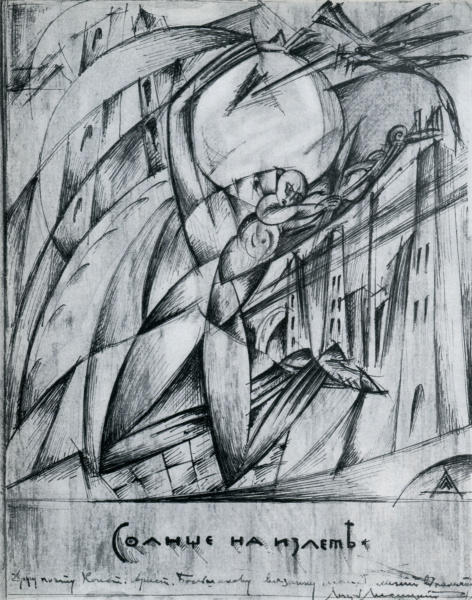
El Lissitzky's "Flying Sun," created in 1916 during the vibrant crucible of Cubo-Futurist experimentation, isn’t merely a depiction of a sun; it’s an embodiment of a revolutionary artistic vision. This black and white drawing, now available as a meticulously hand-painted reproduction at ArtsDot.com, transcends representational art to become a powerful exploration of dynamism, movement, and the very essence of modern existence. Lissitzky, a key figure in the Russian avant-garde, sought to dismantle traditional artistic conventions and build a new visual language rooted in geometric abstraction – a pursuit powerfully realized within this single, arresting composition.
The artwork immediately commands attention with its dynamic arrangement. A central, bird-like form dominates the upper register, seemingly suspended mid-flight, wings outstretched as if caught in an eternal upward surge. Surrounding this primary figure are angular shapes – a complex interplay of triangles, rectangles, and curves – that simultaneously evoke architectural structures and stylized landscapes. These aren’t static elements; they appear to be actively engaged in a spatial dance, creating a sense of depth and layering that defies traditional perspective. Lissitzky masterfully employs lines not just as outlines but as active participants in the composition, guiding the viewer's eye through a fragmented yet cohesive visual experience.
The Language of Line: Hatching and Suprematism
Lissitzky’s technique is characterized by an almost obsessive attention to line. Bold, dark lines define the shapes with unwavering precision, creating dramatic contrasts that heighten their impact. Crucially, he utilizes hatching and cross-hatching – a meticulous layering of parallel lines – to build up tonal variations and suggest texture within the forms. This isn’t simply about depicting surface; it's about imbuing the artwork with a palpable sense of volume and materiality. The illusion of shading is achieved through this masterful manipulation of line weight and density, lending a remarkable three-dimensionality to what could easily have remained a flat composition.
The work firmly aligns itself with Suprematism, a movement pioneered by Kazimir Malevich that prioritized pure geometric forms over representational imagery. Lissitzky’s “Flying Sun” exemplifies this principle – the focus is entirely on the fundamental shapes themselves and their relationships to one another. The absence of recognizable figures or landscapes allows the viewer to engage with the artwork on an intellectual and emotional level, interpreting its symbolic meaning through the purely visual elements.
Symbolism and the Spirit of Flight
The title itself, “Flying Sun,” immediately imbues the work with layers of symbolism. The sun, a potent archetype across cultures, represents not just light but also energy, life force, and spiritual ascension. Within Lissitzky’s composition, the central figure's flight can be interpreted as an aspiration towards transcendence – a yearning for something beyond the earthly realm. The surrounding geometric forms might represent the structures of society or the challenges faced in navigating the modern world, while the sun itself symbolizes hope and renewal.
Considering Lissitzky’s broader context—his involvement in Constructivism and his belief in art's capacity to shape a new social order—"Flying Sun" can be viewed as an expression of revolutionary fervor. It’s a visual manifesto, advocating for a shift towards a more rational and dynamic world through the power of abstract form. The emotional impact is undeniably one of dynamism, tension, and a profound sense of movement – a feeling that resonates even today within this timeless masterpiece. ArtsDot.com offers exceptional hand-painted reproductions, allowing you to experience the full force of Lissitzky’s vision in stunning detail.