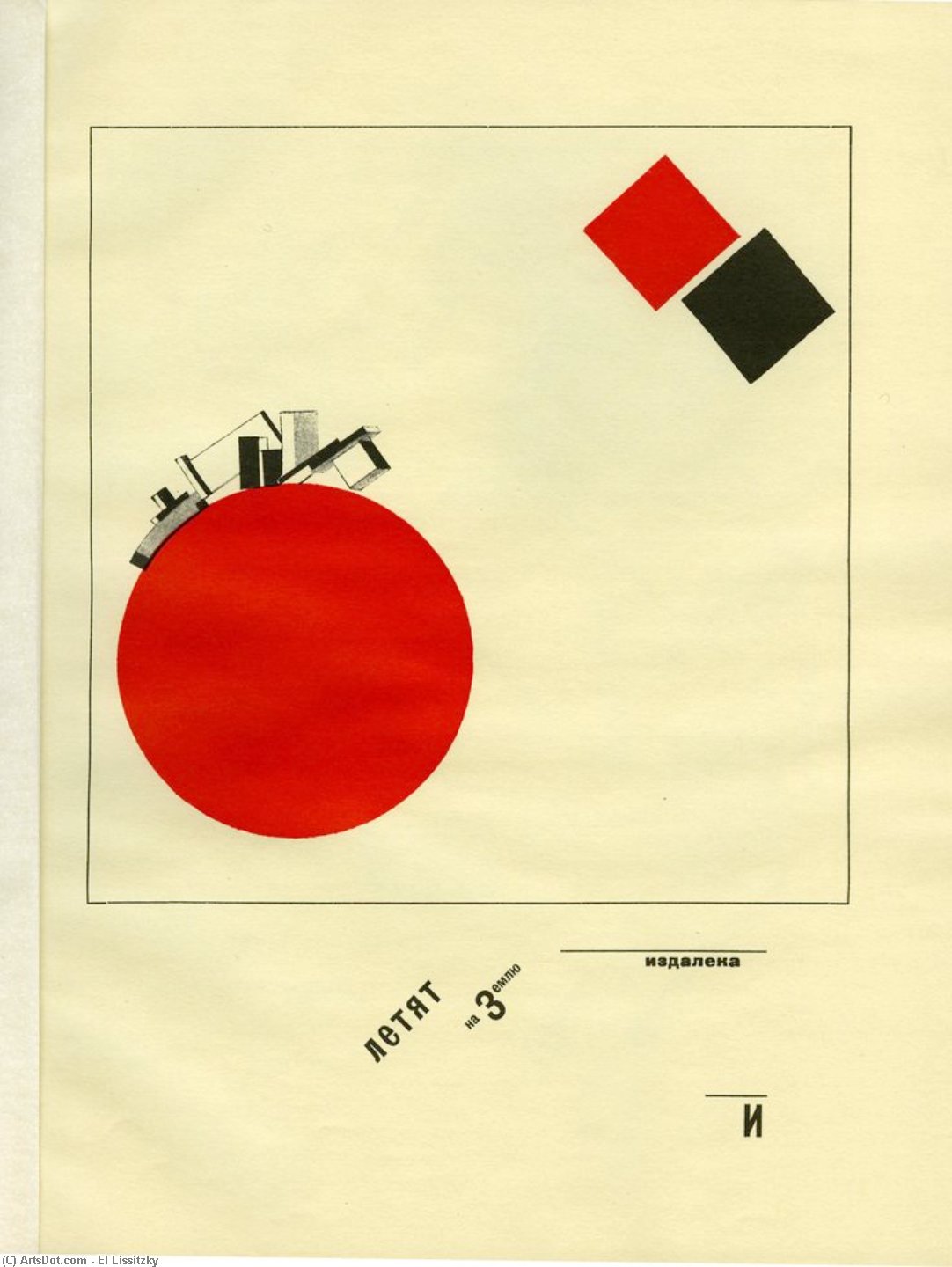
Discover El Lissitzky’s ‘Flying to Earth,’ a striking 1920 Constructivist print! Explore its geometric design, vibrant red & black hues, and symbolic head form. A unique art piece!
El Lissitzky (1890-1941): Russian avant-garde artist of Suprematism, Constructivism & Proun. Explore his Bauhaus influence, typography, photomontage & impactful designs.
A Vision of Flight and Becoming: El Lissitzky’s ‘Flying to Earth from a Distance’
This captivating geometric composition by Russian artist El Lissitzky embodies the radical spirit of early 20th-century abstraction. Created in 1920, *‘Flying to Earth from a Distance’* is a striking example of his exploration within Suprematism and Constructivism – movements that sought to break free from representational art and embrace pure form and color. The artwork measures 25 x 21 cm and presents a bold visual statement despite its relatively small size.
Deconstructing the Form: Style & Technique
The work is dominated by a large, vibrant red circle set against a pale beige background. Below it, precisely arranged black squares and a smaller white rectangle containing what appears to be a mechanical element create a dynamic interplay of shapes. Lissitzky’s style here is characterized by its geometric purity, clean lines, and deliberate flatness – hallmarks of both Suprematism and Constructivism. The absence of traditional perspective reinforces the two-dimensional nature of the piece, emphasizing the artwork as an object in itself rather than a window onto another world. The smooth texture suggests it was likely created using printing techniques such as lithography, allowing for precise reproduction of these sharp edges and flat planes of color.
Historical Context: A Revolutionary Aesthetic
El Lissitzky was a pivotal figure in the Russian avant-garde, deeply involved with Kazimir Malevich’s Supremus movement. Following the 1917 Bolshevik Revolution, artists like Lissitzky believed art could serve as a powerful tool for social and political change. Constructivism, emerging from this context, aimed to reflect modern industrial society and its values. *‘Flying to Earth from a Distance’* reflects this ambition; it's not merely an aesthetic exercise but a visual articulation of new ideas about space, form, and the potential of abstraction. Lissitzky later became influential at the Bauhaus school in Germany, disseminating these revolutionary artistic principles internationally.
Symbolism & Interpretation: A Journey of Growth
The artwork’s title, coupled with the Russian text “летят 3” (“they fly 3”) printed on the upper left corner, hints at a narrative of movement and progression. The large red circle can be interpreted as representing the sun, a celestial body, or even – given its placement and surrounding shapes – an abstracted head. This suggests themes of childhood, growth, and aspiration. The mechanical element within the white rectangle introduces a sense of modernity and technological advancement, perhaps symbolizing the future towards which these “flying” entities are directed. The phrase "издана" ("published") indicates this work was intended for wider dissemination, aligning with Lissitzky’s belief in art as a public force.
Emotional Impact & Interior Design
Despite its abstract nature, *‘Flying to Earth from a Distance’* evokes a sense of optimism and dynamic energy. The bold colors and geometric forms create a visually stimulating experience that can add a sophisticated touch to any interior space. Its minimalist aesthetic lends itself well to modern and contemporary settings, providing a striking focal point without overwhelming the room. The artwork's historical significance also adds intellectual depth, making it an engaging conversation starter for art enthusiasts.
Collecting & Reproductions
As an original work from this period is highly sought after by collectors, high-quality reproductions offer a fantastic opportunity to experience Lissitzky’s vision. When selecting a reproduction, pay attention to color accuracy and printing quality to ensure the integrity of the artwork's impact is preserved. This piece would be particularly effective as part of a curated collection exploring early 20th-century abstraction or Russian avant-garde art.