A Geometric Manifesto: The Soul of El Lissitzky’s Proun
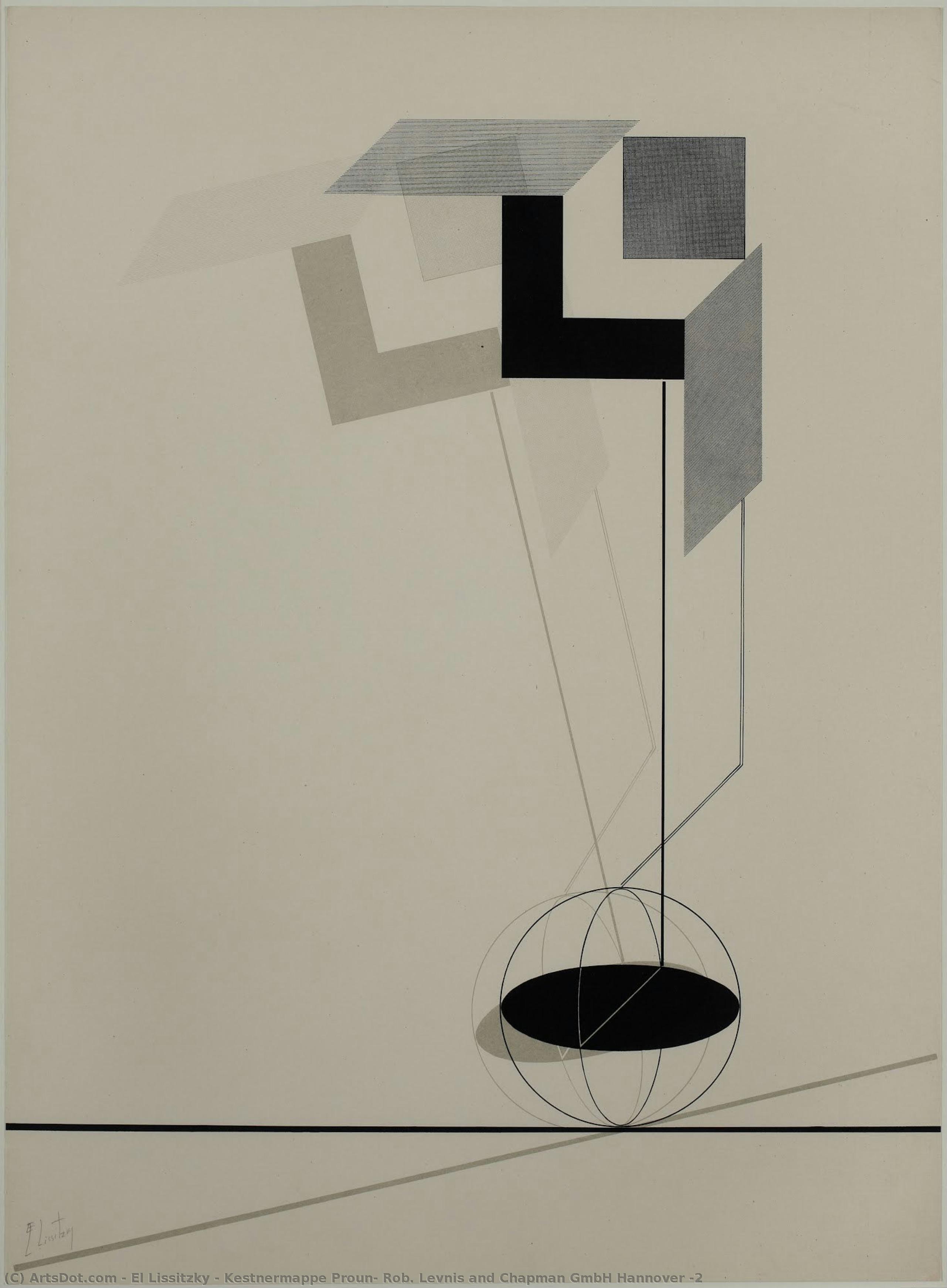
In the turbulent landscape of 1923, amidst the revolutionary fervor of the Russian avant-garde, El Lissitzky birthed a visual language that would forever alter the trajectory of modern abstraction. His work, Kestnermappe Proun, Rob. Levnis and Chapman GmbH Hannover #2, is not merely a lithograph; it is a profound architectural blueprint for a new reality. As part of his celebrated Proun series—an acronym representing "Project for the Affirmation of the New"—this piece serves as an intersection between painting and architecture. To gaze upon this monochrome masterpiece is to witness the birth of Suprematism’s most dynamic evolution, where the flat plane begins to breathe with a structural, three-scale vitality that challenges the very limits of perception.
The composition is a masterclass in controlled tension and spatial illusion. A dominant, tilted black square commands the upper register, acting as an anchor for the eye before it wanders into the complex web of intersecting lines and receding planes. Lissitzky employs a sophisticated use of overlapping geometric forms—most notably a grey rectangle that appears to drift backward into an infinite void—to create a sense of depth that defies traditional perspective. This is not a depiction of a physical object, but rather an exploration of pseudo-perspective, where the artist uses weight and shadow to suggest a multidimensional universe existing entirely within the confines of a two-dimensional surface.
The Alchemy of Monochrome and Line
Stripped of the distraction of color, the artwork relies entirely on the stark, rhythmic interplay of black, white, and varying shades of grey. This deliberate monochromatic palette amplifies the structural integrity of the composition, forcing the viewer to confront the raw power of shape and contrast. The lithographic technique provides a crucial layer of tactile richness; the subtle graininess of the print lends a tangible materiality to the abstract forms, grounding the ethereal geometry in something that feels permanent and architectural. Every line is executed with surgical precision, establishing a sense of mathematical order that nonetheless vibrates with an underlying energy.
For the discerning collector or interior designer, this piece offers a unique opportunity to introduce a sense of intellectual rigor and historical gravity into a space. The artwork’s aesthetic is one of balance and equilibrium, making it a sophisticated focal point for contemporary environments that value minimalism and structural clarity. It does not merely decorate a wall; it commands the atmosphere, inviting contemplation on the relationship between order and chaos, and between the static image and the dynamic movement of modern life.
A Legacy of Revolutionary Vision
Beyond its formal brilliance, the Kestnermappe Proun carries the emotional weight of a world in transition. Lissitzky, an artist whose training was rooted in engineering and architecture, sought to use art as a tool for social reconstruction. The intersecting lines and floating masses evoke the feeling of a complex, interconnected system—a metaphor for the new, industrialized society emerging from the ruins of the old empire. There is a palpable sense of optimism and precision within these shapes, an emotional resonance that speaks to the human desire to build, to organize, and to innovate.
Owning a high-quality reproduction of this work allows one to possess a fragment of the 20th century's most radical aesthetic movement. It is an invitation to inhabit the visionary world of El Lissitzky, where geometry becomes poetry and abstraction becomes a way of life. Whether placed in a curated gallery setting or as a cornerstone of a modern living space, this lithograph remains a timeless testament to the power of the avant-garde to reshape our understanding of the universe.