The Genesis of Abstraction
El Lissitzky's Kestnermappe Proun, Rob. Levnis and Chapman GmbH Hannover #4 isn’t merely a print; it’s a crystallized moment in the birth of modernism, a visual distillation of geometric principles that reverberates with the energy of early 20th-century Russia. Created in 1923, during a period of radical artistic experimentation – a time when artists were actively dismantling traditional representation to explore pure form and spatial relationships – this lithograph embodies the core tenets of Suprematism, spearheaded by Lissitzky’s mentor, Kazimir Malevich. Born Lazar Markovich Lissitzky in 1890 in Pochinok, Russia, his artistic journey was marked by a relentless pursuit of innovative expression, fueled by a deep-seated belief that art could be a catalyst for social and cultural transformation. His early work, often illustrations for Yiddish children’s books, hinted at the narrative power he would later harness within the framework of abstraction. The piece's creation coincided with a pivotal moment in Russian history – the rise of the Bolshevik government and its embrace of avant-garde art as a tool for propaganda and social reform. Lissitzky himself became deeply involved in these efforts, designing iconic posters and exhibition displays that sought to communicate revolutionary ideals through stark geometric forms.
A Dance of Lines and Planes
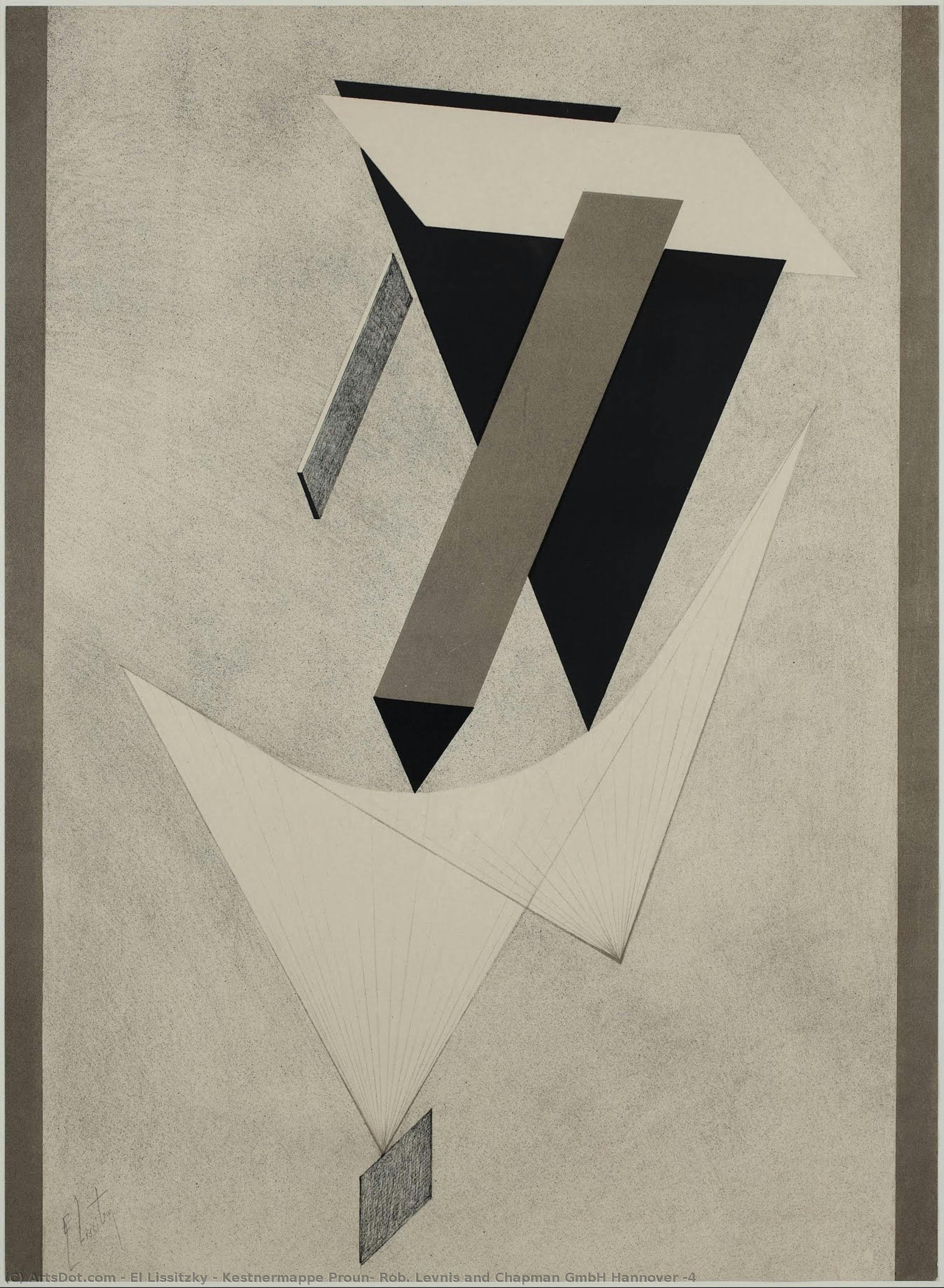
The artwork itself is a masterclass in controlled chaos. A predominantly monochrome palette – ranging from deep grays to lighter shades – establishes a foundation of austere elegance, allowing the intricate interplay of lines and planes to take center stage. Dominating the composition is a bold diagonal rectangle, a powerful anchor that’s intersected by a network of converging lines, creating an illusion of depth and dynamism. Smaller, meticulously placed rectangular and triangular forms add layers of complexity, suggesting spatial relationships without adhering to conventional perspective. Lissitzky's meticulous attention to detail—evident in the crispness of the lithographic lines—is remarkable. The process itself, utilizing a stone or metal plate to transfer ink onto paper, lends a tactile quality to the image, hinting at its handcrafted origins. The subtle variations in tone and texture contribute to a sense of visual richness, preventing the composition from feeling overly flat or sterile.
Symbolism Within Geometry
While ostensibly abstract, Kestnermappe Proun is rich with symbolic potential. Lissitzky’s use of geometric forms—rectangles, triangles, and lines—can be interpreted as representing fundamental building blocks of reality, mirroring the principles of constructivism that were gaining traction in Russia at the time. The diagonal rectangle, often associated with dynamism and movement, suggests a forward-looking vision, while the converging lines create a sense of order and structure. The work’s monochromatic palette—a deliberate rejection of color—underscores its focus on pure form and intellectual concepts. It's not simply about depicting an object; it’s about exploring the relationships between shapes and their spatial arrangements. Lissitzky himself described his approach as “creating according to a goal,” emphasizing the intentionality behind every stroke and line.
A Legacy of Innovation
Kestnermappe Proun stands as a testament to El Lissitzky’s pioneering spirit and his profound influence on 20th-century art. His exploration of abstraction, combined with his mastery of printmaking techniques, paved the way for subsequent generations of artists and designers. The work's impact extends beyond the realm of fine art, influencing graphic design, architecture, and even typography. Today, Lissitzky’s geometric abstractions continue to captivate viewers with their elegant simplicity and intellectual depth. Reproductions of this iconic print offer a powerful connection to a transformative period in artistic history, inviting us to contemplate the fundamental principles that shape our visual world.