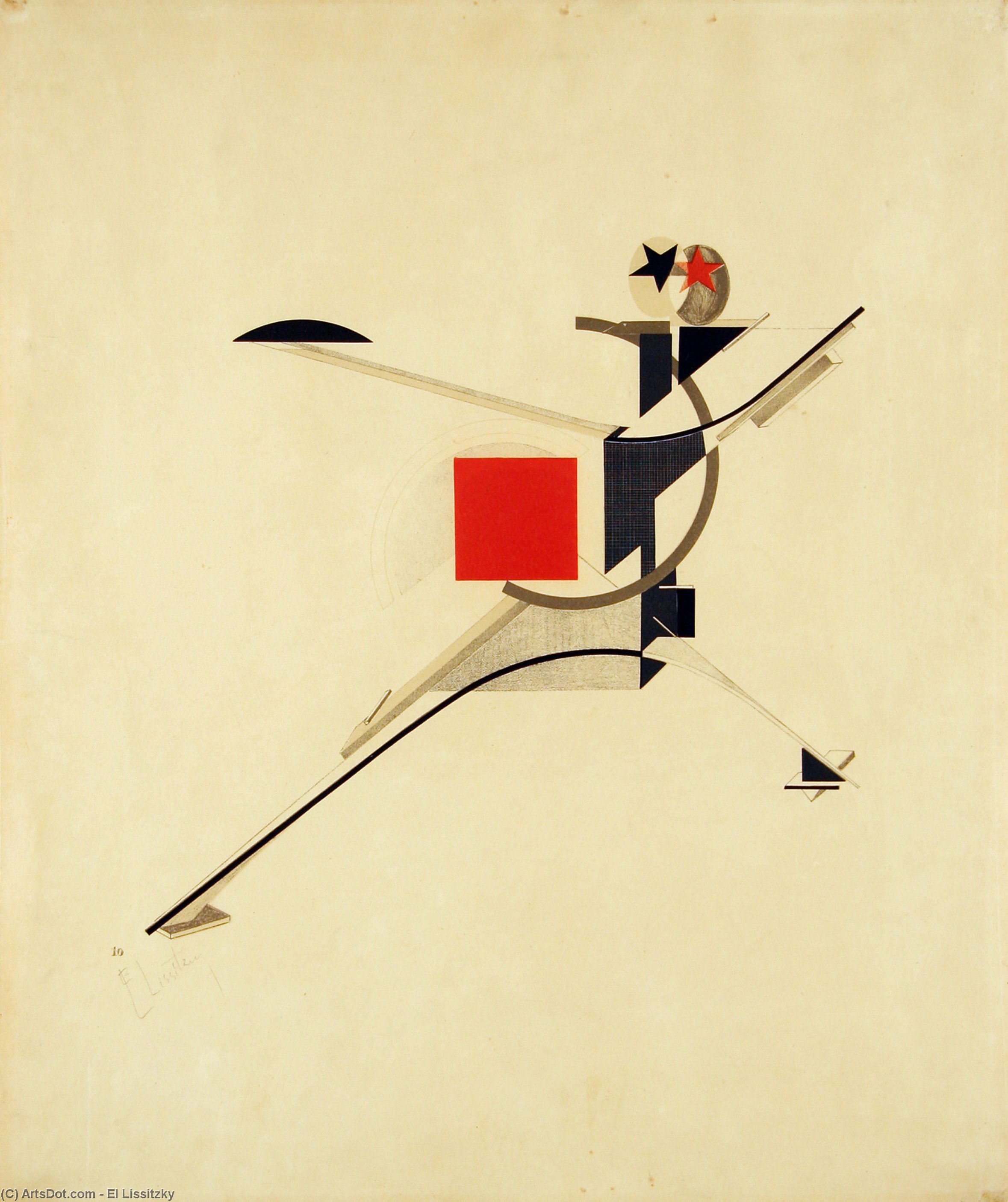
El Lissitzky’s "New Man" (1923) – a dynamic Constructivist abstraction featuring red, black, & geometric forms. Explore this iconic artwork's unique style and symbolic depth.
El Lissitzky (1890-1941): Russian avant-garde artist of Suprematism, Constructivism & Proun. Explore his Bauhaus influence, typography, photomontage & impactful designs.
A Revolutionary Vision: El Lissitzky’s “New Man”
“New Man,” created in 1923 by Russian artist El Lissitzky, is a pivotal work embodying the dynamism and ideological fervor of the Constructivist movement. This geometric abstraction isn't merely an arrangement of shapes; it’s a visual manifesto reflecting the utopian aspirations of post-revolutionary Russia.
Deconstructing Form: Style & Technique
The artwork is characterized by sharply defined, non-representational forms – squares, rectangles, and triangles – meticulously arranged to create a sense of energetic motion. Lissitzky masterfully employs a flattened perspective, rejecting traditional illusionistic depth in favor of a dynamic interplay between planes. The technique appears to be dry brush painting, lending a subtle texture to the smooth surfaces and enhancing the visual impact of the bold colors. The composition’s dominance of diagonal lines and intersecting shapes generates an undeniable feeling of forward momentum.
A Palette of Revolution: Color & Composition
A striking red square commands central attention, flanked by assertive black geometric forms against a pale beige background. This deliberate contrast amplifies the visual impact and draws the eye to the focal point – a prominent red star. The arrangement is intentionally unbalanced, contributing to the overall sense of dynamism and unrestrained energy. The limited color palette—red, black, and beige—is characteristic of Constructivist aesthetics, prioritizing clarity and impactful symbolism over decorative flourishes.
Historical Context: Suprematism & Constructivism
El Lissitzky was a key figure in the Russian avant-garde, initially working alongside Kazimir Malevich to develop Suprematism – an abstract art focused on pure geometric forms. However, he soon moved towards Constructivism, which sought to apply artistic principles to practical design and social purposes. "New Man" exemplifies this shift. Created during a period of intense political and social upheaval following the Russian Revolution, the artwork reflects the belief in building a new society based on rationalism, industrialization, and collective progress. Lissitzky’s work aimed to be more than just aesthetically pleasing; it was intended as a tool for shaping a new world order.
Symbolism & Ideology
The red star is arguably the most potent symbol within “New Man,” representing communist ideology, revolution, and hope for the future. The geometric arrangement itself can be interpreted as a representation of industrial structures or the building blocks of a new society. Lissitzky’s work often aimed to bridge the gap between art and life, and this piece embodies that ambition by visually articulating the principles of Constructivist thought.
Emotional Impact & Lasting Legacy
“New Man” evokes a sense of optimism, energy, and forward momentum. While abstract, it’s not devoid of emotional resonance. The dynamic composition and bold colors create a feeling of excitement and possibility. The artwork continues to inspire artists, designers, and architects today, serving as a powerful reminder of the transformative potential of art and its ability to reflect – and shape – societal values. Its clean lines and impactful design make it an ideal statement piece for modern interiors, bringing a touch of revolutionary spirit and sophisticated abstraction to any space.