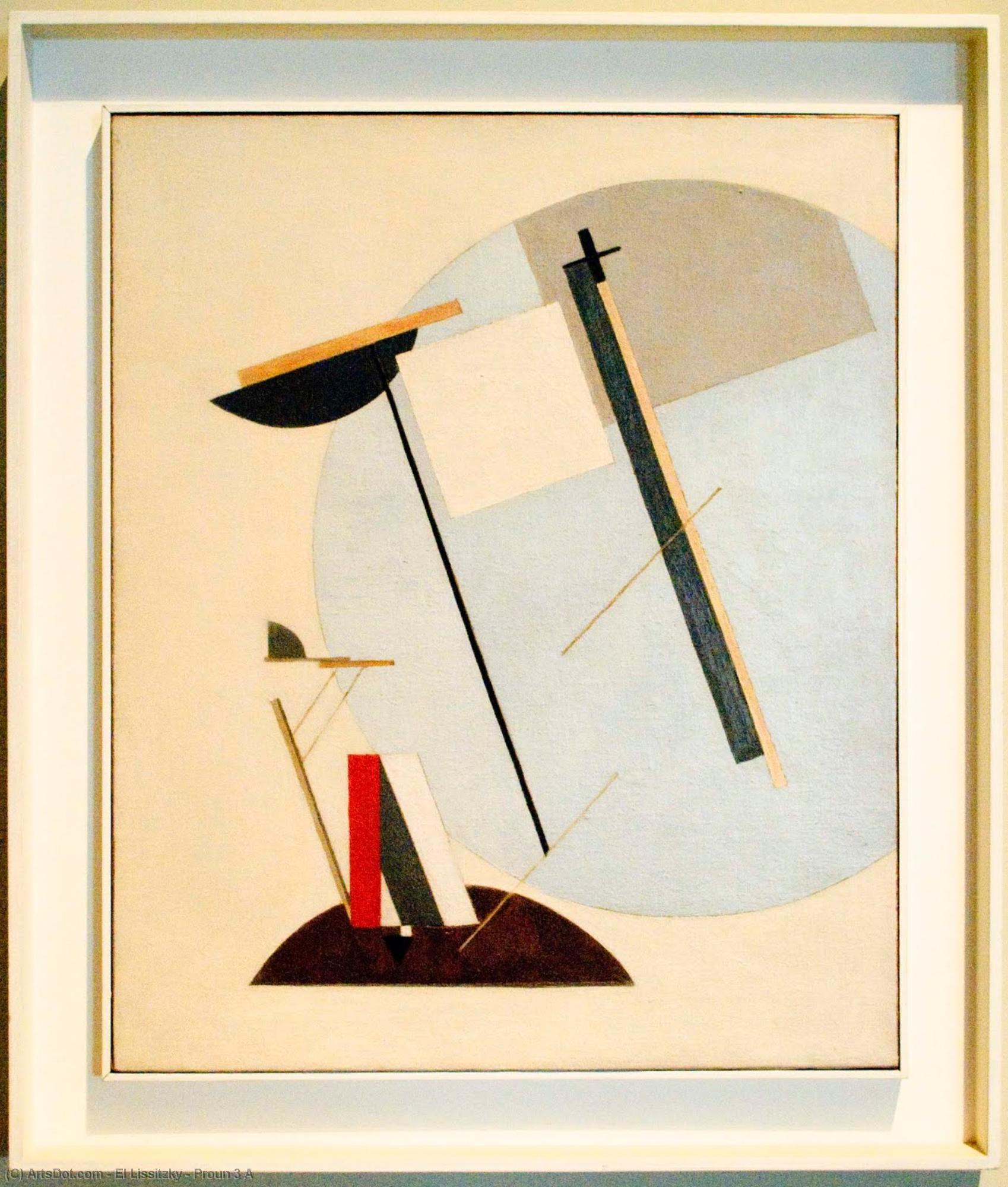
Explore El Lissitzky’s Constructivist masterpiece, Proun 3 A – a striking lithograph featuring a central circle intersected by a cross, embodying revolutionary geometric abstraction and inviting viewers to contemplate its enduring visual impact.
A Geometric Symphony of Revolution
El Lissitzky’s Proun 3 A stands as a testament to the fervent idealism of Constructivism—a movement that sought to liberate art from representational illusion and forge it into a tool for social transformation. Created in 1920, this lithograph is part of a larger portfolio exploring Lissitzky's groundbreaking concept of Proun, which aimed to visualize the underlying structure of reality itself. Unlike traditional painting, Proun abandons depiction; instead, it presents a complex geometric arrangement designed to convey an emotional and intellectual resonance far beyond mere visual appearance.
- Subject Matter: The composition centers around a prominent circle intersected by a cross—a motif that recurs throughout Lissitzky’s Proun series. This seemingly simple form embodies profound symbolic significance, representing the unity of cosmos and human consciousness according to Lissitzky's philosophical framework.
- Style & Technique: Lissitzky’s meticulous execution demonstrates Constructivist precision. Lithography—a printing process known for its ability to reproduce intricate detail—was chosen to capture the essence of Proun’s geometric abstraction. The artist employed a bold palette, utilizing shades of ochre and crimson to heighten the visual impact.
The inclusion of elements like umbrellas and a baseball glove adds an unexpected layer of narrative to the abstract design. These objects aren't merely decorative; they serve as anchors within the geometric expanse, subtly referencing everyday life while simultaneously elevating it to the realm of conceptual art. Lissitzky deliberately juxtaposes these familiar forms with the dominant circle and cross, prompting viewers to contemplate the relationship between the tangible world and the underlying order of existence.
Historical Context: Proun emerged during a period of intense artistic experimentation in Russia following the Bolshevik Revolution. Constructivism sought to dismantle bourgeois aesthetics and embrace rational principles—influences evident in Lissitzky’s unwavering commitment to geometric abstraction as a vehicle for expressing revolutionary ideals. This artwork reflects the broader ambition to construct a new visual language capable of communicating complex ideas about space, time, and human experience.
Symbolism Beyond Geometry
Beyond its formal structure, Proun 3 A resonates with deeper symbolic meanings rooted in Lissitzky’s spiritual explorations. The circle represents wholeness and unity—a concept central to Eastern philosophy and embraced by Lissitzky as a means of overcoming Western dualisms. Simultaneously, the cross symbolizes faith and transcendence—a visual counterpoint that underscores the artist's desire to reconcile reason and spirituality.
Emotional Impact & Artistic Legacy
Ultimately, Proun 3 A transcends mere aesthetic contemplation; it invites viewers into a dialogue about the nature of reality and the role of art in shaping perception. Lissitzky’s masterful manipulation of geometric form conveys an aura of intellectual conviction—a palpable sense of optimism tempered by awareness of social responsibility. This lithograph remains a cornerstone of Constructivist art, inspiring generations of artists to explore the expressive potential of abstraction while grappling with pressing societal concerns. Its enduring appeal lies in its ability to communicate profound ideas through deceptively simple visual elements—a testament to Lissitzky’s genius as both artist and visionary.