El Lissitzky (1890-1941): Russian avant-garde artist of Suprematism, Constructivism & Proun. Explore his Bauhaus influence, typography, photomontage & impactful designs.
A Geometric Revelation: Exploring El Lissitzky’s Proun 30
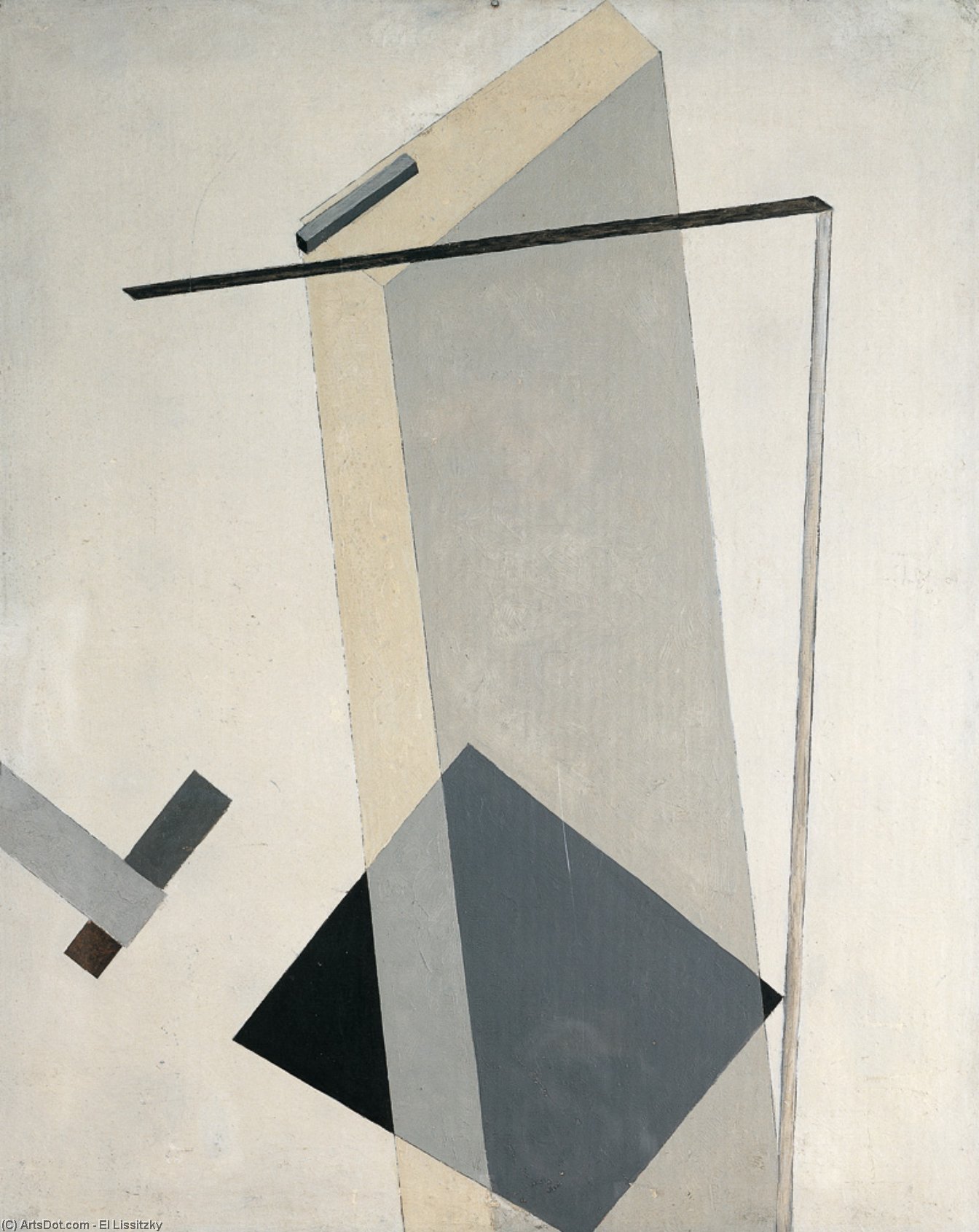
El Lissitzky's Proun 30 stands as a cornerstone of Constructivism, embodying the movement’s radical reimagining of spatial perception and its fervent embrace of geometric abstraction. Created in 1920, this deceptively simple painting—a dominant gray square intersected by two smaller triangles—represents far more than just visual harmony; it encapsulates Lissitzky's profound engagement with architectural theory and his ambition to liberate art from representational constraints. The artwork’s stark monochrome palette underscores its conceptual rigor, prioritizing form over color to convey a powerful message about the relationship between structure and dynamism.
Architectural Roots & Suprematist Influence
Lissitzky’s artistic trajectory was deeply rooted in architectural considerations. Influenced by Bauhaus principles—a collaborative German design school that championed functionalism and geometric forms—he sought to translate architectural concepts into visual language. Proun 30 directly reflects this preoccupation, mirroring the modular construction techniques employed in modernist buildings. The triangles and square aren’t merely decorative elements; they are deliberately positioned to create a dynamic equilibrium reminiscent of cantilevered structures and reinforced concrete frames. This deliberate structuring mirrors Lissitzky's belief that art could actively shape our understanding of space and contribute to the creation of new environments.
Symbolism Beyond Geometry
While seemingly devoid of narrative imagery, Proun 30 is laden with symbolic significance. The square represents stability and permanence—a grounding force against which the triangles assert their movement and expansion. Lissitzky himself interpreted these shapes as embodying “the cosmos,” reflecting his fascination with mathematical formulas and their ability to describe universal patterns. This cosmic symbolism aligns perfectly with Constructivism’s core ethos: a desire to harness scientific principles to transform society and liberate human consciousness. The painting isn't simply about geometric forms; it’s about conveying an intellectual vision of the universe itself.
Technique & Reproduction Considerations
The artwork’s execution is characterized by meticulous attention to detail—a hallmark of Lissitzky’s artistic practice. Produced on canvas, Proun 30 utilizes a smooth, matte finish that enhances its textural qualities and contributes to its understated elegance. Reproductions aim to faithfully capture this original aesthetic, prioritizing archival quality pigments and printing processes. ArtsDot offers exceptional reproductions that allow collectors and interior designers alike to experience the artwork's profound impact firsthand—a testament to Lissitzky’s enduring legacy as a pioneer of geometric abstraction and architectural thought.
A Legacy of Innovation
Proun 30 remains an iconic image of Constructivism, demonstrating Lissitzky’s unwavering commitment to exploring new artistic horizons. Its influence extends beyond the realm of painting, informing graphic design and architectural visualizations. By commissioning a high-quality reproduction from ArtsDot, you can bring this seminal artwork into your home or workspace—a tangible connection to a transformative period in art history and a celebration of Lissitzky’s visionary spirit.