The Genesis of a Geometric Universe
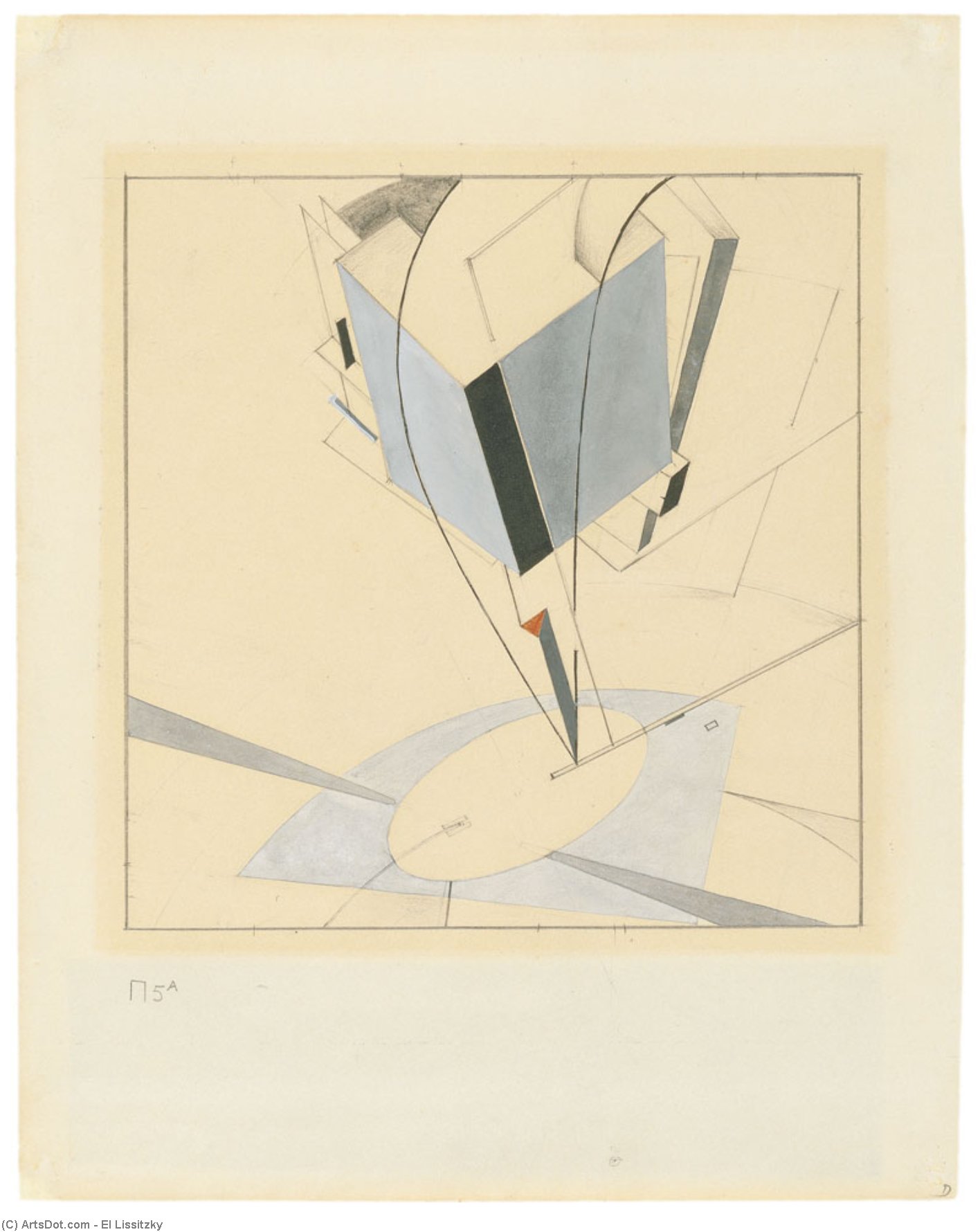
El Lissitzky's “Proun 5 A,” painted in 1919, isn’t merely a depiction of a building; it’s a foundational moment in the development of abstract art and a bold declaration about the relationship between form, space, and perception. Born Lazar Markovich Lissitzky in Pochinki, Russia, his artistic journey was marked by a restless experimentation fueled by a desire to dismantle traditional representation and construct new ways of seeing. This particular Proun – part of a series that evolved from architectural studies into a wholly unique visual language – represents a pivotal stage in this evolution. The painting’s subject is deceptively simple: a stylized building, rendered with the stark geometry characteristic of Lissitzky's work. However, it’s the arrangement and treatment of the circles—a dominant motif throughout the Proun series—that immediately captivate the viewer. These aren’t decorative flourishes; they are fundamental elements, actively shaping the perceived space of the composition.

Constructivism and the Deconstruction of Form
“Proun 5 A” firmly situates itself within the context of Constructivism, a Russian artistic movement that emerged in response to the devastation of World War I. Rejecting the emotionalism of preceding movements like Expressionism, Constructivists sought to create art that served a social purpose – one rooted in functionality and geometric abstraction. Lissitzky’s work embodies this ethos perfectly. He believed that by reducing forms to their essential geometric components—primarily squares, circles, and rectangles—he could unlock the underlying structure of reality itself. The building depicted isn't a faithful representation; it’s an abstracted embodiment of architectural principles, stripped down to its core elements and presented as a dynamic interplay of shapes. The metal-like appearance further reinforces this sense of industrial precision and deliberate construction.
This painting was created during a period of immense social and political upheaval in Russia. The Bolshevik Revolution had just taken place, and the country was undergoing radical transformation. Lissitzky’s art reflected this dynamism, embracing new technologies and visual languages to communicate ideas about progress and societal reconstruction. The use of simplified forms and bold colors aimed to create a universal language accessible to all, regardless of their background or education.
Symbolism Within Geometry: The Circle as Space
The circles in “Proun 5 A” are far more than just decorative elements; they represent Lissitzky’s concept of ‘space.’ He theorized that the circle, unlike a square, was inherently dynamic and capable of encompassing all other forms. In his writings, he described how the circle could be used to create “a new space,” a space that existed beyond the limitations of traditional perspective. The placement of these circles—some clustered near the center, others radiating outwards—suggests a complex spatial relationship, inviting the viewer to explore the painting’s depths and contemplate its underlying structure. The varying sizes of the circles contribute to this sense of depth and movement, creating an illusion of three-dimensionality within a two-dimensional plane.
A Legacy of Innovation: Reproduction and Interior Design
“Proun 5 A” remains a powerfully evocative work of art, demonstrating Lissitzky’s pioneering approach to abstraction. ArtsDot offers meticulously crafted hand-painted reproductions that capture the essence of this iconic piece, allowing you to bring its dynamic geometry and revolutionary spirit into your own space. Whether used as a striking focal point in a modern interior or as an investment piece for art collectors, a reproduction of “Proun 5 A” is a testament to Lissitzky’s enduring legacy – a visual exploration of space, form, and the boundless possibilities of abstract art. Consider how its bold geometric forms can complement minimalist designs or add a touch of intellectual stimulation to a more eclectic setting.