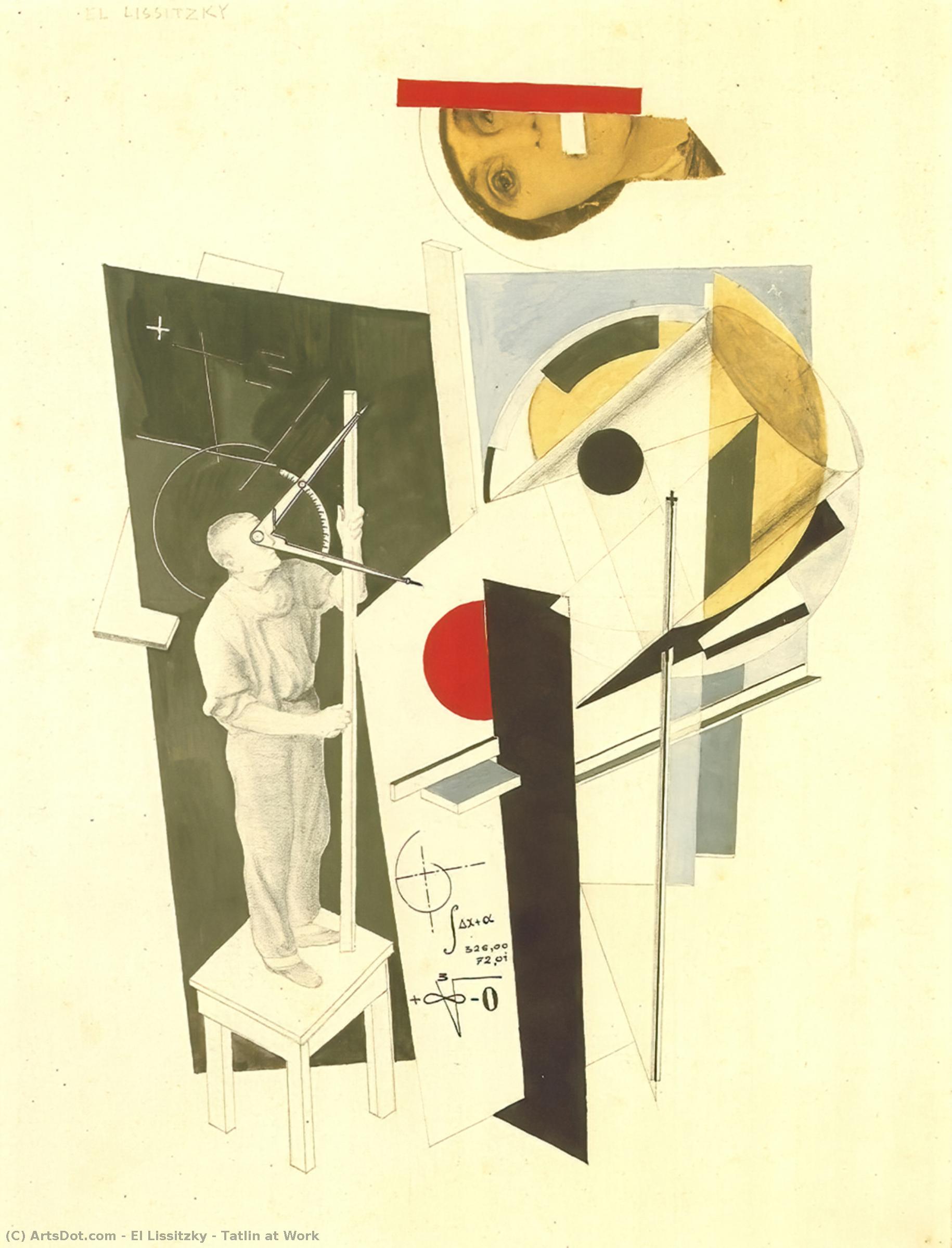
El Lissitzky’s ‘Tatlin at Work,’ a striking Constructivist painting depicting collaborative artistic creation, captures the spirit of revolutionary optimism. Explore this iconic piece and discover more masterpieces by Lissitzky on WikiArt.
A Collaborative Effort Captured in Constructivist Form
“Tatlin at Work,” executed by El Lissitzky in 1928, stands as a testament to the spirit of Constructivism—a movement that sought to liberate art from traditional aesthetics and embrace geometric abstraction as a tool for social transformation. This painting isn’t merely a depiction of an artist engaged in his craft; it's a carefully considered visual manifesto reflecting the intellectual fervor of its time.
Style and Technique: Embracing Geometric Precision
- Constructivism, born from the Russian Revolution, rejected representational art in favor of simplified forms—primarily cubes, spheres, and cylinders—to convey ideas rather than imitate reality. Lissitzky’s masterful application of this stylistic approach is evident throughout “Tatlin at Work.”
- The artist employs a bold palette dominated by muted reds and yellows, colors chosen deliberately to evoke feelings of energy and optimism – mirroring the revolutionary idealism that fueled the movement.
- Lissitzky’s technique leans heavily on planar abstraction, layering shapes onto the canvas with meticulous precision. This deliberate flatness emphasizes the conceptual core of the artwork, prioritizing intellectual engagement over visual spectacle.
Historical Context: The Birth of Soviet Art
Created during the early years of Bolshevik rule in Russia, “Tatlin at Work” embodies the utopian aspirations of the Soviet avant-garde. Lissitzky’s intention was to portray not just an individual artist but also the collective endeavor required to build a new socialist society—a vision articulated through the visual language of geometric abstraction.
The painting reflects the broader preoccupation with industrialization and technological advancement prevalent in the era, aligning seamlessly with the movement's belief that art could serve as a catalyst for societal progress. Lissitzky’s work directly responded to debates surrounding the role of art within the revolutionary project.
Symbolism: Beyond Representation – Ideas Made Visible
While lacking recognizable figures or landscapes, “Tatlin at Work” is rich in symbolic meaning. The central cube represents rationality and order—fundamental principles underpinning Constructivism’s critique of bourgeois aesthetics. Its placement suggests a deliberate hierarchy, emphasizing the importance of intellectual thought.
The surrounding shapes contribute to this conceptual framework, symbolizing interconnectedness and dynamism – mirroring the transformative process envisioned by Lissitzky and his fellow artists.
Emotional Impact: A Reflection of Optimistic Belief
“Tatlin at Work” transcends mere visual representation; it communicates a profound emotional resonance. The painting’s subdued colors convey a sense of quiet determination, reflecting the unwavering conviction that art could contribute to shaping a brighter future. It serves as an enduring emblem of Constructivism's ambition—to transform perception and inspire action.