The Geometry of Revolution: Exploring El Lissitzky's "There Is Over"
To stand before El Lissitzky’s There Is Over is not merely to observe paint on canvas; it is to confront the very architecture of a burgeoning modern consciousness. Created in the charged atmosphere of 1920, this work pulses with the revolutionary energy that defined post-war Russia and the avant-garde spirit sweeping across Europe. Lissitzky, an artist whose life mirrored the tumultuous shifts of his era, channeled his belief in art’s power to rebuild society into a stark, exhilarating visual language. The composition itself—a dialogue between bold geometric forms—demands that the viewer move beyond simple appreciation and engage in intellectual participation.
Suprematism and the Language of Pure Form
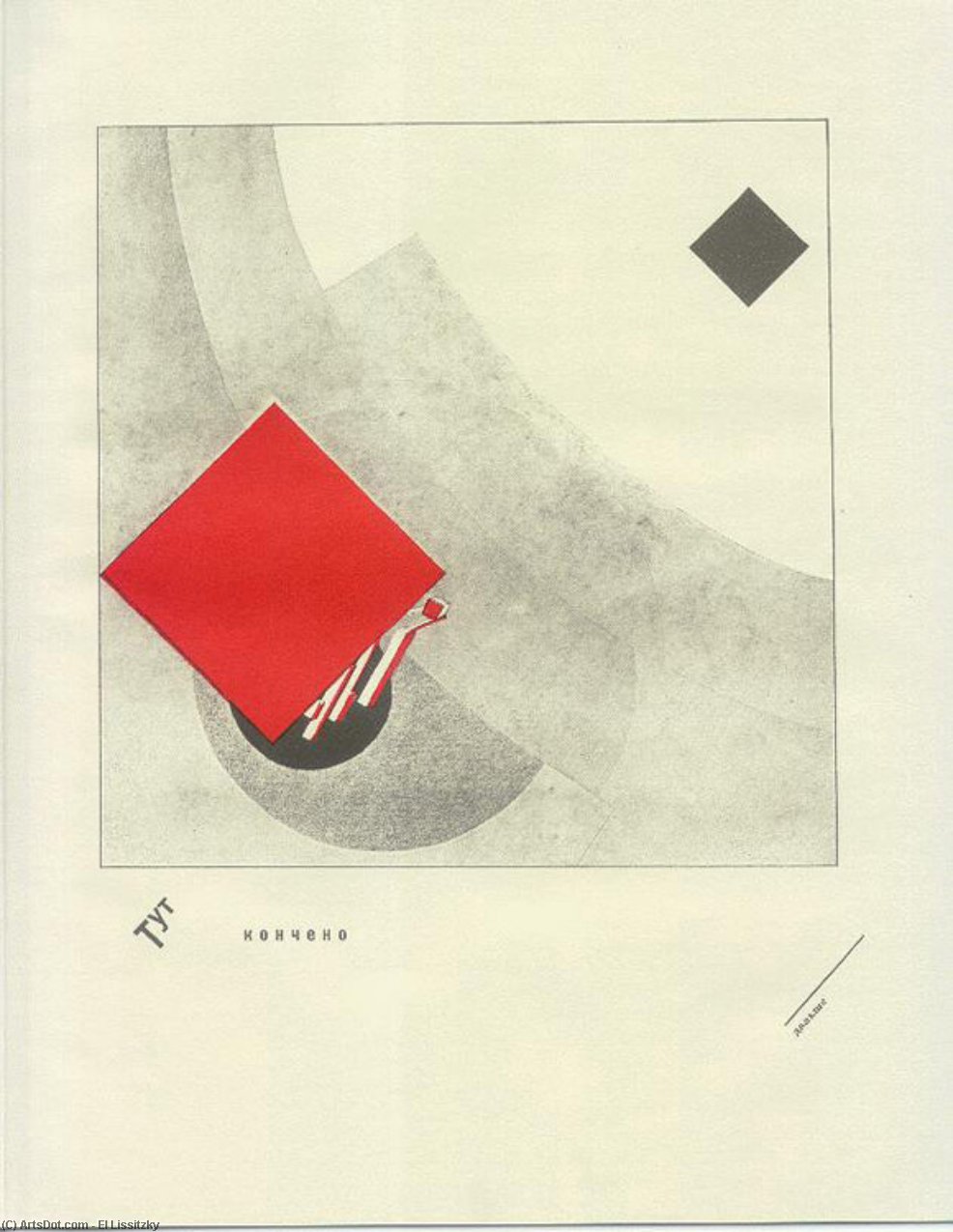
This piece is a quintessential example of Suprematism, an art movement dedicated to the supremacy of pure artistic feeling over any objective representation. Lissitzky stripped away the clutter of recognizable reality, leaving behind only the elemental vocabulary of shape, color, and line. Here, we encounter the powerful interplay between the dominant red square and the serene white circle. The red mass, occupying a significant portion of the upper left quadrant, is not just a block of color; it feels like an assertion, a foundational pillar of energy. Contrasting this assertive geometry is the delicate placement of the white circle on the right—a point of visual rest, a breath taken within the composition’s fervor. The technique employed is one of masterful abstraction, where every edge and plane exists to create tension against its neighbor.
Symbolism in Red, White, and Black
The palette itself carries immense historical weight. In the context of early 20th-century Russia, red was inextricably linked to revolutionary fervor and socialist ideals, while white often symbolized purity or a new beginning. The stark black elements ground the composition, providing necessary anchors against the dynamic interplay of color. These shapes are not arbitrary; they function as visual equations. They suggest movement—the square seems poised, ready to expand, while the circle implies perpetual motion. For the collector or designer, understanding this symbolic resonance allows the artwork to transcend mere decoration; it becomes a potent conversation piece about progress, upheaval, and the enduring human need for structure amidst chaos.
Bringing Revolutionary Art Home
For those seeking to infuse a space with the intellectual vigor of modernism, There Is Over offers unparalleled depth. Whether placed in a minimalist gallery setting or integrated into a contemporary living area, its bold graphic impact commands attention without shouting. Owning a high-quality reproduction allows one to connect directly with Lissitzky’s pioneering vision—a vision that believed art could be an active agent of change. It is a piece that rewards close looking, inviting contemplation on the relationship between order and dynamism, making it a profound statement for any discerning eye.