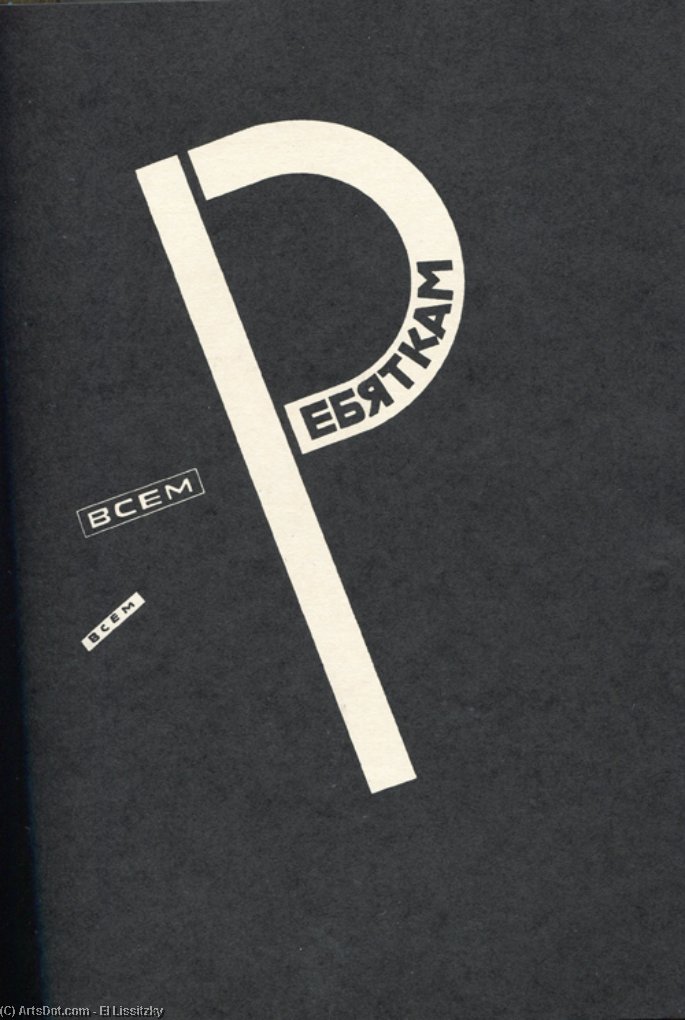
To All The Children – A Bold Statement of Constructivist Ideals
El Lissitzky’s “To All The Children,” painted in 1920, stands as a cornerstone of Constructivism—a movement that sought to liberate art from representational constraints and forge it into a tool for social transformation. More than just an advertisement for children's clothing, this deceptively simple artwork embodies the core tenets of Soviet artistic philosophy during its formative years. Captured in striking black and white photography, the painting’s impact resonates powerfully even today.
- Composition & Form: The image is dominated by a monumental letter ‘P,’ rendered in thick sans-serif typography—a deliberate choice reflecting Constructivism's obsession with geometric abstraction and industrial precision. Its slight curve embraces Cyrillic text, seamlessly integrating typographic design into the overall composition. A diagonal line bisects the 'P,' injecting dynamism and visual tension that prevents stagnation.
- Color Palette & Texture: Strict monochrome—black and white—amplifies the artwork’s austere aesthetic and underscores Constructivism's commitment to clarity and functionality. The photograph reveals a smooth, matte surface texture indicative of paper or canvas, mirroring Lissitzky’s technique which prioritized essential forms over elaborate embellishments.
- Style & Technique: Lissitzky’s masterful use of graphic design principles—precise lines, bold shapes—is evident in every element. He eschewed brushstrokes, opting for a method that emphasized geometric abstraction and reduced visual information to its bare minimum. This deliberate simplification served as a powerful statement about the role of art in shaping perception and promoting rational thought.
- Historical Context: Created during the Russian Revolution, “To All The Children” reflects the fervent optimism surrounding Constructivism’s belief in progress through industrialization and social reform. It aligns with broader artistic ambitions to communicate ideas directly—to bypass narrative storytelling for a more impactful visual message.
- Symbolism & Emotional Impact: The letter ‘P,’ representing “Peace,” is arguably the artwork's most significant symbolic element. Its monumental scale conveys a sense of grandeur and conviction, mirroring Lissitzky’s unwavering dedication to socialist ideals. Viewing this piece evokes contemplation on the power of visual communication to inspire hope and promote collective responsibility—a legacy that continues to captivate audiences worldwide.
Further exploration into El Lissitzky's oeuvre reveals his profound influence on Bauhaus design and his pioneering experimentation with photomontage, cementing his place as one of the most influential artists of the 20th century.