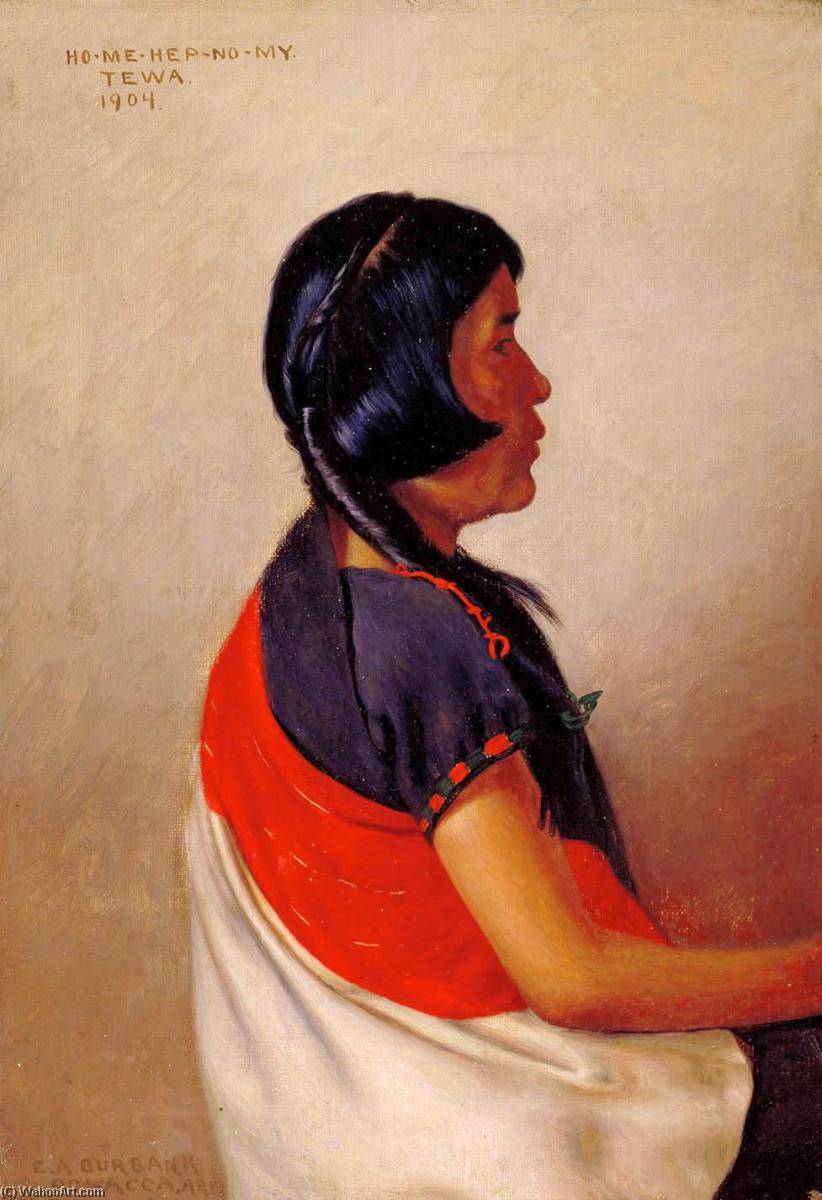
The painting Ho-me-hep-no-my by
Elbridge Ayer Burbank is a stunning example of Native American portraiture. Created in 1904, this oil on canvas piece measures 33 x 23 cm and is currently housed at the
Smithsonian American Art Museum in the United States. The subject of the painting is a Native American woman with long black hair, wearing a red dress and a scarf around her neck. Her contemplative expression adds depth to the portrait, inviting the viewer to ponder her thoughts.
Artist Background
Elbridge Ayer Burbank was an American artist known for his portraits of Native Americans. His work is characterized by its attention to detail and sensitivity towards his subjects. Burbank was born in 1858 and was active during the late 19th and early 20th centuries. His paintings can be found in various museums, including the
Smithsonian American Art Museum and the
Brigham Young University Museum of Art.
Painting Style and Technique
The painting Ho-me-hep-no-my showcases Burbank's skill in capturing the subtleties of human expression. The use of oil on canvas allows for a level of detail and texture that brings the subject to life. The simple background, featuring a white wall, provides a clean and unobtrusive setting for the portrait. This style is reminiscent of other works by Burbank, such as Tlo-be-nel-ly and Ne-i-so-meh, which can be found on
https://ArtsDot.com.
Key Features of the Painting: - The subject's contemplative expression, which adds depth to the portrait
- The use of oil on canvas, allowing for detailed and textured brushstrokes
- The simple background, providing a clean and unobtrusive setting for the portrait
For those interested in learning more about
Elbridge Ayer Burbank and his work, visit
/art/list/?Filter=Elbridge-Ayer-Burbank to explore his paintings and read about his life and career. Additionally, the
Smithsonian American Art Museum website provides valuable information on the painting Ho-me-hep-no-my and other works by Burbank.