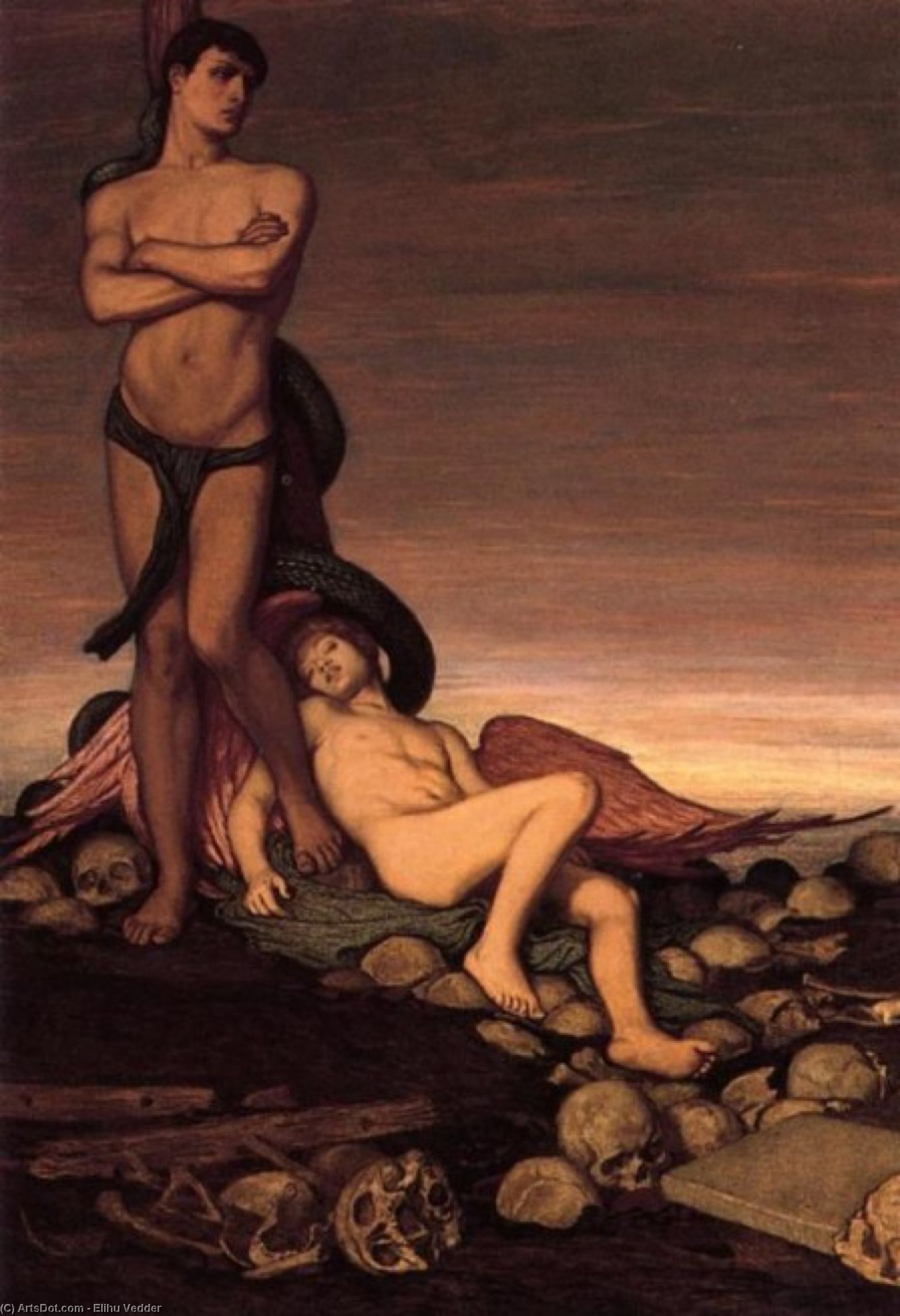
The painting
The Last Man by
Elihu Vedder is a thought-provoking work that invites viewers to contemplate the themes of mortality, decay, and the end of humanity. Created in 1886, this oil on canvas piece is a masterpiece of
Symbolism, a movement that emphasized abstract qualities and symbolic content.
Themes and Symbols
The painting depicts a lone man standing amidst a desolate landscape, surrounded by two women, one lying down and the other standing behind him. The man's gaze is fixed on something in the distance, possibly contemplating his fate or the end of humanity. The presence of skulls scattered throughout the scene serves as a stark reminder of mortality, while the umbrella may symbolize a attempt to shield oneself from the inevitable.
Neo-Impressionism, an art movement that emerged during this period, also influenced Vedder's work. As seen in the paintings of
Georges Pierre Seurat, such as
El arcoiris, 1883, available on
ArtsDot.com, this movement emphasized the use of abstract qualities and symbolic content.
Atmosphere and Style
The overall atmosphere of
The Last Man is somber and contemplative, reflecting the themes of mortality and decay. Vedder's use of muted colors and bold brushstrokes creates a sense of tension and unease, drawing the viewer into the desolate world of the painting. For more information on
Elihu Vedder and his works, visit
ArtsDot.com.
- Symbolism is a key element in understanding the painting's themes and symbols.
- The influence of Neo-Impressionism can be seen in Vedder's use of abstract qualities and symbolic content.
- The painting's atmosphere is somber and contemplative, reflecting the themes of mortality and decay.
For handmade oil paintings reproductions of
The Last Man and other masterpieces, visit
ArtsDot.com.