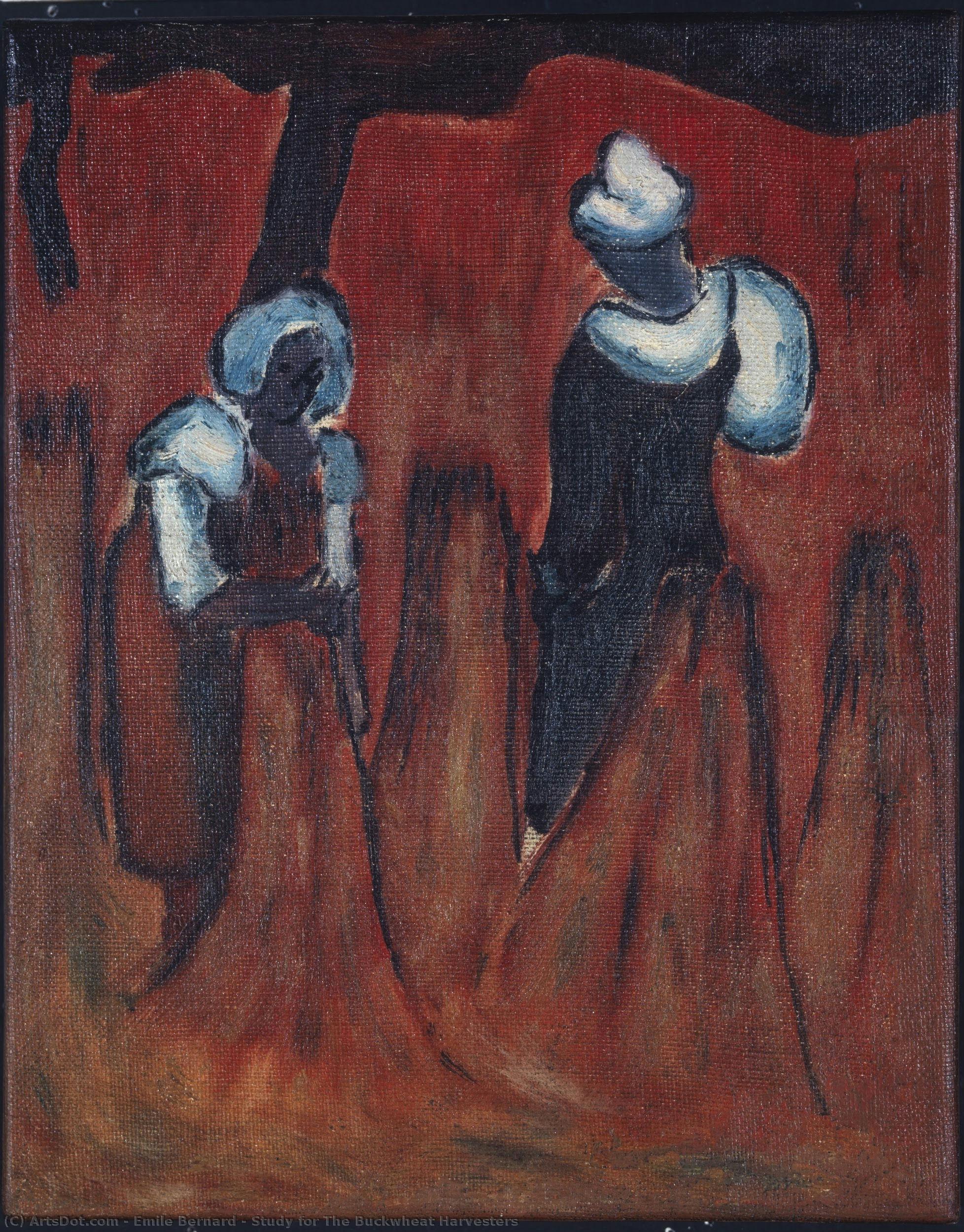
Émile Bernard's 'Study for The Buckwheat Harvesters,' created in 1888, embodies Pont-Aven’s aesthetic with its Synthetism style. This sketch captures two women harvesting buckwheat under a striking red backdrop, reflecting Bernard's fascination with Breton landscapes and Gauguin's influence.
Discover Émile Bernard (1868-1941): Post-Impressionist pioneer of Cloisonnism & Synthetism. Friend to Van Gogh & Gauguin, known for Breton landscapes and bold style.
Discover the Musée de Pont-Aven in Brittany, France – home to masterpieces from Paul Gauguin & the Pont-Aven School! Explore Impressionist & Post-Impressionist art and the region's unique artistic heritage.
A Moment Frozen in Brittany’s Crimson Harvest
Émile Bernard's "Study for The Buckwheat Harvesters," created in 1888 during his formative years alongside Paul Gauguin in Pont-Aven, embodies the core tenets of Synthetism—a stylistic movement born from Impressionism and championed by artists like Bernard and Gauguin—and represents a cornerstone of Breton artistic expression. This unassuming sketch, destined to become part of a larger canvas depicting “Le Ble noir,” offers a glimpse into Bernard’s meticulous observation of rural life and his unwavering dedication to capturing the essence of Pont-Aven's atmosphere.
The Essence of Synthetism
Bernard’s approach transcends mere representation; he strives for a fusion of color and form that prioritizes expressive emotion over photographic accuracy. Influenced by Cézanne and Gauguin, Bernard sought to distill visual experience into simplified geometric shapes—circles, squares, triangles—layered upon one another to convey mood and feeling. The muted tones of the sketch serve as an anchor for the bold splashes of red that dominate the background, mirroring the vibrant hues of buckwheat stems drying in late summer. This deliberate contrast exemplifies Synthetism’s ambition to transcend naturalistic depiction and tap into a deeper psychological realm.
Pont-Aven: A Crucible of Artistic Innovation
The Pont-Aven School flourished between 1886 and 1905, attracting artists drawn to Brittany's unspoiled landscapes and Celtic traditions. Bernard’s time in Pont-Aven was marked by intense collaboration with Gauguin, fostering a dialogue that propelled both artists toward groundbreaking stylistic developments. The sketch reflects the school’s preoccupation with capturing the spirit of place—the rugged coastline, the dense forests, and crucially, the seasonal rhythms of rural life. It's a testament to the desire to portray not just what is seen but how it feels.
Composition and Technique: A Study in Simplicity
Executed in black ink on canvas, Bernard’s “Study for The Buckwheat Harvesters” demonstrates remarkable control over line and tonal variation. Delicate hatching marks delineate the contours of the two women figures, subtly conveying their posture and movement. The artist's careful attention to detail—evident in the depiction of the shovels—underscores his commitment to capturing the textures of everyday objects. Despite its apparent simplicity, the sketch is imbued with a profound sense of observation and artistic intention.
Symbolism Beyond Representation
The red background isn’t merely decorative; it symbolizes the ripening buckwheat stems – a key element in Breton agriculture and folklore – representing vitality and fecundity. The positioning of the women upright against this backdrop speaks to themes of resilience and labor, mirroring the spirit of Pont-Aven's inhabitants. Bernard’s intention was not simply to depict a scene but to distill its symbolic significance into a visual form that would resonate with viewers long after seeing it. This piece serves as an invaluable precursor to Gauguin’s monumental canvas, cementing Bernard’s place as a pivotal figure in the history of modern art and capturing the enduring beauty of Brittany's harvest season.