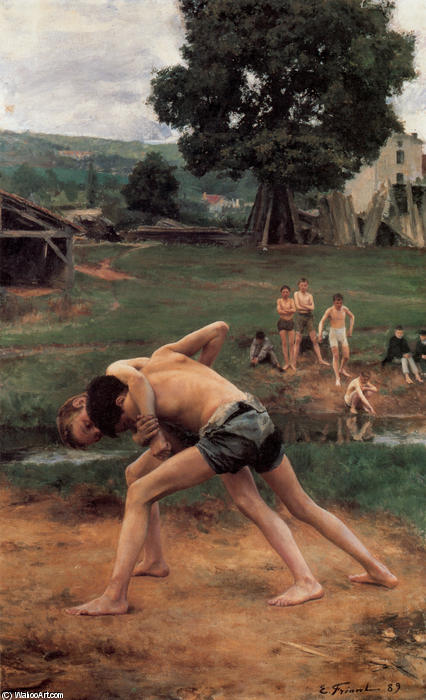
Explore Émile Friant's evocative 'Wrestling,' a masterful Realism painting depicting a rural wrestling match—a testament to French life and artistry from 1889.
Explore the realist paintings of Émile Friant (1863-1932), a French artist celebrated for evocative portraits, genre scenes & patriotic works like 'La Toussaint'. Discover his Salon successes and influence on late 19th/early 20th century art.
Discover the Musée Fabre in Montpellier through its magnificent collection of French and Italian masterpieces including works by Rubens and Courbet, offering an unmissable journey through art history that invites you to explore.
Émile Friant: Wrestling – A Study in Rural Realism
The painting “Wrestling,” executed by Émile Friant in 1889, stands as a testament to the burgeoning realism movement within French art at the turn of the century. More than just a depiction of physical exertion, it’s an immersive snapshot of provincial life—a scene brimming with palpable atmosphere and subtly layered symbolism that speaks volumes about the anxieties and aspirations of its era. Friant, deeply rooted in the traditions of Nancy where he honed his craft under Louis-Théodore Devilly, meticulously observed the world around him, translating his observations onto canvas with unwavering dedication to detail and emotional resonance.
Subject Matter and Composition
At first glance, “Wrestling” presents a straightforward tableau: two men locked in combat amidst a rural landscape dominated by trees—a stark contrast between human struggle and natural serenity. However, Friant’s compositional choices elevate the scene beyond mere physicality. The figures are positioned centrally within the frame, drawing immediate attention to their confrontation. Furthermore, the inclusion of several additional individuals – spectators observing the wrestling match – adds depth to the narrative and underscores the importance of communal experience in shaping identity. Notably, a baseball bat held by one man introduces an incongruous element—a symbol perhaps of modernity encroaching upon traditional values.
Technique and Style
Friant’s masterful technique exemplifies the core tenets of realism. He employed oil paints on canvas with painstaking precision, layering brushstrokes to achieve remarkable tonal gradations and capturing the textures of earth, skin, and clothing with astonishing accuracy. The artist's meticulous attention to detail—evident in the depiction of sweat glistening on the wrestlers’ brows and the rough bark of the trees—reflects Devilly’s influence and underscores Friant’s commitment to portraying reality as faithfully as possible. Unlike Impressionists who sought to capture fleeting moments of light, Friant prioritized conveying psychological depth alongside visual representation.
Historical Context and Societal Concerns
“Wrestling” emerged during a period marked by significant social transformations—the aftermath of the Franco-Prussian War instilled in French society a preoccupation with national identity and resilience. The painting captures this spirit through its depiction of rural labor and communal activity, reflecting anxieties about preserving traditional values amidst the pressures of industrialization. Friant’s work aligns with broader artistic trends exploring themes of masculinity, physicality, and social hierarchy—topics that resonated powerfully with audiences of his time.
Symbolism and Emotional Impact
Beyond its immediate visual appeal, “Wrestling” carries symbolic weight. The wrestling match itself represents a struggle for dominance—a microcosm of larger societal conflicts. Yet, the tranquil backdrop of trees symbolizes permanence and connection to the land—a counterpoint to the dynamism of human interaction. Friant’s ability to evoke emotion through subtle gestures and facial expressions underscores his artistic prowess and ensures that “Wrestling” continues to captivate viewers with its poignant portrayal of human experience.
Further Exploration
For a deeper understanding of Émile Friant's oeuvre, explore his celebrated Salon successes and influence on late 19th/early 20th century art at the Musée Fabre in Montpellier. Discover more prominent pieces of genre painting at Wikiart.org – best visual art database. You can find more information about Pierre-Eugène Hébert, a sculptor who also explored theatrical designs and detailed figures, at WikiArt.org as well.