A Sacred Moment in the Vatican Courtyard
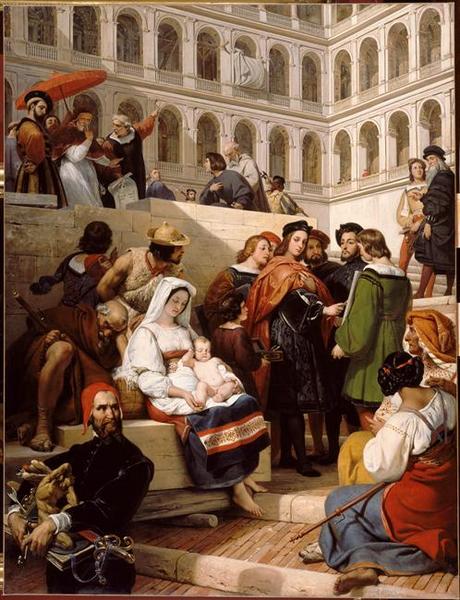
This magnificent scene transports the viewer directly into the heart of historical reverence—a bustling, yet profoundly sacred moment within what appears to be the venerable courtyards of the Vatican. The composition immediately draws the eye toward the apex, where the Virgin Mary and the infant Jesus are depicted, forming a luminous focal point around which all human activity orbits. It is not merely a portrait of figures; it is an immersion into a narrative tapestry woven from devotion, artistic observation, and the enduring weight of history. One can almost hear the hushed whispers and feel the cool stone beneath one's feet as the various characters gather to witness this divine tableau.
Mastery in Composition and Light
The artist has employed a masterful understanding of classical composition, utilizing a subtle pyramidal structure that lends inherent stability and grandeur to the scene. Notice how the architectural elements—the receding colonnades and grand steps—employ linear perspective to create an astonishing sense of depth, pulling the viewer deep into the painted space. While strong vertical lines lend a monumental quality to the background architecture, these rigid forms are beautifully softened by the organic curves found in the drapery and the gentle poses of the assembled figures. The handling of light is particularly noteworthy; it appears diffused, suggesting an overcast yet brilliant day. This soft illumination allows for subtle highlights on skin and rich folds of fabric, giving the entire scene a palpable sense of volume without harsh contrast.
Echoes of Academic Grandeur
Stylistically, this work speaks to the tradition of 19th-century academic painting—a period characterized by meticulous detail, historical accuracy in costume, and an elevated sense of narrative purpose. The palette itself is rich and warm, dominated by deep browns, creamy ivories, and muted reds, punctuated by cooler accents of blue and green that provide necessary visual relief. The technique suggests the careful layering characteristic of oil paint on canvas, where the artist achieved a refined finish, allowing the viewer to appreciate both the texture—from rough-hewn stone to silken garments—and the seamless blending of color.
Symbolism and Enduring Emotion
Beyond the technical brilliance lies the profound emotional resonance. The presence of the divine figures anchors the piece in religious symbolism, evoking awe and deep respect. Yet, the surrounding crowd transforms the scene into a commentary on human experience itself—the act of witnessing, the pursuit of beauty, and the confluence of faith with earthly life. For the collector or designer, this painting offers more than mere decoration; it provides an atmosphere. It is a visual meditation on reverence, making any space it graces feel imbued with timeless dignity and quiet contemplation.