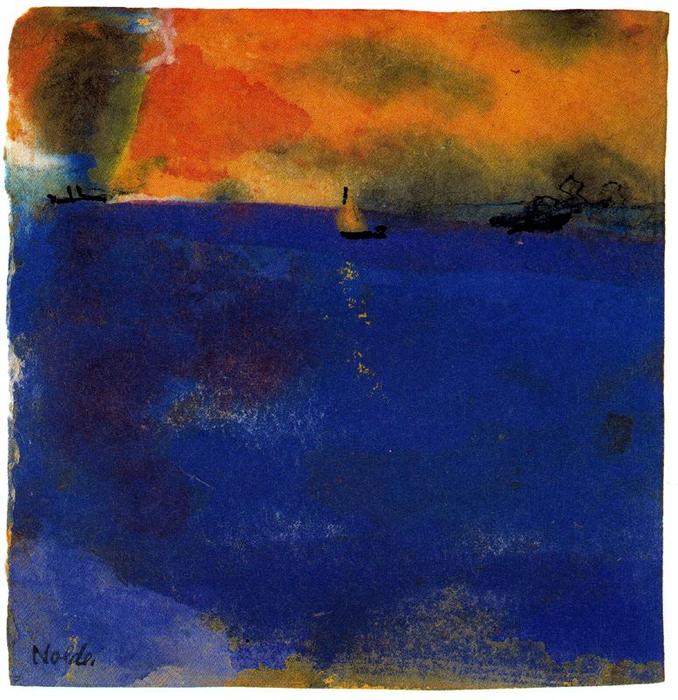
Emil Nolde’s Expressionistic masterpiece captures a dramatic seascape ablaze with vibrant orange and yellow hues—a bold departure from realism that embodies the artist's emotive style and reflects the spirit of early 20th-century art. Explore this stunning reproduction.
Explore Emil Nolde's vibrant Expressionism! Discover bold colors, emotive landscapes & iconic works like 'The Mocking of Christ'. A key figure in Die Brücke.
A Symphony of Color and Emotion: Exploring Emil Nolde’s “Blue Sea”
Emil Nolde's "Blue Sea (Sailboat and Two Steamships)" isn't merely a depiction of a seascape; it’s an embodiment of Expressionism—a movement that prioritized emotional intensity over objective representation. Painted sometime between 1920 and 1930, this artwork captures the spirit of its era, reflecting anxieties about modernity alongside a yearning for primal beauty. It resides in the Kunsthalle Düsseldorf, where visitors can experience firsthand the visceral impact of Nolde’s masterful technique.
The Essence of Expressionism: Distortion as Revelation
Nolde's stylistic approach aligns perfectly with the core tenets of Expressionism. Rejecting Impressionistic attempts to capture fleeting moments of light and color, he deliberately distorted forms and flattened perspective—a conscious decision to bypass visual realism in favor of conveying inner feelings. This technique wasn’t about accurately portraying what was seen; it was about expressing what *was felt*. Like fellow artists such as Edvard Munch and Ernst Ludwig Kirchner, Nolde sought to communicate psychological states directly through color and shape, prioritizing emotional resonance above all else.
Technique and Materials: Watercolor's Fluid Embrace
The artwork’s luminous quality stems from Nolde’s skillful use of watercolor—likely gouache layered beneath—applied to paper. The artist employed loose brushstrokes, allowing the pigment to bleed and blend organically across the surface. This technique creates a textured appearance that subtly enhances the emotional impact of the scene. Careful layering contributes to tonal variations and imbues the painting with depth despite its simplified geometry. The resulting surface possesses an ethereal glow, mirroring the mood conveyed by the vibrant hues dominating the composition.
A Palette of Passion: Color Symbolism in “Blue Sea”
The color palette is undeniably arresting—a deliberate orchestration designed to evoke specific emotions. Dominating the lower portion of the canvas is a deep indigo blue, representing not just the sea but also feelings of melancholy and contemplation. Above this expanse, fiery oranges, yellows, and browns blaze across the sky, symbolizing optimism, energy, and perhaps even danger. These contrasting colors heighten the drama of the scene and underscore Nolde’s intention to communicate psychological states rather than simply documenting a visual experience. The dark silhouettes of the boats serve as anchors against these luminous hues, grounding the composition while simultaneously emphasizing their isolation.
Historical Context: Navigating Uncertainty
“Blue Sea” was created during a period of significant social upheaval in Germany—the Weimar Republic—characterized by economic instability and political polarization. Nolde’s Expressionist style reflects this atmosphere of anxiety and disillusionment, mirroring broader artistic trends that questioned traditional values and embraced subjective experience. Yet, amidst the turbulence of his time, Nolde retained an unwavering faith in the transformative power of art, believing it could offer solace and inspiration to viewers grappling with existential concerns. This artwork stands as a testament to Nolde’s ability to distill complex emotions into a deceptively simple visual form—a captivating reminder that beauty can emerge from darkness.