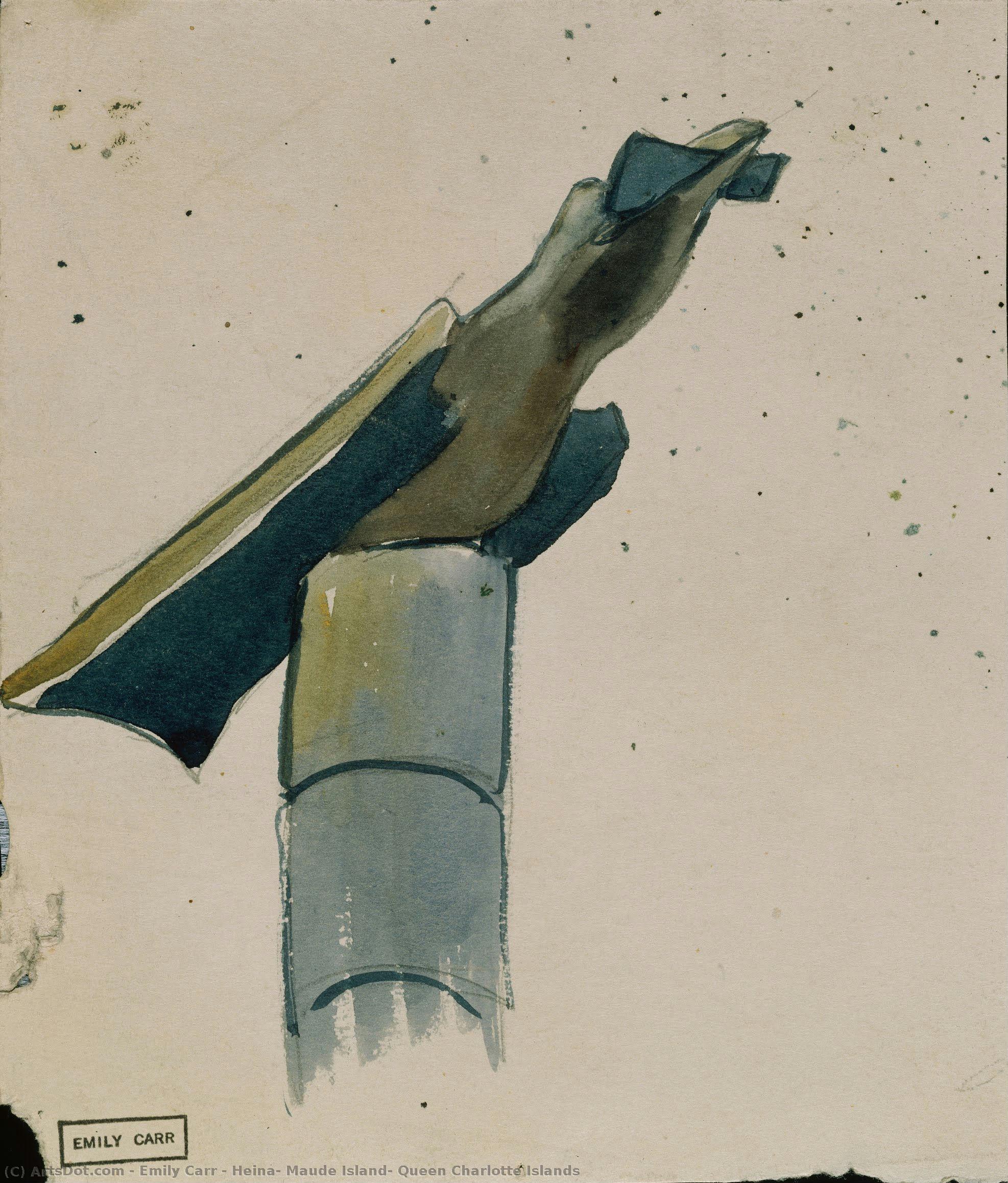
A Whisper of the Coast: Emily Carr’s “Heina, Maude Island”
Emily Carr's "Heina, Maude Island," painted in 1912, isn’t merely a depiction of a bird perched upon a weathered pole; it’s a profound meditation on solitude, resilience, and the enduring spirit of British Columbia’s Indigenous communities. This watercolor captures a fleeting moment along the rugged coastline of Haida Gwaii, specifically Maude Island, a place steeped in history and imbued with a quiet dignity that resonates deeply within the artwork. Carr, a pivotal figure in Canadian art, masterfully translated her observations into a style uniquely her own – one characterized by loose brushwork, vibrant color, and an intimate connection to the land and its people.
Composition and Technique: Embracing Impressionistic Fluidity
The composition immediately draws the eye upward, anchored by the stark verticality of the pole against the expansive, muted backdrop. Carr’s technique is deliberately impressionistic; she eschews precise detail in favor of capturing the *feeling* of the scene. The watercolor washes are applied with a remarkable fluidity, creating an atmospheric haze that softens the edges and suggests the dampness of the coastal air. Notice how the colors bleed into one another – blues and grays dominate, punctuated by subtle ochre highlights hinting at the weathered wood of the pole and the bird’s plumage. The artist employs a wet-on-wet technique, allowing the pigments to mingle and blend seamlessly, resulting in an almost ethereal quality. The slight perspective shift in the pole subtly draws the viewer into the scene, creating a sense of depth without resorting to rigid linear rules.
Symbolism: Echoes of Haida Culture and Enduring Strength
Beyond its aesthetic beauty, “Heina” is rich with symbolic meaning. The bird itself – identified as likely a raven or crow – is a frequent motif in Haida art and carries significant cultural weight. Ravens are often associated with intelligence, prophecy, and connection to the spirit world. The weathered pole, seemingly rooted firmly in the earth, speaks to resilience and endurance—a visual metaphor for the enduring strength of both the landscape and the Indigenous communities who have called it home for millennia. The island’s name, “Haina,” is a direct reference to this historical settlement, grounding the artwork within its specific context. Carr's deliberate choice to depict this quiet scene speaks volumes about her respect for the natural world and her desire to document a vanishing way of life.
Carr’s Vision: A Bridge Between Worlds
Emily Carr’s work is inextricably linked to her deep engagement with First Nations culture. She wasn't simply an observer; she sought to understand and represent their worldview, their connection to the land, and their artistic traditions. “Heina” exemplifies this approach – it’s not a photographic representation but rather a subjective interpretation filtered through Carr’s own unique sensibility. The painting invites contemplation, prompting us to consider our relationship with nature and the importance of preserving cultural heritage. It's a testament to Carr’s ability to capture the essence of a place and its people, transforming a simple observation into a powerful work of art that continues to resonate today.
Additional Research & Reproduction Details
- Artist: Emily Carr (1871-1945)
- Date: Unknown, likely circa 1912
- Medium: Watercolor on Paper
- Size: 16 x 19 cm
- Location: Royal BC Museum PDP2298
- Further Information: Royal BC Archives
ArtsDot offers high-quality reproductions of “Heina, Maude Island,” allowing you to bring this evocative piece into your home or office. Consider a custom size for optimal impact within your space.