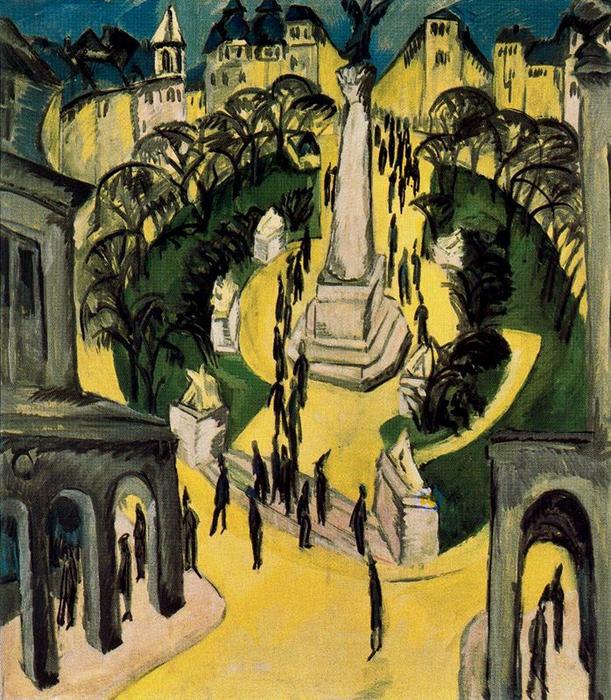
Belle-Alliance Platz, Berlin: A Dynamic Expressionist Vision
- Artist: Ernst Ludwig Kirchner
- Date: Unknown
- Style: German Expressionism
- Medium: Oil on Canvas (Assumed)
A Bustling Urban Scene in Bold Color
"Belle-Alliance Platz, Berlin," painted by Ernst Ludwig Kirchner, offers a captivating glimpse into the heart of early 20th-century urban life. The artwork depicts the bustling public square, Belle-Alliance Platz (now Bebelplatz) in Berlin, with its characteristic energy and dynamism. Rooted firmly within the German Expressionist movement, Kirchner eschews realistic representation in favor of conveying emotional intensity through distorted forms, bold colors, and a fragmented composition. The scene is populated by figures moving about their daily lives, set against a backdrop of towering buildings and a central monument that dominates the space. This isn't merely a depiction of a place; it’s an exploration of the psychological impact of urban existence.
Expressionist Technique and Visual Language
Kirchner’s technique is immediately recognizable as Expressionist. He employs thick, expressive lines rather than precise detailing, contributing to a sense of movement and tension throughout the canvas. The color palette—dominated by yellows, greens, and blues with touches of grey and brown—is far from naturalistic. Yellows in the foreground create a feeling of warmth and light, while greens are used extensively for foliage and buildings, and blues appear in the sky and architectural details. Shapes are simplified and abstracted; buildings become blocky forms, and figures are reduced to basic silhouettes. This simplification isn't about lacking skill; it’s a deliberate choice to amplify the emotional impact of the scene. Perspective is deliberately distorted, with buildings appearing tilted or skewed, creating a disorienting effect that reflects the anxieties of modern urban life. The layering of forms creates depth, though not in a conventional sense, as the monument appears closer than the buildings behind it, further contributing to the unsettling atmosphere.
Historical Context and the Rise of Expressionism
"Belle-Alliance Platz, Berlin" was created during a period of significant social and political upheaval in Germany. The early 20th century witnessed rapid industrialization, urbanization, and growing anxieties about modernity. Kirchner, along with his fellow artists in *Die Brücke* (The Bridge), sought to express these feelings through their art. *Die Brücke*, founded in Dresden in 1905, was a collective of young artists who rejected the traditional academic style and embraced a more subjective and emotionally charged approach to painting. They were influenced by post-impressionists like Van Gogh and Gauguin, but developed their own distinct visual language characterized by bold colors, distorted forms, and an emphasis on psychological expression. Kirchner’s work reflects this commitment to portraying the raw realities of modern life, capturing both its vibrancy and its alienation.
Emotional Impact and Symbolic Elements
The painting evokes a complex range of emotions—anxiety, tension, and perhaps even alienation. The chaotic composition, jarring colors, and distorted forms contribute to this emotional impact. The bustling crowd suggests the impersonal nature of urban life, where individuals are lost in the anonymity of the city. While seemingly depicting an everyday scene, Kirchner transforms it into a powerful commentary on the psychological toll of modern existence. The monument at the center could be interpreted as representing authority or tradition, standing amidst the swirling energy of the crowd, perhaps symbolizing the individual's struggle against societal forces. Ultimately, "Belle-Alliance Platz, Berlin" is not just a depiction of a place but an evocative exploration of the human condition in the face of rapid change and urban modernity.