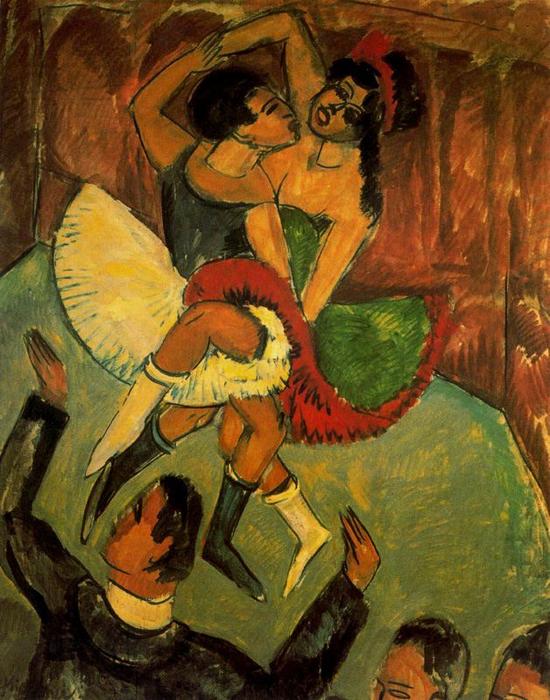
Dance of the Blacks by Ernst Ludwig Kirchner: A Descent into Emotional Intensity
Ernst Ludwig Kirchner’s “Dance of the Blacks” isn't merely a depiction of a cabaret scene; it’s a visceral plunge into the anxieties and restless energy that defined the early 20th century. Painted in 1918, during his time with Die Brücke – a group of German Expressionist artists seeking to shock and provoke – this work embodies the movement's core tenets: raw emotion, distorted form, and a deliberate rejection of academic realism. The painting immediately confronts the viewer with a dynamic chaos, a swirling vortex of figures bathed in unsettling colors that speak volumes about the artist’s inner turmoil.
- Subject Matter & Context: The scene unfolds within a dimly lit cabaret, a space rife with social alienation and fleeting pleasures. Kirchner was deeply concerned with the impact of industrialization and urbanization on the human psyche, themes frequently explored by Die Brücke. This painting captures not just a performance but the underlying sense of unease and disorientation felt in a rapidly changing world.
- Expressionist Style: “Dance of the Blacks” is a quintessential example of Expressionism. Kirchner employs deliberate distortions – elongated figures, flattened planes, and exaggerated gestures – to convey emotional intensity rather than objective representation. The angular lines contribute significantly to this sense of agitation and instability.
A Symphony of Color and Texture
Kirchner’s masterful use of color is central to the painting's impact. Dominated by warm, earthy tones – browns, oranges, and yellows – punctuated by jarring greens and reds, the palette isn’t intended for pleasant viewing; it’s designed to evoke a powerful emotional response. The thick application of paint, achieved through an impasto technique, adds a crucial layer of texture. Visible brushstrokes aren't accidental; they are deliberate marks that amplify the painting’s raw energy and sense of urgency. The cool greens used for the stage floor and parts of the dancers’ costumes provide a stark contrast to the warmer tones, further intensifying the visual drama.
Deconstructing Form: Perspective and Composition
Traditional perspective is entirely abandoned in “Dance of the Blacks.” Kirchner employs a flattened composition with a triangular arrangement, placing the dancers at its apex. This deliberate distortion creates a sense of unease and disorientation, mirroring the psychological state he sought to portray. The simplified forms of the onlookers – reduced to mere silhouettes – emphasize the isolation and detachment experienced within the crowded space. The overall effect is one of heightened emotion and a rejection of comfortable realism.
Symbolism and Emotional Resonance
Beyond its formal qualities, “Dance of the Blacks” is laden with symbolic meaning. The distorted figures can be interpreted as representations of anxieties surrounding modernity, social alienation, and the loss of traditional values. The dancers’ poses – a mixture of grace and vulnerability – suggest a precarious balance between pleasure and despair. The painting's unsettling atmosphere invites viewers to confront uncomfortable truths about human experience. It is a powerful testament to Kirchner’s ability to translate personal turmoil into a universally resonant work of art.