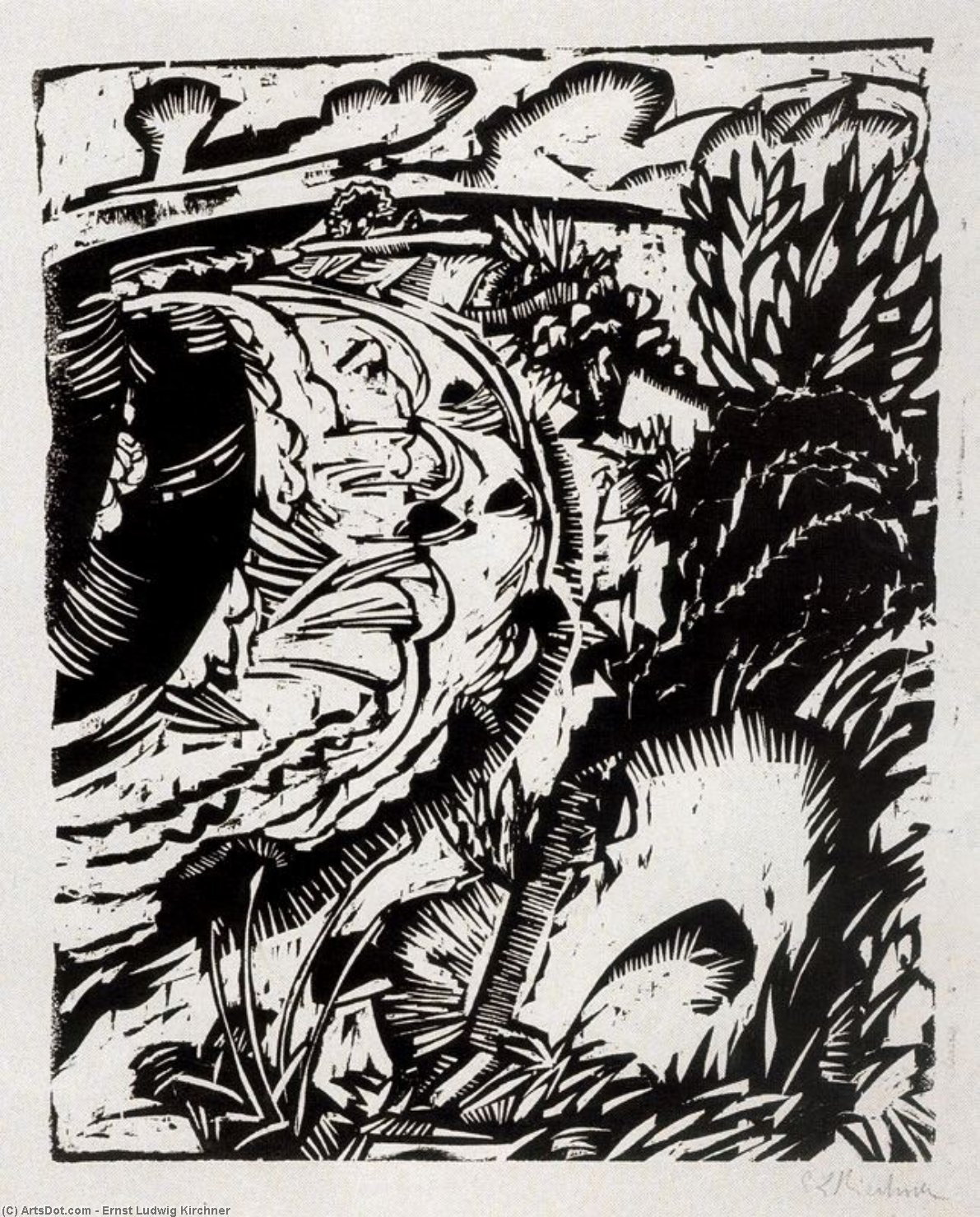
Experience Ernst Ludwig Kirchner’s dramatic Expressionist woodcut "Dunes Cove," a stark portrayal of isolation and unease through bold lines and monochrome contrasts – perfect for art lovers seeking powerful, emotive artwork.
Dunes Cove: A Descent into Expressionist Emotion
Ernst Ludwig Kirchner’s “Dunes Cove” is not merely a depiction of a coastal scene; it's an immersion into the turbulent heart of German Expressionism. Executed as a woodcut print, this stark and arresting image immediately confronts the viewer with a world stripped bare – a landscape reduced to its essential forms, imbued with a palpable sense of unease and isolation. The work’s power resides in its deliberate distortion, its rejection of naturalistic representation in favor of an intensely subjective emotional response. Kirchner, born in Aschaffenburg in 1880, was a pivotal figure in the Expressionist movement, driven by a desire to capture not what he *saw*, but what he *felt* – anxieties about modernity, alienation, and the psychological strain of a rapidly changing world.
Technique and Materials: The Language of Wood and Ink
- Woodcut Print: “Dunes Cove” exemplifies the meticulous process of woodcut printing. Kirchner began with a meticulously carved block of wood, each line representing an element within the composition. This relief technique demanded precision and control, resulting in bold, graphic shapes that define the scene.
- Monochromatic Palette: The deliberate use of black and white – achieved through varying densities of ink – amplifies the dramatic impact. The absence of color forces the viewer to focus entirely on form, line, and texture, intensifying the emotional resonance.
- Layered Hatching & Cross-Hatching: Kirchner masterfully employed hatching and cross-hatching to build up tonal values, creating a sense of depth and suggesting the roughness of the sand dunes and the solidity of the trees. This technique is crucial to understanding the work's textural quality.
A Distortion of Reality: Perspective and Symbolism
Kirchner’s artistic vision deliberately rejects traditional perspective, flattening space and distorting forms in a manner characteristic of Expressionist art. The figures wading in the water or sand are not rendered with anatomical accuracy; instead, they are elongated, stylized representations of human vulnerability within a hostile environment. This distortion isn't accidental; it serves to heighten emotional intensity and convey a sense of psychological unease. The sweeping curve of the dune acts as a visual metaphor for instability and perhaps even the overwhelming force of nature. The dense clouds overhead further contribute to this feeling of confinement and foreboding, suggesting a world shrouded in uncertainty.
Emotional Resonance: Isolation and Anxiety
“Dunes Cove” is profoundly evocative, communicating a powerful sense of isolation and anxiety – themes central to Kirchner’s oeuvre. The stark contrast between light and shadow, the simplified forms, and the deliberate distortion all contribute to this unsettling atmosphere. It's a scene that invites contemplation on the human condition, prompting questions about our place in the world and our relationship with nature. This artwork speaks to a deeper truth – the inherent loneliness of modern existence, amplified by the anxieties of a society undergoing rapid transformation.