Erich Zheckel: A Window into Kirchner's Soul
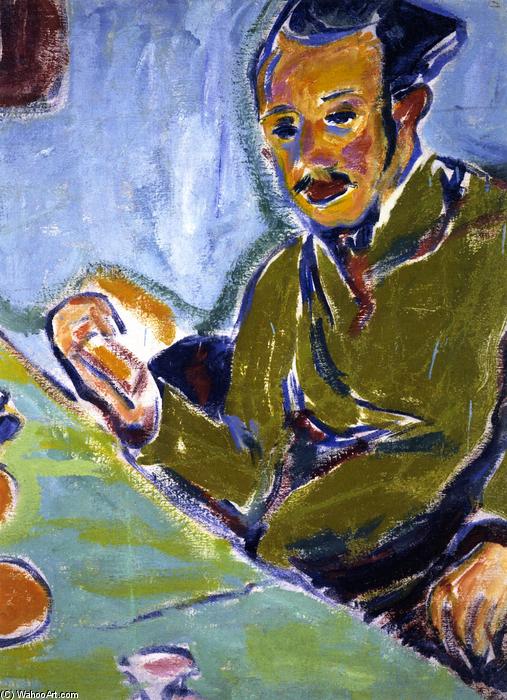
Ernst Ludwig Kirchner’s “Erich Zheckel,” painted in 1909, is more than just a portrait; it’s a visceral plunge into the heart of German Expressionism. This oil on panel work, measuring 84 x 61 cm and currently residing at the Bunder Kunstmuseum Chur, offers a compelling glimpse into Kirchner's unique vision – a world saturated with emotion, distorted forms, and a profound sense of unease. The painting immediately arrests the viewer with its bold color palette: vibrant greens, deep blues, assertive yellows, and flashes of red coalesce to create an atmosphere thick with tension and introspection. It’s a testament to Kirchner's mastery in manipulating color not merely for aesthetic effect, but as a direct conduit for expressing inner turmoil.
Subject and Composition
The subject is a man – Erich Zheckel himself – rendered with a deliberate lack of idealized beauty. He sits at a table, lost in contemplation, a spoon clutched in his hand as if mid-meal, his gaze fixed on the distance. The setting, likely a restaurant or dining room, adds to the sense of isolation and detachment. Kirchner’s compositional choices – the slightly skewed perspective, the disproportionate scale of certain elements – contribute to the painting's unsettling quality. It isn't a comfortable portrait; it’s an invitation to confront uncomfortable truths about human existence.
Expressionist Technique and Influences
"Erich Zheckel" exemplifies Kirchner’s signature Expressionistic style, heavily influenced by the Die Brücke group of which he was a founding member. The artist employs thick impasto strokes, building up layers of paint to create a textured surface that amplifies the emotional impact. The distorted forms and exaggerated features are hallmarks of this movement, rejecting traditional representational accuracy in favor of conveying subjective experience. Kirchner’s use of color is particularly striking, echoing the techniques explored by Paul Klee, another influential figure who championed color theory and its expressive potential. The painting's dynamism reflects a broader artistic landscape grappling with modernity and the anxieties of the early 20th century.
Symbolism and Emotional Resonance
Beyond its formal qualities, “Erich Zheckel” is laden with symbolic weight. The man’s solitary posture, his distant gaze, and the unfinished meal suggest a sense of alienation and perhaps even despair. The muted yet intense colors contribute to this feeling, creating an atmosphere that is both captivating and profoundly unsettling. Kirchner wasn't simply depicting a man; he was channeling a mood, a state of mind – a reflection of the anxieties and uncertainties prevalent in his time. This painting speaks to the fundamental human condition: loneliness, contemplation, and the search for meaning in a world increasingly defined by rapid change.
Own a Piece of History
Handmade oil painting reproductions of “Erich Zheckel” are now available at ArtsDot.com, offering art enthusiasts the opportunity to acquire a tangible connection to this seminal work of Expressionism. Bring Kirchner’s powerful vision into your home or office and experience the raw emotion and intellectual depth that have captivated audiences for over a century.