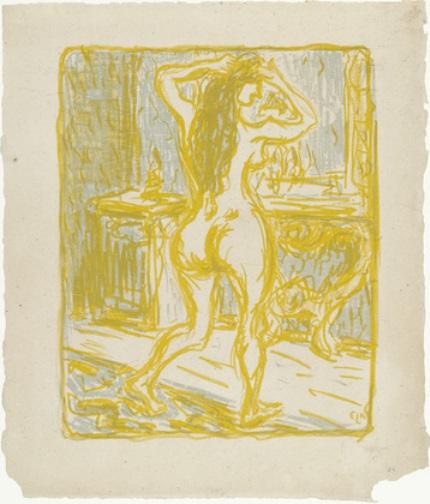
A Portrait of Inner Turmoil: Ernst Ludwig Kirchner's *Girl Before a Mirror*
Ernst Ludwig Kirchner’s Girl Before a Mirror (Mädchen vor Spiegel) is not merely a depiction of a young woman contemplating her reflection; it’s a visceral plunge into the anxieties and fragmented identities that defined the heart of German Expressionism. Completed around 1918, this lithograph or woodcut – a testament to Kirchner's mastery of line and color – captures a moment of profound introspection, rendered with an almost brutal honesty that continues to resonate powerfully today. The artwork’s raw energy stems directly from Kirchner’s personal experiences: his early life marked by instability and displacement, coupled with the turbulent social and political climate of Wilhelmine Germany, fueled a desire to express not just what he *saw*, but how he *felt*.
- A Symphony of Discordant Lines: Kirchner’s technique is immediately arresting. Bold, jagged lines dominate the composition, eschewing the smooth curves and delicate shading favored by earlier artistic movements. Hatching – a meticulous layering of parallel lines – builds up form and texture, creating a palpable sense of roughness and unease. This deliberate distortion isn't an accident; it’s a conscious rejection of academic realism in favor of conveying emotional intensity directly to the viewer.
- Yellow and Blue: A Palette of Emotion: The color palette is deliberately jarring, dominated by intense yellows and blues. The yellow outlines the figure and key objects with an almost feverish glow, suggesting both vulnerability and a desperate attempt to assert control. The blue, used in the background and reflections, adds a layer of melancholy and disorientation. This combination evokes a sense of psychological tension, mirroring the subject’s internal struggle.
- Symbolism Within Distortion: The distorted reflection itself is arguably the most significant element of the work. It's not a faithful representation of the girl; instead, it’s a fractured image, hinting at a fragmented sense of self – a common theme in Expressionist art. Some scholars interpret this as a commentary on the anxieties surrounding identity and modernity during a period of rapid social change.
The Roots of Expressionism: Kirchner's Context
Kirchner’s artistic journey was deeply rooted in the intellectual and cultural currents of his time. He initially studied architecture, influenced by the rationalism of the Bauhaus movement, but quickly abandoned this path for painting, drawn to the radical ideas of Vincent van Gogh and Paul Gauguin. His early work, often depicting urban scenes and portraits, gradually evolved towards a more intensely expressive style, reflecting the growing sense of alienation and disillusionment prevalent in German society at the turn of the 20th century. The rise of industrialization, coupled with political instability, created an atmosphere of anxiety that found its way onto the canvas through Kirchner’s emotionally charged brushstrokes.
- Influence of Dürer and Beyond: While Kirchner admired the technical skill of Albrecht Dürer, he ultimately sought to transcend mere imitation. He was influenced by a broader range of artists, including Cézanne and Seurat, incorporating elements of pointillism into his work while retaining a distinctly Expressionist sensibility.
- Frankfurt’s Artistic Hub: Kirchner spent much of his formative years in Frankfurt am Main, where he formed close artistic relationships with other key figures of the German Expressionist movement, including George Grosz and Max Pechstein. This environment fostered experimentation and encouraged artists to challenge conventional norms.
Technique and Materials: A Window into Kirchner’s Process
The creation of Girl Before a Mirror exemplifies Kirchner's meticulous approach to printmaking. The artwork was likely created using a lithographic stone or woodblock, a technique that allowed for the precise execution of his bold lines and intricate hatching. The visible texture – achieved through multiple layers of ink and careful manipulation of the printing process – adds another dimension to the work’s expressive power. Kirchner's use of layering and overlapping lines demonstrates a sophisticated understanding of printmaking techniques, allowing him to build up form and create a sense of depth despite the flattened perspective characteristic of Expressionism.
- Lithographic Stone or Woodblock: The artwork’s surface reveals the marks of its creation – evidence of the stone or woodblock used in the printing process.
- Ink and Paper: Kirchner employed a range of inks, carefully chosen to achieve the desired color effects. The paper itself played an important role, contributing to the overall texture and visual impact of the work.
Collecting the Echoes of Expressionism
A hand-painted reproduction of Girl Before a Mirror offers a remarkable opportunity to own a piece of art history – a tangible connection to one of the most influential movements in modern art. Whether displayed as a striking focal point within a contemporary interior or studied for its historical significance, this artwork continues to captivate and challenge viewers with its raw emotional power and enduring relevance. ArtsDot offers meticulously crafted reproductions that faithfully capture Kirchner’s vision, allowing you to experience the intensity of his artistic expression firsthand.