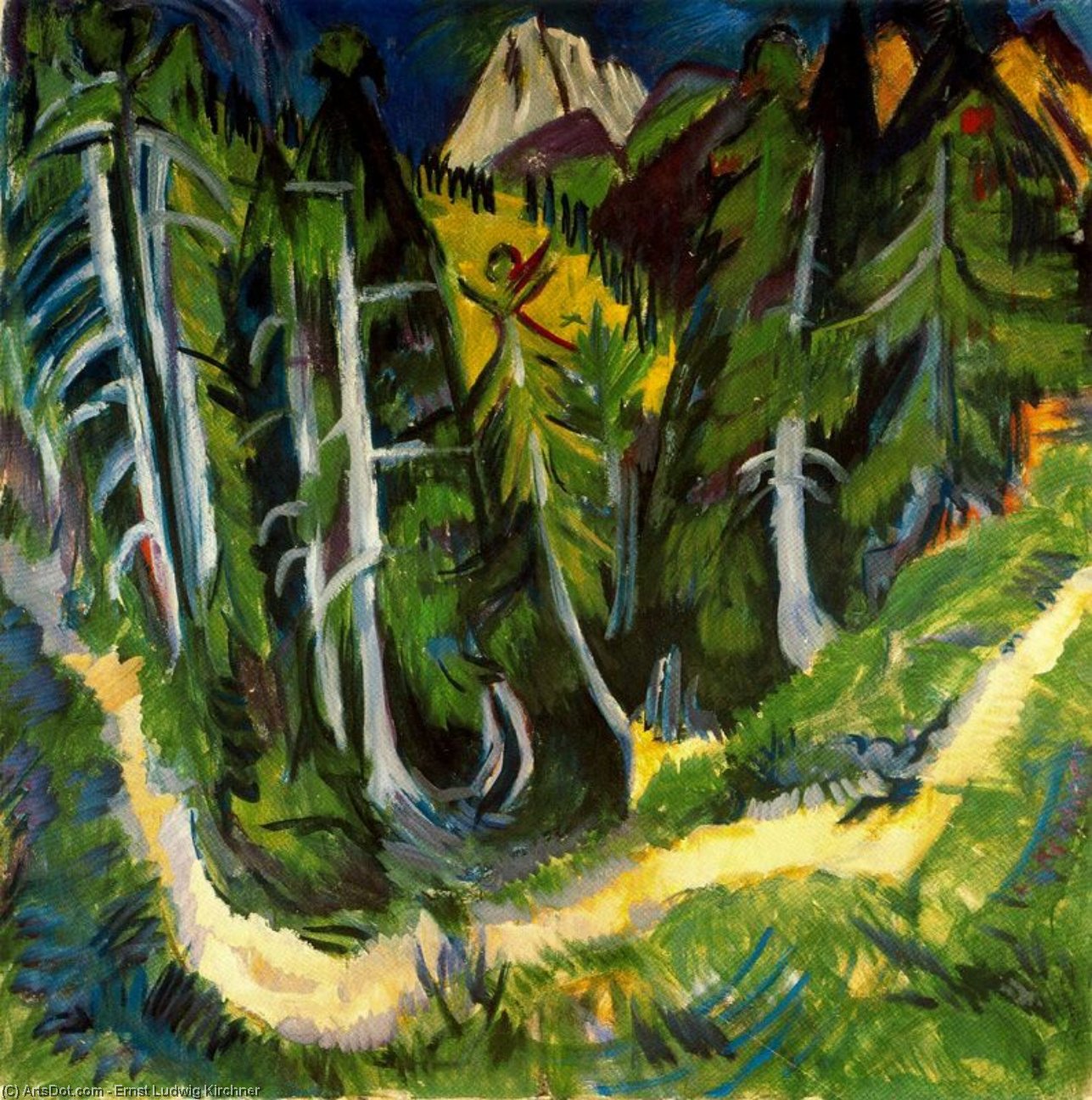
Gola nel bosco di Stafel

Experience Ernst Ludwig Kirchner's expressive 'Gola nel bosco di Stafel,' a vibrant Expressionist landscape painting dominated by bold colors and distorted forms depicting a forest path to distant mountains, perfect for art lovers.


Ernst Ludwig Kirchner (1880 - 1938)

Ernst Ludwig Kirchner (1880-1938): A leading German Expressionist & Die Brücke founder. Explore his bold, emotive paintings of urban life, nudes, and landscapes – a powerful voice of early 20th-century art.

Gola nel bosco di Stafel: A Window into Kirchner's Soul

  • Ernst Ludwig Kirchner’s ‘Gola nel bosco di Stafel,’ a vibrant landscape painting from around 1910, offers a profound glimpse into the heart of German Expressionism. This isn’t merely a depiction of a forest; it's an intensely felt experience rendered in bold strokes and emotionally charged colors. The scene – a winding path leading towards imposing mountains beneath a subtly overcast sky – immediately draws the viewer into its unsettling beauty. Kirchner, deeply influenced by the anxieties of his time and a rejection of academic realism, sought to convey not what he *saw*, but what he *felt* about the world around him.
  • The painting’s power resides in its deliberate distortion. Forms are simplified, colors amplified, and lines aggressively applied, creating an atmosphere of unease and psychological intensity. This was a conscious departure from the naturalism favored by many artists of the period, reflecting a broader artistic movement grappling with the rapid changes and social tensions of early 20th-century Europe.

Technique and Materiality: The Language of Impasto

  • Kirchner’s technique is immediately recognizable – a masterful use of impasto, where thick layers of oil paint are applied directly to the canvas with visible brushstrokes. This creates a tactile surface, almost sculptural in its texture, inviting close inspection and emphasizing the artist's physical engagement with the work. The rough, uneven finish isn’t accidental; it’s integral to the painting’s expressive force.
  • The color palette – dominated by greens and blues punctuated by yellows and whites – is far from harmonious in a traditional sense. Instead, Kirchner employs contrasting hues to heighten emotional impact. The cool blues of the sky and shadows are juxtaposed with warmer tones of the path and foliage, creating a visual tension that mirrors the underlying psychological state of the scene. The strategic use of yellow, particularly highlighting the path, directs the viewer's gaze and adds a crucial element of dynamism.

Symbolism and Interpretation: A Journey Within

  • ‘Gola nel bosco di Stafel’ is rich in symbolic potential. The winding path, the central motif, can be interpreted as a metaphor for life's journey – a challenging, uncertain route towards an unknown destination. The imposing mountains represent obstacles and perhaps even the unattainable, while the dense foliage could symbolize the complexities and anxieties of human existence. Kirchner’s work often reflects his own personal struggles with isolation and mental instability, themes prevalent in Expressionist art.
  • The painting's lack of precise detail isn't a flaw; it’s a deliberate choice that forces the viewer to actively participate in constructing meaning. There are no easy answers here – instead, Kirchner invites us to confront our own anxieties and uncertainties about the world around us.

Historical Context: The Rise of Expressionism

  • Created during a period of immense social and political upheaval in Germany, ‘Gola nel bosco di Stafel’ reflects the broader anxieties of the era. Kirchner was part of a group of artists who rejected the prevailing artistic conventions of the time, seeking instead to express their subjective experiences through intensely emotional imagery. The Expressionist movement emerged as a reaction against both the perceived superficiality of Impressionism and the increasingly rigid rules of academic art.
  • Kirchner’s work aligns with the broader trajectory of German Expressionism, which sought to explore themes of alienation, isolation, and psychological distress. His paintings are powerful testaments to the human condition in a rapidly changing world – a world grappling with industrialization, urbanization, and the looming threat of war.