Ernst Ludwig Kirchner (1880-1938): A leading German Expressionist & Die Brücke founder. Explore his bold, emotive paintings of urban life, nudes, and landscapes – a powerful voice of early 20th-century art.
Hafen Burgstaaken, Fehmarn – A Vision of Urban Anxiety
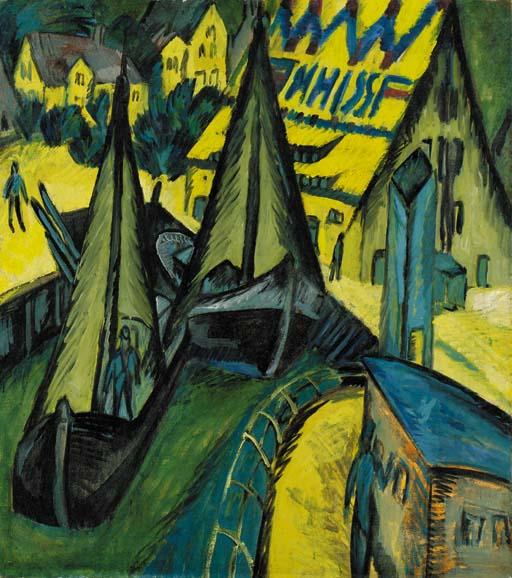
The artwork “Hafen Burgstaaken, Fehmarn” by Ernst Ludwig Kirchner stands as a cornerstone of Expressionist painting, capturing not merely a harbor scene but an intensely felt emotional response to the environment. Painted in 1913 during Kirchner’s third visit to the Baltic island of Fehmarn—a location he considered vital for fostering his artistic ideals—the canvas embodies the stylistic hallmarks of Die Brücke group, reflecting their preoccupation with portraying subjective experience rather than objective reality. It's a piece that compels viewers to confront unsettling truths about modern life and the human condition.
Composition and Technique: Flattened Space and Dynamic Brushstrokes
Kirchner’s masterful technique—characterized by loose, expressive brushstrokes—immediately establishes a sense of unease. The composition abandons traditional perspective, opting for a flattened effect that intensifies the visual impact. Buildings cluster on the right side, rendered as angular masses devoid of subtlety, while tall sailboats dominate the foreground, their triangular sails sharply contrasting against the muted backdrop. A low wall serves as an impassive barrier, furthering the feeling of confinement and disrupting any illusion of depth. These deliberate choices underscore Kirchner’s rejection of academic conventions and his commitment to conveying raw emotion through visual form. The impasto technique—thickly applied paint—adds a tactile quality to the canvas, mirroring the turbulent energy of the depicted harbor.
Color Palette: Emotion Over Representation
The color palette is deliberately subdued yet powerfully expressive. Greens dominate the boats and surrounding landscape, juxtaposed against yellows in the buildings and sky – hues that convey warmth but also hint at artificial illumination. Blues appear in shadows and outlines, contributing to a melancholic atmosphere. Kirchner eschews naturalistic coloration, prioritizing emotional resonance over accurate depiction. The strategic use of color reinforces the painting’s thematic concerns: isolation, anxiety, and the pervasive influence of urban life—themes central to Kirchner's artistic vision.
Symbolism and Emotional Impact: Reflections of Existential Angst
“Hafen Burgstaaken, Fehmarn” transcends its subject matter as a harbor scene; it functions as a conduit for profound psychological exploration. The distorted forms and jarring colors evoke feelings of alienation and disorientation—mirroring the anxieties prevalent in Germany during this period. Kirchner’s depiction of the harbor embodies the existential angst characteristic of Expressionism, reflecting a disillusionment with societal norms and an awareness of human vulnerability. The sailboat's triangular sail symbolizes ambition and aspiration against the backdrop of a bleak landscape, highlighting the tension between hope and despair.
Historical Context: Die Brücke and the Expressionist Movement
Kirchner’s painting is inextricably linked to the broader context of Die Brücke (The Bridge), a German Expressionist group founded in Dresden in 1905. Members of Die Brücke sought to liberate art from academic constraints, prioritizing emotional intensity and subjective experience over objective representation. Kirchner's exploration of themes like urban decay, psychological torment, and the confrontation with nature aligns perfectly with the movement’s core tenets—a testament to his enduring influence on twentieth-century art history. The painting serves as a poignant reminder of the anxieties and uncertainties that shaped the era in which it was created.