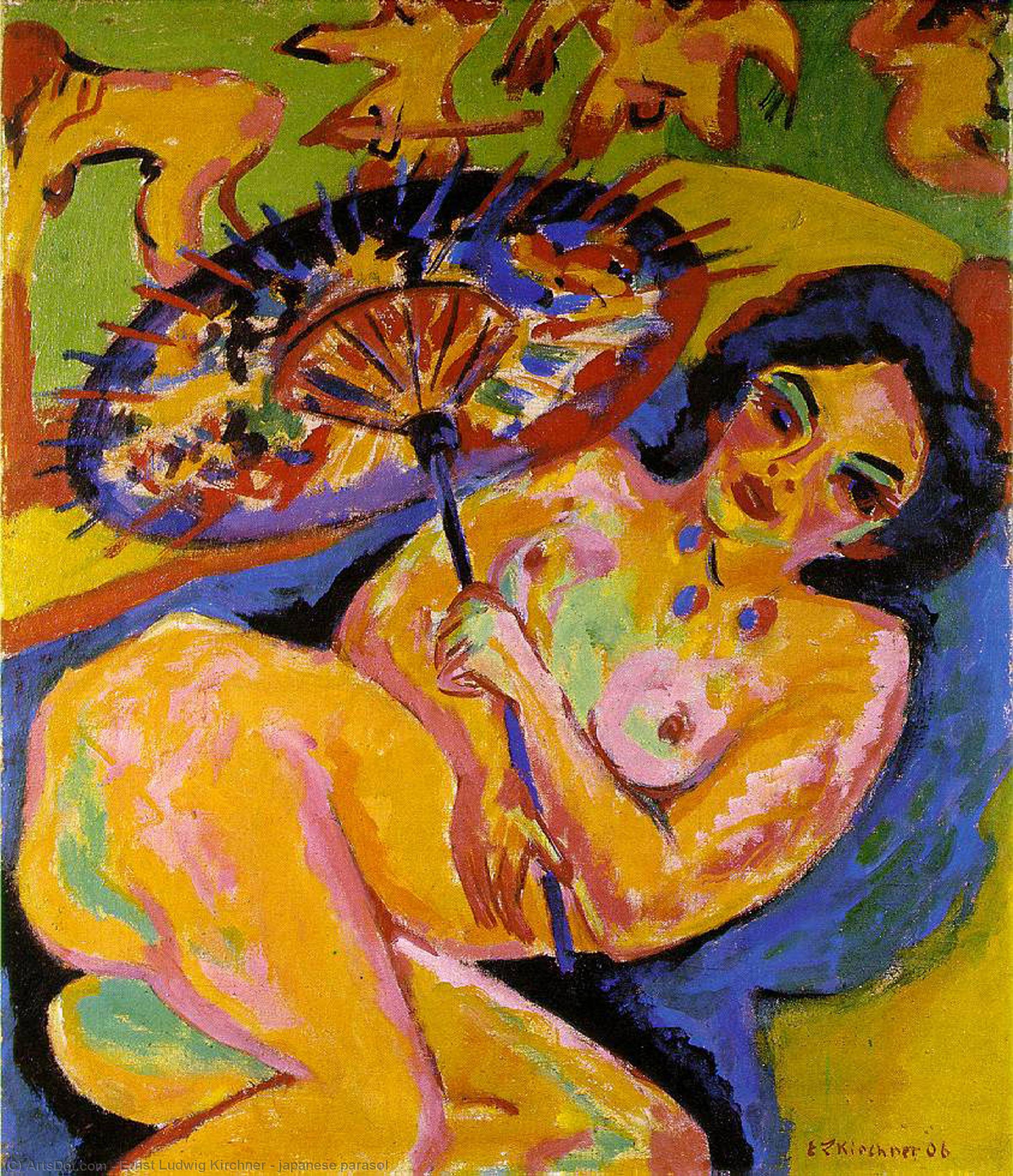
Experience the raw emotion of Ernst Ludwig Kirchner's 'Japanese Parasol,' a vibrant Expressionist painting featuring a woman and bold brushstrokes. This iconic 1909 artwork captures anxiety and fascination with non-Western culture – discover or own this masterpiece.
The Enigmatic Beauty of Kirchner's Japanese Parasol
Ernst Ludwig Kirchner’s “Japanese Parasol,” painted in 1909, isn’t merely a depiction of a woman shielding herself from the sun; it’s a visceral plunge into the heart of Expressionism. This artwork, brimming with vibrant color and unsettlingly distorted forms, captures a moment suspended between fascination and anxiety – a hallmark of Kirchner's artistic vision and the burgeoning anxieties of early 20th-century Europe. The painting immediately draws the eye to the central figure, a woman reclining on the ground, her posture both vulnerable and defiant as she holds a Japanese parasol before her face. This seemingly simple scene is layered with complex symbolism, reflecting Kirchner’s deep engagement with non-Western cultures – a fascination that was simultaneously admiring and critical.
- A Masterstroke of Expressionism: Kirchner, a founding member of the Die Brücke group, relentlessly pursued an artistic language defined by raw emotion. “Japanese Parasol” exemplifies this perfectly, showcasing his signature use of bold, clashing colors – reds, blues, and yellows – applied with agitated, almost violent brushstrokes.
- Distortion as Emotion: The woman’s form is deliberately distorted, her features elongated and exaggerated, contributing to the painting's overall sense of unease. This distortion isn't a stylistic flourish; it’s a deliberate attempt to convey psychological tension and emotional turmoil – a core tenet of Expressionist philosophy.
- The Parasol as Symbol: The Japanese parasol itself holds multiple layers of meaning. It represents not just protection from the sun, but also a connection to an exotic, “primitive” culture that was both alluring and unsettling for Kirchner and his contemporaries. This fascination with non-Western cultures was common at the time, yet Kirchner’s portrayal avoids simple romanticization, instead hinting at a deeper, perhaps uncomfortable, awareness of cultural difference.
Technique and Composition: A Study in Contrast
Kirchner's technique is characterized by an almost frenetic energy. He employed loose, gestural brushstrokes that create a sense of movement and instability within the composition. The background is deliberately ambiguous, offering no clear spatial cues and further intensifying the feeling of disorientation. This stark contrast between the sharply delineated figure and the blurred background is crucial to the painting’s impact – it forces the viewer to confront the emotional intensity of the scene directly. The use of color isn't about realistic representation; it’s about conveying mood and psychological state. The cool blues and greens of the surrounding environment are juxtaposed with the fiery reds and yellows of the woman’s dress, creating a visual tension that mirrors the emotional turmoil within the painting.
Historical Context: A World in Transition
“Japanese Parasol” was created during a period of immense social and political upheaval. Germany at the turn of the 20th century was undergoing rapid industrialization, urbanization, and modernization – processes that were simultaneously exciting and deeply unsettling. Kirchner’s art reflects this anxiety, capturing the sense of alienation and disorientation felt by many individuals in a rapidly changing world. The painting's interest in non-Western cultures also speaks to broader European anxieties about cultural identity and the perceived threat posed by foreign influences. Kirchner was part of a generation grappling with modernity, and his work serves as a powerful visual record of these struggles.
Owning a Piece of Expressionist History
Handmade oil painting reproductions of “Japanese Parasol” are now available on ArtsDot.com, offering art lovers the opportunity to experience the raw power and emotional intensity of Kirchner’s masterpiece in their own homes. These meticulously crafted reproductions capture not only the visual details but also the spirit and energy of the original artwork. A testament to Kirchner's legacy, the Kunstsammlung Nordrhein-Westfalen museum in Düsseldorf, Germany, houses the original painting – a cornerstone of Expressionist art history.