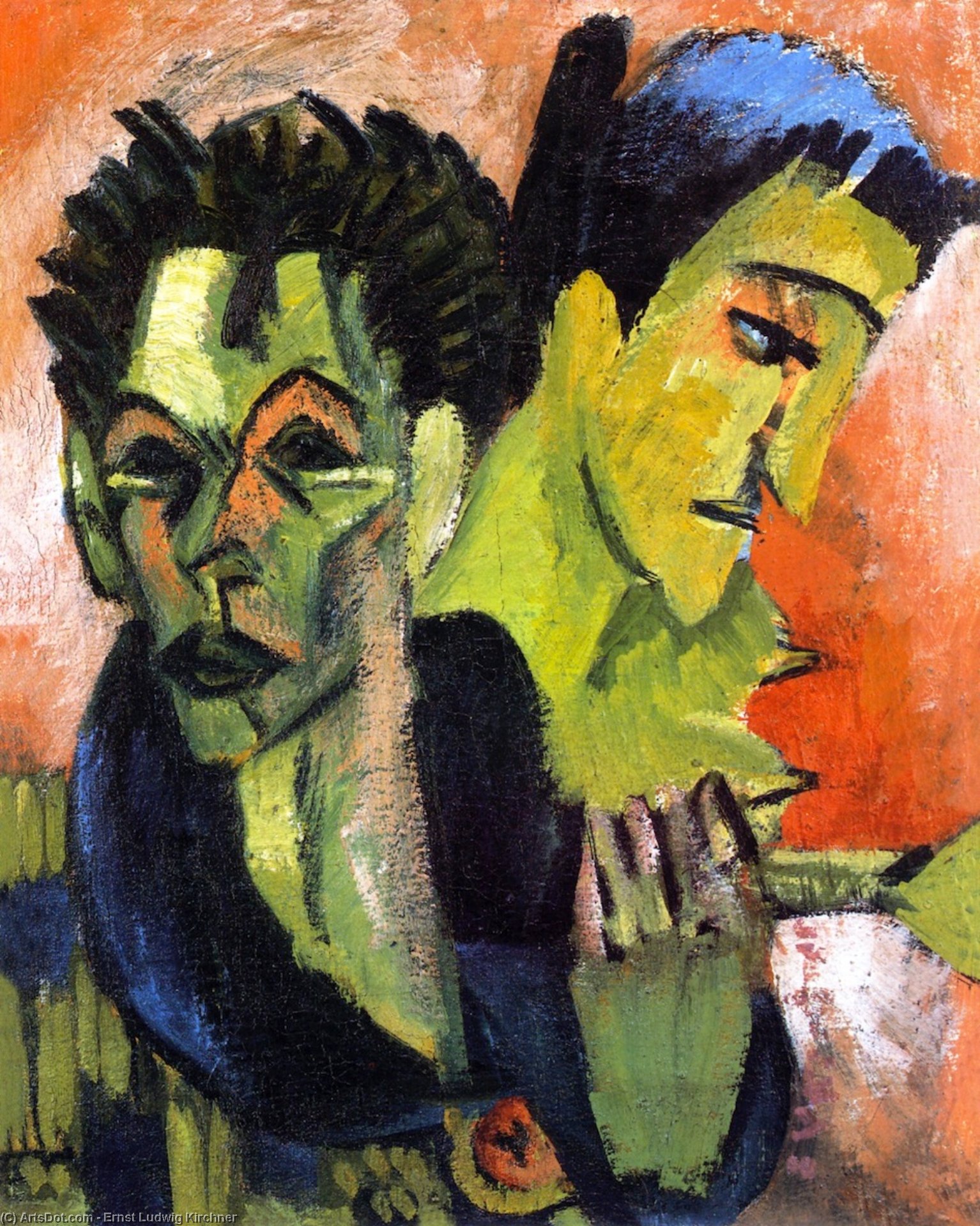
Ernst Ludwig Kirchner’s haunting ‘Self-Portrait, Double Portrait,’ painted in 1914 during the Expressionist movement, captures intense emotion through vibrant greens and blues alongside a man's brooding gaze. Explore this iconic piece and its legacy at Staatliche Museen zu Berlin.
A Window Into Emotion: Exploring Ernst Ludwig Kirchner’s ‘Self-Portrait, Double Portrait’
Kirchner's 'Self-Portrait, Double Portrait', painted in 1914, stands as a cornerstone of Expressionist art—a testament to the movement’s preoccupation with psychological depth and visceral emotion. Executed on canvas measuring 60 x 49 cm at the Staatliche Museen zu Berlin, this artwork transcends mere representation; it delves into the artist's inner landscape, mirroring anxieties prevalent during the tumultuous years preceding World War I. The painting immediately captivates with its bold chromatic palette—dominantly greens, blues, and reds—a deliberate choice designed to amplify the emotional intensity of the scene. Kirchner’s signature style is evident in his distorted forms and expressive brushstrokes, rejecting academic precision for a raw immediacy that captures the essence of human experience.
- Style & Technique: Kirchner's Expressionist approach prioritized conveying feeling over factual accuracy. Thick impasto—heavy application of paint—creates textural surfaces that vibrate with energy, emphasizing the artist’s emotional state. The use of color is not merely decorative; it serves as a conduit for psychological projection, mirroring anxieties and uncertainties.
- Composition & Symbolism: Two male faces dominate the canvas, positioned symmetrically on either side. Their gaze directs outwards, hinting at contemplation and perhaps alienation—a common theme in Kirchner’s oeuvre reflecting the pervasive sense of unease felt by artists grappling with societal shifts. The intense expressions conveyed by each figure – one brooding, one confrontational – symbolize internal struggles and unresolved tensions.
- Historical Context: Created during a period marked by significant social upheaval and artistic experimentation, ‘Self-Portrait, Double Portrait’ embodies the spirit of Die Brücke—a group dedicated to challenging artistic conventions and exploring darker psychological themes. Kirchner's involvement in the military service foreshadowed his personal breakdown and subsequent discharge, experiences that undoubtedly informed his artistic vision.
- Emotional Impact: The painting evokes a profound sense of melancholy and introspection. Its unsettling color scheme and distorted figures compel viewers to confront uncomfortable truths about human vulnerability and isolation. Kirchner’s masterful manipulation of pigment and form achieves an unparalleled level of emotional resonance, cementing its place as a seminal work within Expressionist art.
Kirchner's artistic legacy extends beyond ‘Self-Portrait, Double Portrait,’ encompassing other notable pieces like ‘Self Portrait with Cat’ and ‘Potsdammer Platz.’ These works further solidify his reputation as an innovator who dared to explore the complexities of human emotion through a uniquely expressive visual language. For interior designers seeking inspiration or collectors desiring a stunning reproduction, Kirchner's art offers a powerful connection to the anxieties and artistic fervor of its time—a reminder that true beauty resides not in flawless imitation but in honest emotional portrayal.