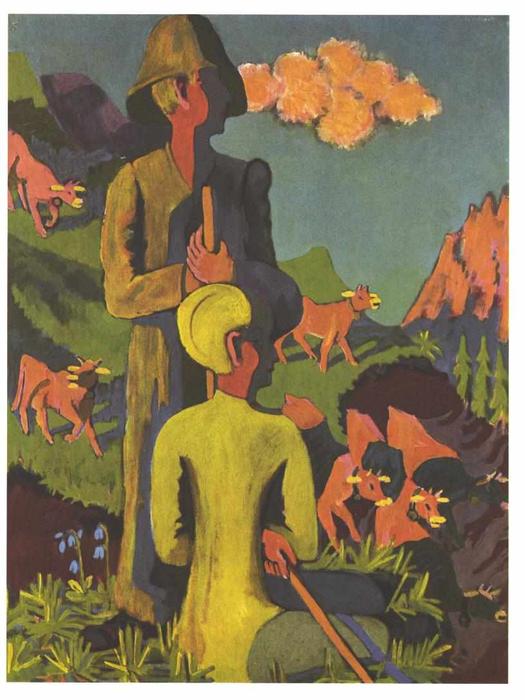
Experience the evocative power of Kirchner's 'Shepherd in the Evening.' This Expressionist masterpiece captures rural life with bold colors and striking forms. Explore German modernism!
Ernst Ludwig Kirchner (1880-1938): A leading German Expressionist & Die Brücke founder. Explore his bold, emotive paintings of urban life, nudes, and landscapes – a powerful voice of early 20th-century art.
A Pastoral Vision: Ernst Ludwig Kirchner's "Shepherd in the Evening"
This evocative artwork by Ernst Ludwig Kirchner transports viewers to a serene yet dramatic rural landscape. Depicting a shepherd tending his flock against a backdrop of imposing mountains and a vibrant sky, “Shepherd in the Evening” exemplifies Kirchner’s distinctive style within the German Expressionist movement. The scene is not merely representational; it's an emotionally charged interpretation of pastoral life, filtered through the lens of early 20th-century anxieties and artistic innovation.
Style and Technique: Echoes of Expressionism and Fauvism
Kirchner’s approach blends elements of Expressionism and Fauvism, evident in his bold use of color and simplified forms. The composition is vertically oriented, emphasizing the grandeur of the mountainous terrain. Geometric shapes dominate – rectangular clothing, rounded faces, and angular buildings—creating a somewhat flattened perspective that prioritizes emotional impact over realistic depiction. Notice how lines are used not just to define outlines but also to create texture and movement within the scene. The visible brushstrokes, characteristic of oil paint on canvas, add depth and dynamism. The color palette is far from naturalistic; instead, it’s employed expressively – the bright yellow-orange sky contrasts sharply with the darker tones of the foreground vegetation and figures, amplifying the emotional intensity of the moment.
Historical Context: Die Brücke and Modern Life
“Shepherd in the Evening” was created during a period of significant social and artistic upheaval in Germany. Kirchner was a founding member of *Die Brücke* ("The Bridge"), an artist collective formed in 1905 that sought to bridge the gap between traditional art and modern life. Rejecting academic conventions, *Die Brücke* artists embraced bold colors, distorted forms, and emotionally raw subject matter to reflect the anxieties and uncertainties of a rapidly changing world. This work reflects this ethos; while depicting a seemingly timeless pastoral scene, it also carries undertones of alienation and the search for stability in an increasingly industrialized society. The simplified figures and stylized landscape can be interpreted as a response to the impersonal nature of modern urban life, seeking solace and connection with nature.
Symbolism and Emotional Impact
Beyond its aesthetic qualities, “Shepherd in the Evening” is rich in symbolic meaning. The shepherd himself represents tradition, livelihood, and perhaps even a sense of responsibility. His flock symbolizes sustenance and community. The towering mountains evoke both challenge and stability—a visual metaphor for the enduring power of nature against the backdrop of human endeavors. The dramatic sky adds to the overall emotional intensity, suggesting a moment of transition or reflection. Ultimately, Kirchner’s work invites viewers to contemplate themes of humanity's relationship with nature, the passage of time, and the search for meaning in a modern world. It evokes a sense of quiet contemplation tinged with melancholy, capturing a fleeting moment of beauty amidst an uncertain landscape.