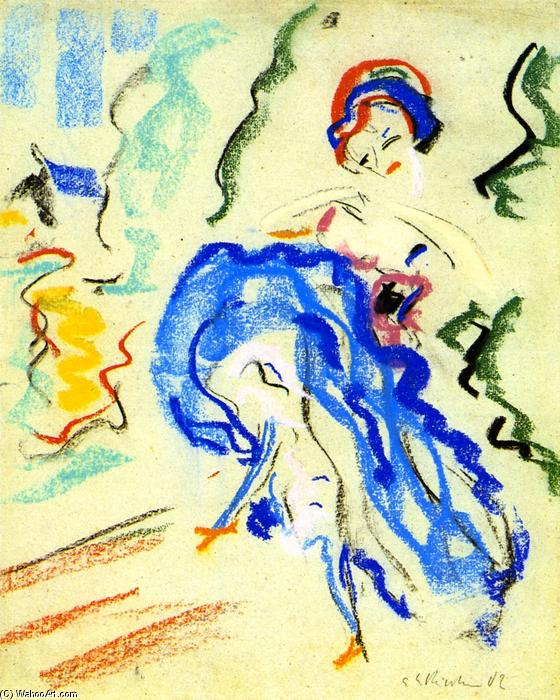
Experience the vibrant energy of Expressionism through Ernst Ludwig Kirchner’s ‘Tänzerin mit blauem Rock,’ a captivating portrait capturing movement and emotion with bold colors against a textured cityscape backdrop – discover this iconic masterpiece.
Ernst Ludwig Kirchner (1880-1938): A leading German Expressionist & Die Brücke founder. Explore his bold, emotive paintings of urban life, nudes, and landscapes – a powerful voice of early 20th-century art.
A Dance Frozen in Time: Exploring Ernst Ludwig Kirchner’s Tänzerin mit blauem Rock
The painting “Tänzerin mit blauem Rock” (Dancer with Blue Dress) by Ernst Ludwig Kirchner stands as a cornerstone of German Expressionism, capturing not merely an image but an emotion—the restless energy and fleeting joy of movement itself. Created in 1908, this artwork transcends simple representation; it’s a visceral distillation of Kirchner's distinctive vision for portraying the human condition amidst societal upheaval.
The Artist’s Vision: Expressionist Style and Technique
Kirchner’s artistic approach was fundamentally rooted in Expressionism, rejecting the idealized beauty championed by Impressionists and Academic painters. Instead, he sought to convey inner feelings—fear, anxiety, alienation—through bold distortions of form and color. “Tänzerin mit blauem Rock” exemplifies this technique brilliantly. Kirchner employs thick impasto – applying paint thickly onto the canvas – creating a textured surface that pulsates with energy. The dominant hues are jarringly vibrant: searing yellows and oranges clash against deep blues and greens, mirroring the dynamism of the dancer’s movement and injecting an unsettling tension into the composition. Lines are angular and fractured, conveying instability and disrupting any sense of serene harmony. This deliberate disregard for conventional aesthetics underscores Kirchner's commitment to expressing psychological truths rather than merely depicting external reality.
Historical Context: Weimar Republic Anxiety
The painting emerged during the turbulent Weimar Republic (1918-1933), a period marked by economic instability, political polarization, and profound social anxieties following World War I. Kirchner’s artistic output reflects this pervasive sense of unease. The dancer herself embodies a figure caught between freedom and constraint—a woman striving to escape the pressures of societal expectations while simultaneously acknowledging their inescapable influence. The building in the background serves as a visual reminder of the rigid structures that confine human experience, contrasting sharply with the dancer’s spirited movement. Kirchner wasn't attempting to celebrate triumph; he was confronting the darker side of existence – loneliness and disillusionment—themes prevalent throughout Expressionist art.
Symbolism Within the Frame
Beyond its stylistic brilliance, “Tänzerin mit blauem Rock” is laden with symbolic significance. The blue dress itself isn’t merely a garment; it represents both beauty and vulnerability. Its color evokes feelings of melancholy and introspection, hinting at the dancer's inner turmoil. Furthermore, Kirchner’s masterful use of perspective creates an illusionistic space that feels simultaneously claustrophobic and expansive—a metaphor for the human psyche grappling with conflicting impulses. The presence of two figures flanking the dancer adds to this complexity, suggesting a dialogue between individual experience and social context. They represent observers, perhaps judgmental or indifferent, highlighting the isolation inherent in artistic expression.
Emotional Resonance: Capturing Transient Joy
Ultimately, “Tänzerin mit blauem Rock” succeeds in capturing a fleeting moment of joy—the exhilaration of dance—but tempered by an underlying sense of melancholy. Kirchner doesn’t offer comfort; he confronts us with the uncomfortable truth that beauty and freedom coexist alongside fear and anxiety. The painting compels viewers to contemplate their own relationship to movement, emotion, and the complexities of human existence. It remains a powerful testament to Kirchner's ability to transform visual experience into profound psychological insight—a legacy that continues to inspire artists and collectors alike.