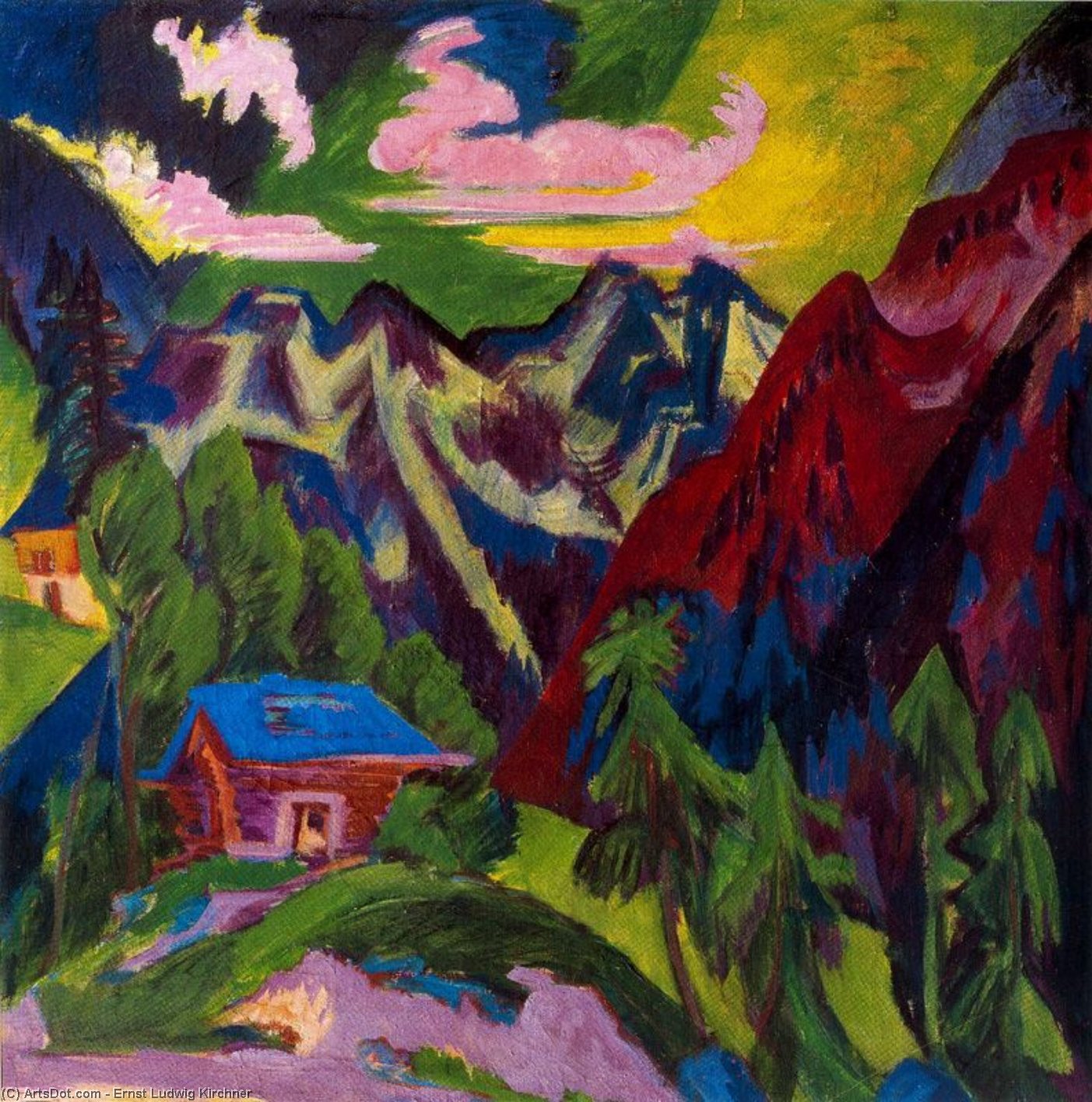
This painting, titled "The Klosters mountain," exemplifies Ernst Ludwig Kirchner's signature style within German Expressionism. Created around 1912, it depicts a serene yet subtly unsettling Alpine panorama featuring two houses nestled amongst towering mountains under a cloudy sky. Kirchner’s masterful use of color – reds, blues, greens, and yellows – conveys both grandeur and unease, reflecting t
Ernst Ludwig Kirchner (1880-1938): A leading German Expressionist & Die Brücke founder. Explore his bold, emotive paintings of urban life, nudes, and landscapes – a powerful voice of early 20th-century art.
A Window Into Alpine Angst: Exploring Ernst Ludwig Kirchner’s “The Klosters Mountain”
Ernst Ludwig Kirchner's "The Klosters Mountain" isn’t merely a depiction of the Swiss Alps; it’s a visceral embodiment of the anxieties simmering beneath the surface of early 20th-century German Expressionism. Painted circa 1913, this landscape masterpiece captures a moment frozen in time—a stark contrast to the turbulent social and intellectual currents reshaping Europe during that era. Kirchner, along with fellow artists Fritz Bleyl and Karl Schmidt-Rottluff, formed Die Brücke ("The Bridge"), a collective dedicated to rejecting academic conventions and forging a new visual language rooted in emotion and psychological intensity. This painting exemplifies their core principles perfectly.
Style & Technique: Bold Strokes and Fragmented Reality
Kirchner’s distinctive style is immediately recognizable through his use of bold, angular brushstrokes—a hallmark of Expressionist technique. Unlike Impressionists who sought to capture fleeting moments of light and color, Kirchner prioritized conveying inner feelings rather than objective observation. The painting employs a flattened perspective, compressing the mountainous landscape into an almost claustrophobic space. This deliberate distortion reflects the artists’ preoccupation with psychological fragmentation – mirroring the anxieties felt by individuals grappling with uncertainty and disillusionment in a rapidly changing world. Thick impasto—heavy application of paint—creates textural surfaces that heighten the emotional impact of the scene. The artist skillfully utilizes color to amplify mood; dominant hues of red and yellow convey urgency and unease, while cooler blues suggest isolation and melancholy.
Historical Context: Weimar Republic Uncertainty
“The Klosters Mountain” emerged during the Weimar Republic (1918-1933), a period marked by political instability, economic hardship, and simmering social tensions following World War I. Kirchner’s artistic vision responded directly to these anxieties—a preoccupation with themes of alienation, loneliness, and psychological distress that resonated deeply within the collective consciousness of his time. The painting speaks to the broader cultural movement questioning traditional values and confronting the darker side of human experience. It's a visual testament to the disillusionment felt by artists grappling with the aftermath of war and the looming shadow of totalitarian ideologies.
Symbolism & Emotional Resonance: Beyond Landscape Representation
While ostensibly portraying a mountain landscape, Kirchner’s painting transcends mere topographical accuracy. The solitary house nestled amongst the peaks symbolizes vulnerability and isolation—a poignant reminder of humanity's precarious position within the vastness of nature. The jagged mountains themselves represent obstacles to progress and psychological turmoil, mirroring the inner struggles of the artist and perhaps reflecting broader societal anxieties. More than just a beautiful vista, “The Klosters Mountain” is an emotionally charged exploration of human condition – inviting viewers to contemplate themes of solitude, fear, and resilience. It’s a painting that lingers in the mind long after viewing, prompting reflection on the complexities of modern life and the enduring power of artistic expression.
A Reproduction Worth Admiring
ArtsDot.com offers exceptional reproductions of “The Klosters Mountain,” meticulously crafted to capture the essence of Kirchner's original vision. Utilizing archival pigments and printing techniques ensures vibrant colors and remarkable detail—allowing you to experience this iconic artwork in stunning clarity within your own home or interior design project.