A Melancholic Passage Through Time
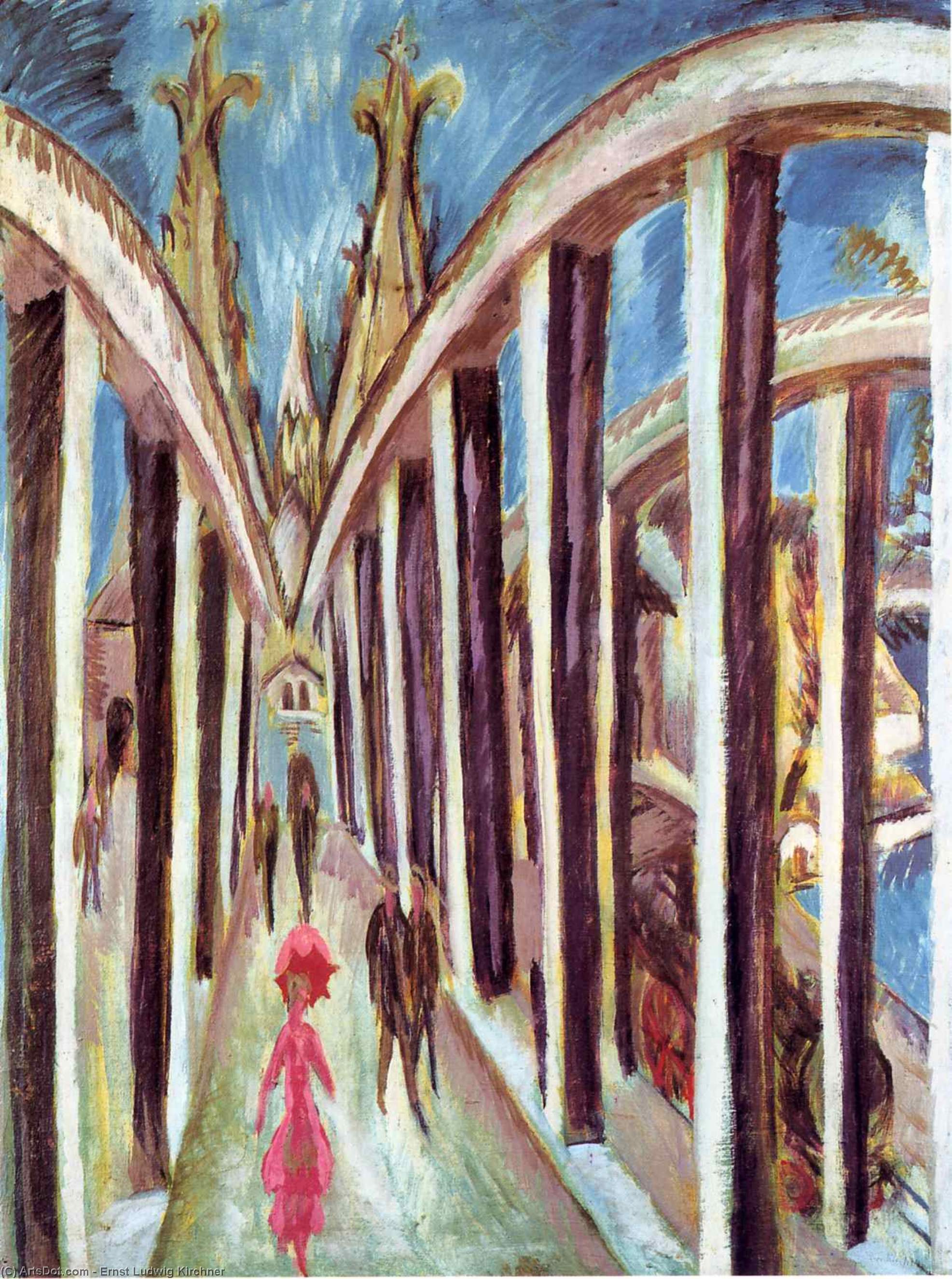
In the hauntingly beautiful oil on canvas, The Rhine Bridge, Ernst Ludwig Kirchner invites us into a world where the boundaries between urban reality and emotional abstraction dissolve. Painted in 1914, a year of profound global tension, this masterpiece captures more than just a structural feat of engineering; it captures a moment of existential pause. The bridge, defined by two sweeping arches that span the width of the composition, serves as a stage for the quiet drama of human existence. As figures traverse the span, they appear caught in a transient state, moving through a landscape that feels both physically grounded and spiritually adrift. The presence of a single figure in a striking red coat provides a vital pulse of warmth against an otherwise somber palette, acting as a focal point that draws the eye through the rhythmic movement of the crowd.
The technique employed by Kirchner is a quintessential display of German Expressionism, characterized by bold, emotive brushwork and a deliberate departure from naturalistic color. The atmosphere is thick with shades of deep blue, violet, and indigo, creating a nocturnal or twilight mood that envelops the viewer in a sense of profound contemplation. This use of cool, dark tones does not merely depict a setting; it evokes a psychological state—one of melancholy, introspection, and perhaps an underlying anxiety regarding the modernizing world. The way the light seems to struggle against the encroaching shadows lends the painting a tactile, heavy quality, making the canvas feel as though it is breathing with the weight of history.
The Soul of German Expressionism
To understand The Rhine Bridge, one must look toward the turbulent era of its creation. As a founding member of Die Brücke, Kirchner sought to bridge the gap between the internal human experience and the external reality of the modern city. This painting reflects that mission perfectly, utilizing the architecture of the Rhine to mirror the psychological structures of the mind. The figures walking across the bridge are not mere bystanders; they are symbols of the collective human journey, navigating a world that is rapidly changing and increasingly uncertain. There is a rhythmic, almost musical quality to the composition, where the structural lines of the arches harmonize with the fragmented movements of the pedestrians.
For the discerning collector or interior designer, this artwork offers an unparalleled opportunity to introduce a sense of depth and intellectual gravity into a space. A high-quality reproduction of this piece serves as more than just decoration; it acts as a window into the early 20th century's most transformative artistic movement. The painting’s ability to command attention through its moody, atmospheric palette makes it an ideal centerpiece for sophisticated environments—be it a quiet study, a contemporary gallery-style living room, or a curated office space. It provides a conversation piece that invites viewers to linger, to observe the subtle interplay of light and shadow, and to find beauty in the somber elegance of the human condition.