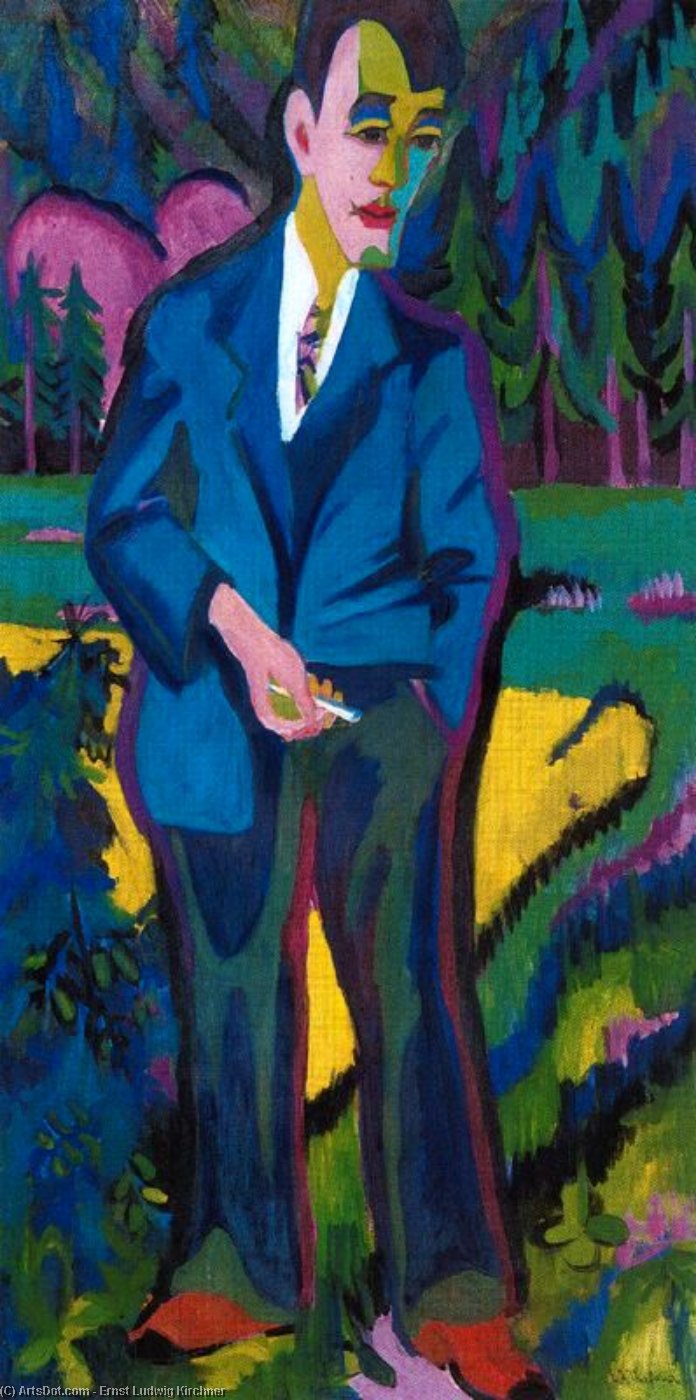
Young Artist, Hans Schiess: A Portrait of Anxiety in the Expressionist Landscape
Ernst Ludwig Kirchner’s “Young Artist, Hans Schiess” is not merely a portrait; it's a visceral plunge into the turbulent psyche of a young man grappling with the anxieties of modernity. Painted circa 1912, during the height of German Expressionism’s fervor, this work embodies the movement’s core tenets – a deliberate distortion of reality to convey raw emotion and psychological intensity. The painting depicts Hans Schiess, likely an aspiring artist himself, standing within a stylized forest, his posture suggesting both contemplation and unease. Kirchner masterfully employs color and form not to represent the world as it appears, but to evoke a feeling—a potent blend of introspection, alienation, and perhaps even a touch of dread.
A Symphony of Discordant Color
Kirchner’s palette is aggressively non-naturalistic. Dominating blues in Schiess's jacket and trousers create a sense of coldness and isolation, while the greens and purples of the background swirl with an unsettling energy. The strategic use of yellow/gold highlights – particularly around the figure’s face – draws attention to his vulnerability and perhaps symbolizes a desperate search for illumination within the darkness. This deliberate departure from traditional color theory is central to Expressionism's goal: to bypass rational perception and directly access emotional truth. Thick, bold brushstrokes contribute to this effect, creating a textured surface that vibrates with unrest.
Distorted Forms and Fragmented Space
The composition itself reflects the fractured state of mind suggested by the subject matter. The figure is positioned slightly off-center, adding to the sense of imbalance. Simplified shapes – blocky forms for the body and elongated cones for the trees – contribute to a feeling of spatial ambiguity. Perspective is deliberately distorted, creating an unsettling effect where objects appear compressed and unreal. This technique, characteristic of Expressionism, rejects the illusionistic conventions of academic painting in favor of a more subjective and emotionally charged representation.
Symbolic Resonance and Psychological Depth
"Young Artist, Hans Schiess" resonates with themes prevalent in Kirchner’s work – the anxieties of urban life, the alienation of the individual, and the struggle for artistic identity. The direct gaze of the young artist, though detached, invites the viewer to confront these same questions. The forest setting itself can be interpreted as a metaphor for the unconscious mind—a wild, untamed space where hidden emotions lurk. Kirchner’s masterful use of light and shadow further amplifies this psychological drama, creating a sense of dramatic tension that lingers long after viewing.
Technique and Historical Context
Executed in oil on canvas, the painting showcases Kirchner's signature technique – bold, expressive brushstrokes applied with deliberate force. This method, combined with his distorted perspective and jarring color choices, firmly places “Young Artist, Hans Schiess” within the heart of German Expressionism’s early years. Born in 1880, Kirchner was a pivotal figure in this movement, alongside artists like Emil Nolde and Max Pechstein, who sought to redefine art as a vehicle for emotional expression rather than objective representation. This work exemplifies his commitment to capturing the anxieties and uncertainties of a rapidly changing world.