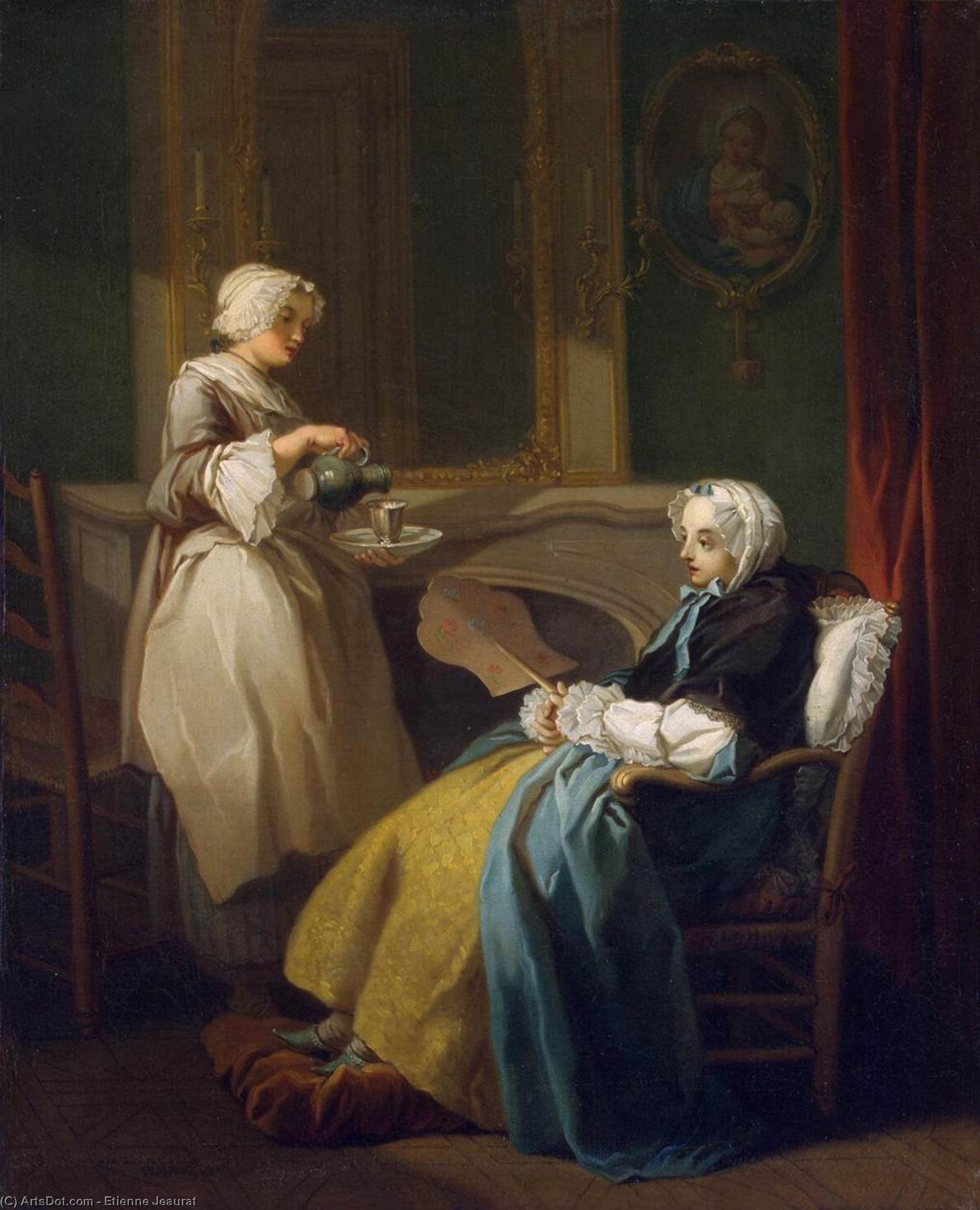
Recovering: A Portrait of Resilience by Étienne Jeaurat
Étienne Jeaurat’s “Recovering,” painted in 1744, isn't merely a depiction of two women engaged in conversation; it’s a poignant study of connection and the quiet strength found within shared intimacy. This intimate portrait, housed within the Hermitage Museum collection, offers a rare glimpse into the burgeoning world of Parisian genre painting during a period of significant social and artistic transition – a world that Jeaurat masterfully captured with an almost Impressionistic sensitivity decades before the movement formally emerged.
The scene unfolds within a modestly furnished room, bathed in soft light that suggests either early morning or late afternoon. A simple table and chair anchor the composition, while a vase of flowers – likely lilies, judging by their delicate form – adds a touch of understated elegance to the space. The central focus is undeniably on the two women: one seated gracefully, her gaze directed towards her companion; the other standing beside her, holding what appears to be a cup or teapot, an offering of warmth and perhaps solace. Their postures are relaxed yet attentive, conveying a sense of comfortable familiarity – a silent dialogue that transcends mere words.
Jeaurat’s technique is characterized by a remarkable ability to render texture and light with subtle brushstrokes. He employs a loose, almost sketch-like approach, prioritizing the capturing of atmosphere and mood over precise detail. Notice how he uses broken color – small, distinct strokes of paint layered upon one another – to create a sense of depth and luminosity. The fabrics of their clothing are rendered with a delicate sheen, while the shadows beneath them hint at the softness of the light. This technique, reminiscent of Chardin’s work, contributes significantly to the painting's intimate and inviting quality.
A Window into 18th-Century Parisian Life
“Recovering” is firmly rooted in the vibrant social landscape of 18th-century Paris. Jeaurat was a keen observer of everyday life, documenting scenes of commerce, leisure, and domesticity with an unparalleled eye for detail. His paintings offer invaluable insights into the customs, manners, and values of the time. The presence of the teapot suggests a scene of hospitality and social interaction – a common occurrence in Parisian households. The room itself is not opulent, reflecting the realities of middle-class life rather than the extravagant displays favored by the aristocracy.
Furthermore, Jeaurat’s work aligns with the broader artistic currents of his era. He was influenced by the Rococo style, characterized by its emphasis on elegance, grace, and playful subject matter. However, unlike many of his contemporaries, Jeaurat possessed a remarkable ability to infuse his paintings with a sense of realism and psychological depth. This is particularly evident in the subtle expressions on the women’s faces – hints of amusement, contemplation, and perhaps even vulnerability.
Symbolism and Emotional Resonance
While seemingly straightforward, “Recovering” is rich in symbolic meaning. The act of offering a cup of tea can be interpreted as an expression of generosity, friendship, or reconciliation. The seated woman’s gaze suggests a receptive attitude – a willingness to listen and understand. The painting speaks volumes about the importance of human connection and the restorative power of shared moments.
More profoundly, considering the context of Jeaurat's life and the period in which he painted, “Recovering” can be viewed as an allegory for resilience and emotional recovery. The title itself – "Recovering" – immediately evokes a sense of healing and renewal. The painting’s quiet intimacy and understated beauty offer a comforting reminder that even after periods of hardship or loss, connection and solace can still be found in the simple pleasures of human interaction.
A Timeless Masterpiece for Your Collection
Reproductions of “Recovering” by Étienne Jeaurat capture the essence of this remarkable painting while offering a beautiful addition to any interior space. The delicate brushwork, evocative lighting, and subtle symbolism create a work that is both visually stunning and emotionally resonant. Whether you are an art collector, an interior designer seeking to infuse your home with character, or simply someone who appreciates the beauty of timeless artistry, “Recovering” offers a unique opportunity to own a piece of 18th-century Parisian life – a testament to the enduring power of human connection.