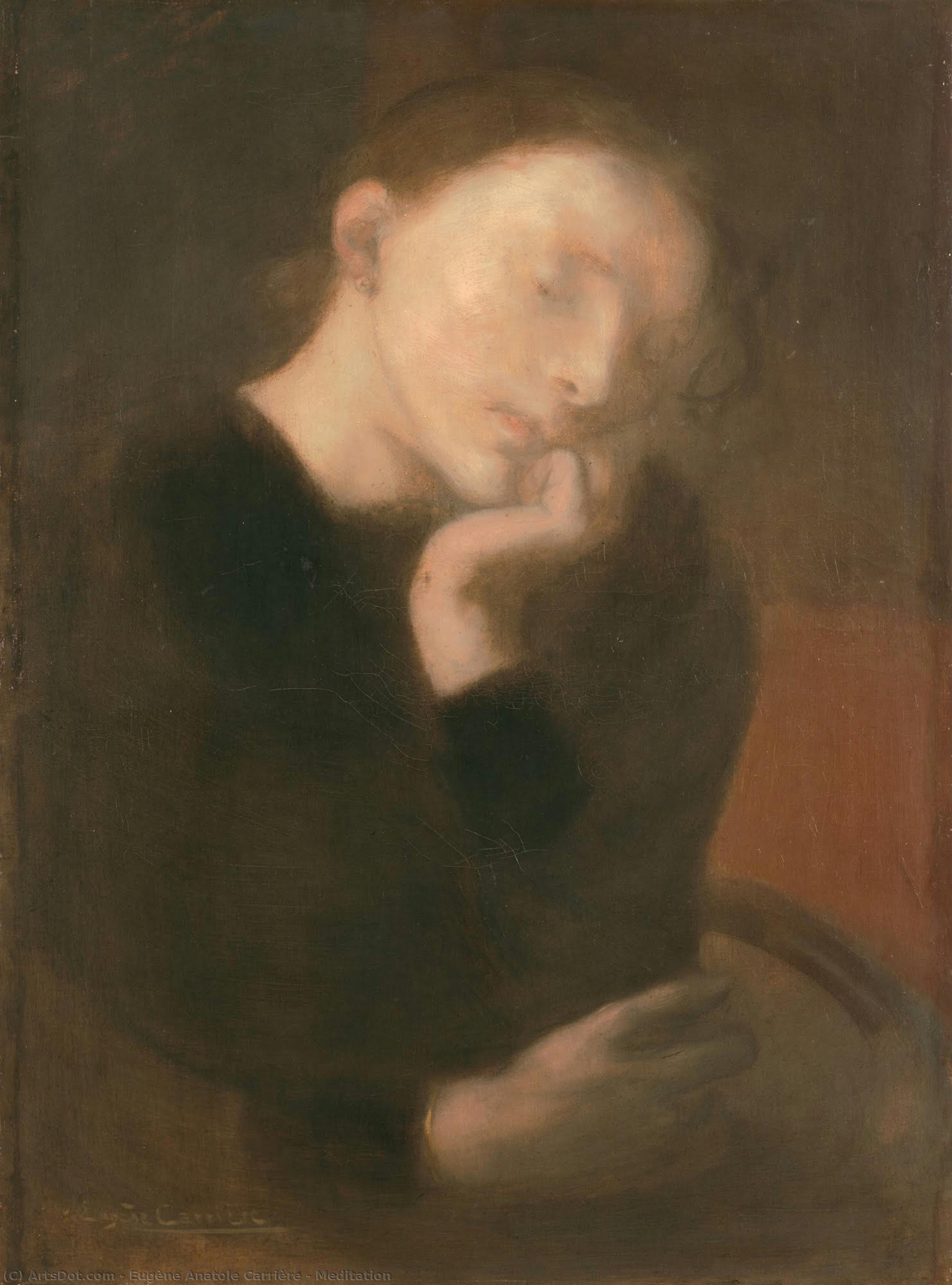
Meditation
Eugène Anatole Carrière’s “Meditation” stands as a poignant testament to the Symbolist movement's preoccupation with psychological depth and emotional resonance. Painted in 1893, this oil on canvas portrait captures a young woman lost in contemplation—a figure instantly recognizable for its haunting stillness and subdued palette.
The artwork’s immediate impact is achieved through Carrière’s masterful use of color. Rejecting the vibrant hues favored by Impressionists, he opted for a deliberate monochrome scheme dominated by shades of brown and black, punctuated by subtle hints of muted reds and oranges. This restricted tonal range wasn't merely stylistic choice; it served as a crucial element in conveying the subject’s inner turmoil—a reflection of Rubensian influence evident in the luminous glow of his early canvases.
Technically, Carrière employed an ambitious layering process, meticulously blending oil paints to create a velvety texture that envelops the figure. Extensive glazing techniques were utilized to build up depth and luminosity, capturing the nuances of light and shadow with remarkable precision. The artist’s brushstrokes are loose yet controlled, conveying both spontaneity and deliberate artistic intention.
Beyond its aesthetic qualities, “Meditation” resonates deeply with Symbolist themes—specifically, the exploration of human emotion and subconscious experience. The woman's posture embodies vulnerability and introspection, mirroring the movement’s fascination with confronting inner anxieties and grappling with existential questions. Her gaze directs inward, suggesting a preoccupation with grief or melancholy – emotions central to the Symbolist canon.
The painting’s composition is deliberately flattened, prioritizing the figure against a hazy background—a technique designed to heighten emotional intensity and draw the viewer's eye directly to the subject’s face. Lines are organic and flowing, mirroring the contours of her body and emphasizing her stillness. The subtle use of warmer tones around her eyes lends warmth to the overall somber mood.
“Meditation” continues to captivate audiences today as a powerful example of Symbolist art—a piece that transcends mere visual representation to communicate profound psychological truths. Its enduring appeal lies in its ability to evoke empathy and contemplation, inviting viewers to consider themes of solitude, sorrow, and the complexities of human consciousness.