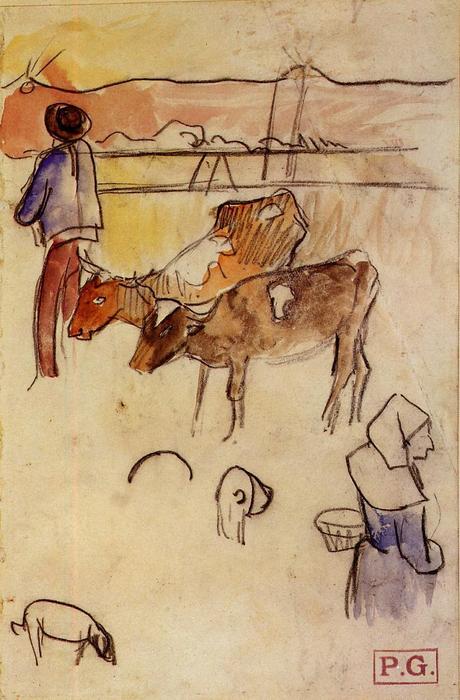
Bretons and Cows (Sketch): A Moment of Rural Reverie Captured in Gauguin’s Watercolor
Paul Gauguin's “Bretons and Cows,” completed in 1889, stands as a cornerstone of the Breton period—a pivotal moment in his artistic evolution. More than just a depiction of livestock grazing in Brittany’s countryside, this sketch delves into Gauguin’s fascination with capturing raw emotion and distilling essence onto paper using watercolor and colored pencil.
- Subject Matter: The painting centers around two cows—one positioned slightly to the left and another on the right—alongside a solitary man tending to them. Scattered figures add depth to the scene, hinting at a broader community engaged in rural life.
- Style & Technique: Gauguin’s approach aligns squarely with Post-Impressionism, rejecting Impressionistic optical realism for expressive color and simplified forms. The watercolor medium lends itself beautifully to capturing subtle tonal variations and conveying an atmosphere of tranquility. Notice the deliberate lack of meticulous detail; instead, Gauguin prioritizes conveying feeling over precise representation.
- Historical Context: Created during a period of significant societal upheaval—the burgeoning Industrial Revolution—Gauguin’s retreat to Brittany represents a conscious rejection of urban pressures and a yearning for connection with nature. This impulse is mirrored in the painting's composition, which seeks to evoke a sense of timelessness and pastoral beauty.
- Symbolism: The cows themselves symbolize fertility and sustenance – fundamental elements of Breton culture and Gauguin’s broader preoccupation with primal instincts. The man’s posture suggests contemplation and observation, embodying the artist’s desire to engage in a dialogue with the natural world.
Influence of Japonisme: Echoes of Eastern Aesthetics
Like many Impressionists and Post-Impressionists before him, Gauguin was profoundly impacted by Japonisme—the Western fascination with Japanese prints (ukiyo-e). This influence is evident in the flattened perspective characteristic of Breton landscapes, mirroring the compositional conventions found in Japanese woodblock prints. The decorative patterns subtly incorporated into the background contribute to this aesthetic sensibility.
Color Palette: Bold Strokes of Emotion
Gauguin’s masterful use of color—primarily blues and greens—is not merely descriptive; it serves as a conduit for emotion. These hues convey a sense of serenity and melancholy, reflecting Gauguin's own psychological state during this period. The artist deliberately eschews naturalistic coloration, opting instead for bold shades that amplify the painting’s expressive power.
A Legacy of Authenticity: Beyond Representation
"Bretons and Cows" transcends mere visual depiction. It embodies Gauguin's unwavering commitment to artistic authenticity—a desire to capture not just what he sees but how he feels. This sketch remains a testament to the transformative potential of art, demonstrating that true beauty lies in embracing simplification and prioritizing emotional resonance.