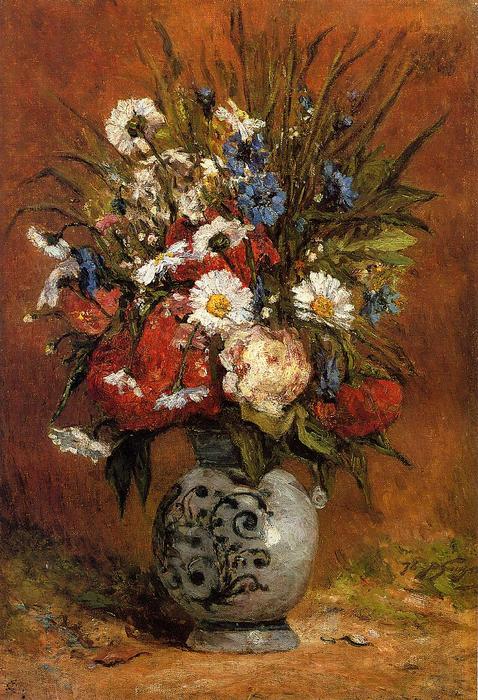
Daisies and peonies in blue vase, 1876 - Paul Gauguin - WikiArt.org
“Daisies and peonies in blue vase” stands as a cornerstone of Paul Gauguin’s artistic journey, encapsulating the essence of Symbolist aesthetics within Impressionistic form. Created in 1876 during his formative years, this oil on canvas painting—measuring 55 x 38 cm—offers an unparalleled glimpse into Gauguin's innovative approach to color and composition, cementing its place as a seminal work of art history.
Composition and Color Palette
The artwork’s visual impact derives from its deliberate arrangement: a serene tableau featuring flowers nestled within a striking blue vase. The vase itself—painted in creamy white accented with delicate azure hues—acts as a focal point, elevating the overall aesthetic. Gauguin masterfully blends vibrant shades of crimson, ivory, lemon yellow, and sapphire blue to generate depth and dimensionality, mirroring the natural world’s richness.
Artistic Influences
Gauguin's artistic vision was profoundly shaped by movements preceding him—primarily Impressionism and Synthetism. Embracing Synthetism—a stylistic rebellion against Impressionist realism—he prioritized expressive color and simplified forms, mirroring the influence of Japanese woodblock prints (ukiyo-e). This fascination with ukiyo-e’s flattened perspective and bold decorative motifs is palpable in the painting's composition.
Museum Collections
The Musée Réattu in Arles, France, proudly houses a collection showcasing the evolution of modern art. Established in 1868, this institution honors Jacques Réattu—a French painter who secured the prestigious Prix de Rome in 1790—demonstrating a dedication to preserving and disseminating artistic heritage.
Related Works
Beyond “Daisies and peonies in blue vase,” Gauguin’s oeuvre encompasses masterpieces like “Tomatoes and a pewter tankard on a table” and “Still Life with Mangoes and Hisbiscus,” each demonstrating his experimentation with color, light, and techniques gleaned from fellow artists. These paintings underscore Gauguin's pioneering role in redefining artistic expression.