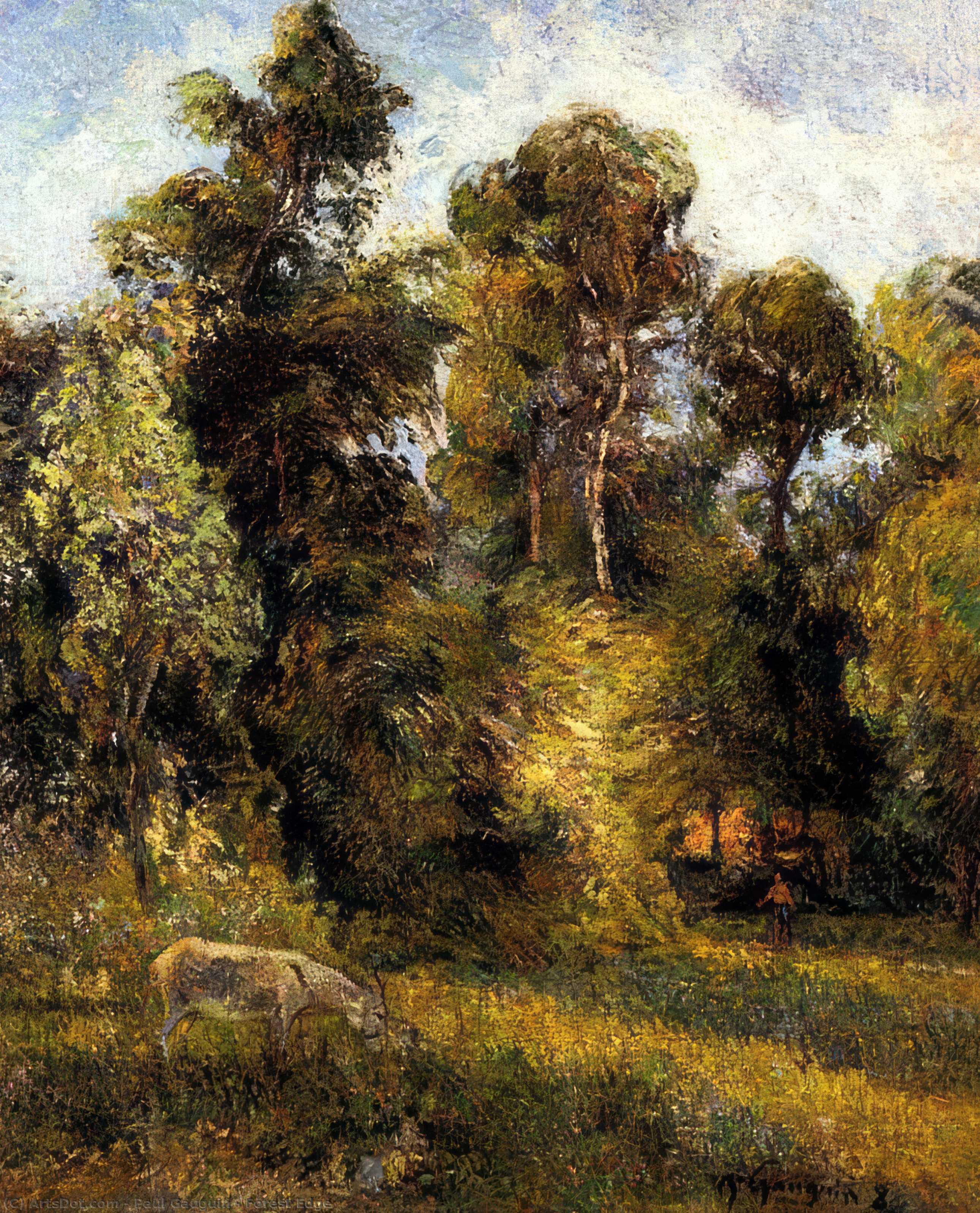
A Window Into Gauguin’s Soul: The Primal Beauty of Forest Edge
Paul Gauguin's "Forest Edge," painted in 1885, is far more than a mere depiction of a woodland scene; it is a profound embodiment of the artist’s engagement with primal beauty and his unwavering pursuit of artistic truth. Measuring 81 x 65 cm, this oil on canvas offers a rare glimpse into the creative process of a man who sought to transcend the boundaries of reality. The painting immediately captivates the viewer with its audacious palette—dominantly greens and yellows—a deliberate departure from the soft, pastel hues favored by his contemporaries like Monet and Renoir. This bold chromatic choice reflects Gauguin’s desire to express emotion directly onto the canvas, bypassing meticulous observation in favor of a more visceral, instinctive reaction to nature's grandeur.
As one gazes upon the composition, the scene unfolds within a lush, forested area where trees stand as silent sentinively. The leaves rustle with an unseen breeze, and certain branches glow with yellow foliage, adding a touch of autumnal warmth to an otherwise cool, verdant palette. In the foreground, two cows graze peacefully upon the soft carpet of grass, their calm demeanor injecting a sense of profound tranquility into the woodland haven. A solitary figure can be seen walking along a distant path, a subtle human element that suggests this forest is not merely a wilderness, but a sanctuary where humanity and nature exist in quiet, spiritual harmony.
The Post-Impressionist Vision: Technique and Texture
Firmly established within the Post-Impressionist movement, "Forest Edge" inherits the foundational interest in light from Impressionism but rejects its commitment to optical realism. Gauguin employs a thick impasto technique—a heavy application of paint that creates a palpable texture, mimicking the ruggedness of tree bark and the density of foliage. His brushstrokes are energetic and expressive, conveying a sense of immediacy and spontaneity that breathes life into the canvas. Unlike the Impressionists who sought to blend colors seamlessly to mimic light, Gauguin deliberately juxtaposes contrasting hues to heighten the emotional impact of the work.
This meticulous attention to detail serves a higher purpose; the rendering of individual leaves and branches acts as a conduit for feeling rather than mere imitation. For collectors and interior designers, this technique offers a magnificent tactile quality. A high-quality reproduction of such a piece brings a sense of movement and depth to any space, acting as a focal point that commands attention through its rich textures and vibrant, non-traditional color relationships.
Symbolism and the Search for Spiritual Renewal
Beyond its visual splendor, "Forest Edge" resonates with deep layers of symbolic meaning. The forest itself serves as a metaphor for a sanctuary from the anxieties of modern life, mirroring Gauguin’s lifelong fascination with landscapes that offered spiritual renewal. This piece captures the tension between the civilized world and the untamed wild, a theme that would later define his famous works in Polynesia. The grazing animals and the wandering figure represent a state of primordial peace, an existence untouched by the industrial tumult of late 19th-century Europe.
For those seeking to adorn their homes with art that inspires contemplation, this painting offers an invitation to step into a serene landscape and lose oneself in the beauty of nature. It is a testament to Gauguin's ability to capture the essence of life in its most raw and unfiltered form. Whether viewed as a historical masterpiece or a decorative centerpiece, "Forest Edge" remains a powerful window into the soul of one of the most influential figures in the history of modern art.